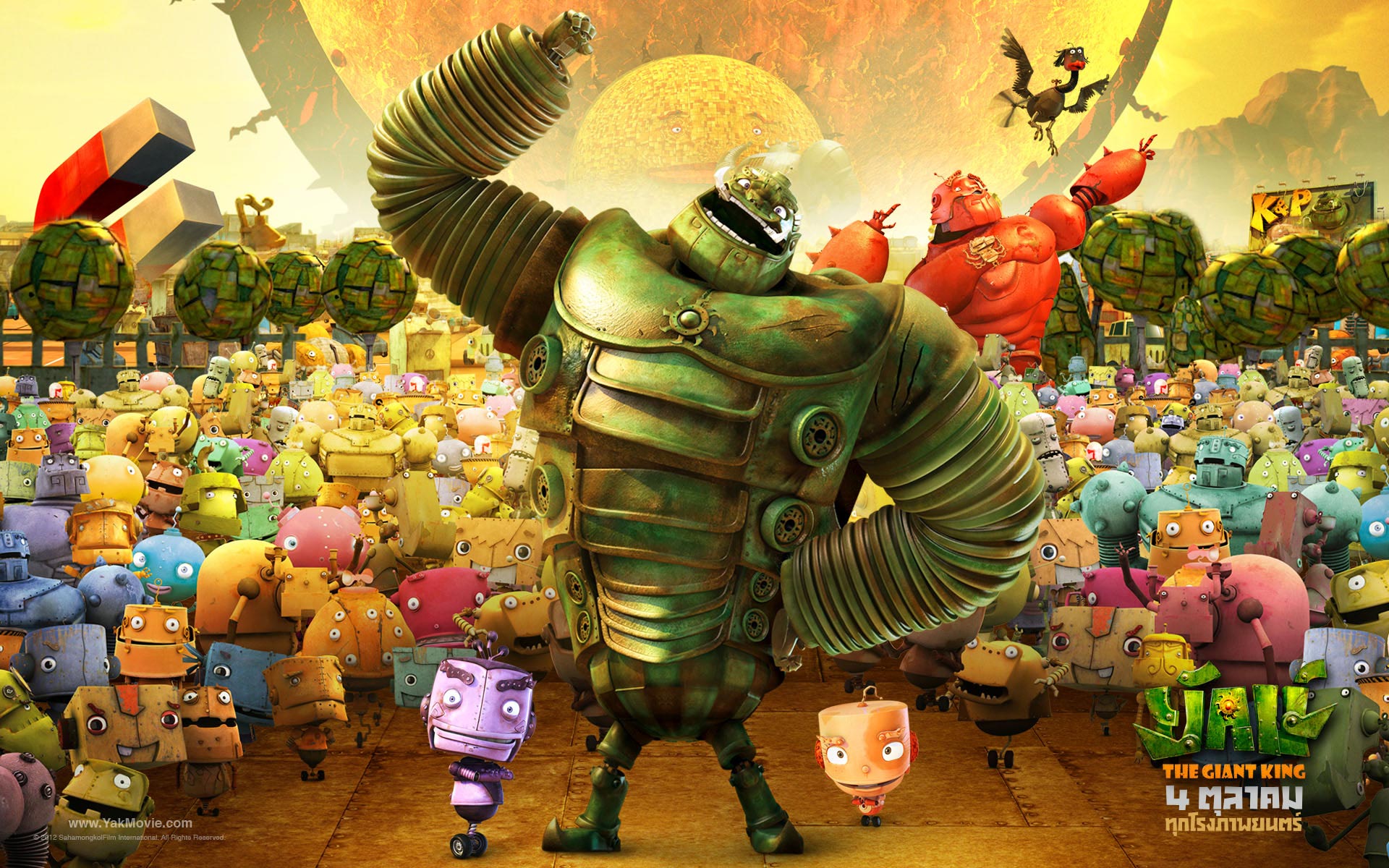
You probably haven’t heard of a 100-million Baht Thai animation that reimagines a thousand-year-old Hindu epic using rusty robots and satellite gods. Honestly, most people haven't. But Yak the Giant King (released in some territories simply as The Giant King) is one of those rare films that manages to be both a bizarre cultural artifact and a genuinely sweet story about friendship. It’s a 2012 3D animated feature that takes the Ramakien—Thailand’s national epic derived from the Indian Ramayana—and drops it into a post-apocalyptic wasteland where everyone is made of scrap metal.
The movie follows two robots who should be mortal enemies. On one side, you’ve got Na Kiew (Big Green), a massive war machine inspired by the ten-headed demon king Tosakan (Ravana). On the other is Jao Phuek, a tiny, nimble bot based on the monkey god Hanuman. After an epic battle that leaves them buried for a million days, they wake up with no memory and an unbreakable chain physically linking them together. It’s a literal "chained together" trope taken to its mechanical extreme.
What Really Happened With Yak the Giant King?
When people talk about this movie, there is often a massive disconnect between the original Thai version and the international English dubs. If you watched the version released in the U.S. by Lionsgate and Grindstone Entertainment, you saw a movie called The Giant King starring the voices of Russell Peters and Bella Thorne. Here's the kicker: that version stripped away almost every single reference to the Ramayana.
In the original script by Prapas Cholsaranont, the characters are deeply rooted in Buddhist and Hindu mythology. The "Ram" they are searching for isn't just a "Remote Automated Motherbot" (as the American dub calls it); he is a representation of the god-king Rama. When Na Kiew recovers his memory, the conflict isn't just a plot point; it's a spiritual struggle against a pre-destined role as a villain. The U.S. version turned a thoughtful cultural reimagining into a standard "odd couple" road trip movie with booger jokes. It’s a bit of a shame, really.
The animation itself was a huge deal for Thailand. Produced by Workpoint Entertainment and Sahamongkol Film International, it was a massive swing at the fences for Southeast Asian CGI. It doesn't look like Toy Story 4, obviously. The textures are a bit grittier, and the movements can be stiff, but the character design is brilliant. They managed to take Ravana’s iconic ten heads and turn them into a mechanical array that actually makes sense for a giant robot.
The Robot Ramayana: A Strange New World
Basically, the world of Yak the Giant King is a junkyard that feels lived-in. You have scavengers, broken-down mechanics, and a robotic sun that literally runs on a track across the sky. This is where the movie gets surprisingly deep. While the kids are laughing at the physical comedy, the film is asking if we are defined by our past or our choices.
- Na Kiew (Zork): He starts as a gentle giant who sees beauty in everything. But inside him is the "giant king" program—a fierce warrior designed for destruction.
- Jao Phuek (Pinky): Small but incredibly strong and witty. In the American version, this character was changed to a female (voiced by Bella Thorne), which shifted the dynamic significantly.
- Rusty (Sanim): A sickly little bot with a "rusty nose" who just wants a family. She’s the heart of the group and a character created specifically for the film, not the original epic.
The relationship between Na Kiew and Jao Phuek is the core of the film. They spend the first half of the movie building a bond based on mutual survival. When their memories finally return—revealing that they were the primary generals in a war that destroyed the world—the movie hits its emotional peak. Can you stay friends with someone when your "programming" tells you to kill them?
Why This Movie Still Matters Today
In 2026, we see a lot of "sanitized" global content. Yak the Giant King is a reminder of a time when local studios were trying to bring their own massive cultural stories to the global stage without losing their soul. Even though the international edits muddied the waters, the original intent remains a fascinating bridge between ancient tradition and futuristic sci-fi.
It's a "cult" film in the truest sense. You won't find it on the front page of Netflix, and it didn't set the box office on fire in the States. However, for animation fans and students of mythology, it's a masterclass in adaptation. It proves that the themes of the Ramayana—loyalty, duty, and the nature of evil—are universal enough to work even if the characters are made of gears and oil.
Critical Reception and the "Lost in Translation" Effect
Critics were... let's say, mixed. Most Western reviewers who saw the 2016 DVD release were confused by the "chintzy" animation and the jumbled storytelling. They didn't realize they were watching a heavily edited version of a 2012 Thai masterpiece. The original Thai version won several awards at the Bangkok Critics Assembly and is remembered much more fondly at home than abroad.
If you’re going to watch it, try to find the original Thai audio with subtitles. You’ll get the song "We Were Born To Be Friends" by the band ROOM 39, which captures the vibe way better than the generic pop tracks added to some of the dubs. Honestly, the cultural nuance makes all the difference.
Actionable Next Steps for Fans
If you're interested in checking out this unique piece of animation, here is how you can actually engage with it:
- Look for the 2012 Thai Cut: Avoid the 93-minute international version if you want the full story. The 105-minute original has more depth and the correct mythological context.
- Compare the Epics: If you're a mythology nerd, read a summary of the Ramakien after watching. Seeing how they turned "Hanuman trying to swallow the sun" into a robot encounter is a fun exercise in creative writing.
- Support Southeast Asian Animation: Studios like Workpoint are still active. Checking out their newer projects helps ensure that non-Western perspectives keep getting a platform in the global CGI landscape.
Understanding Yak the Giant King requires looking past the "kids' movie" label and seeing it as a bold experiment in cultural storytelling. It's weird, it's metallic, and it's surprisingly human.
To get the most out of your viewing, start by researching the basic story of the Ramakien so the character motivations click. Then, seek out the original 105-minute cut of the film—usually available on specialized animation streaming services or imported physical media—to see the directors' true vision before it was edited for Western markets. Finally, compare the robotic character designs to traditional Thai masks to appreciate the level of detail the artists poured into this mechanical reimagining of their national heritage.