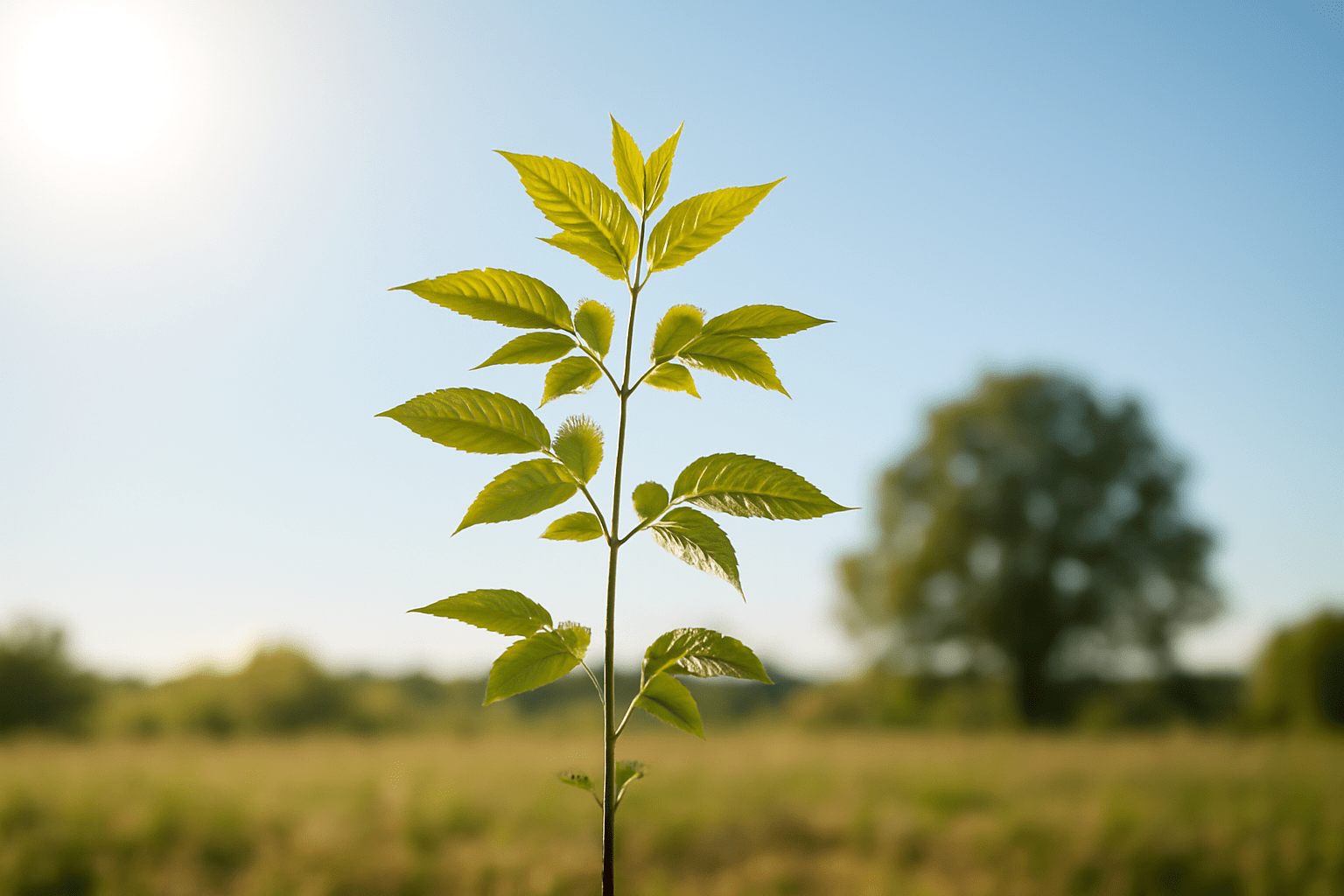
You’ve seen them in old photos. Massive, sweeping canopies of Fraxinus americana—the white ash—shading suburban streets and baseball diamonds. It’s a classic American tree. But if you're looking at a white ash tree sapling today, you aren't just planting a tree. You’re basically entering a rescue mission.
It’s a bit of a gamble. Honestly, twenty years ago, you’d just stick one in the ground, water it, and walk away. Now? The emerald ash borer (EAB) has changed the math entirely. This tiny, metallic green beetle from Asia has decimated tens of millions of ash trees across North America. So, before you grab that shovel, we need to talk about whether planting one is actually a good idea in 2026, or if you're just setting yourself up for heartbreak.
What a healthy white ash tree sapling actually looks like
Don't just buy the first one you see at the nursery. You want a fighter.
A quality white ash tree sapling should have a single, straight "leader"—that’s the main vertical trunk. If it forks early, you're going to have structural nightmares later. The bark on a young one is surprisingly smooth, almost gray-green, nothing like the deeply furrowed, diamond-patterned bark you see on the giants.
Check the leaves. White ash usually has five to nine leaflets on a single stem. Here’s a pro tip for identification: look at the leaf scars. If you pull a leaf off (or find where one fell), the scar left on the twig is shaped like a "C" or a crescent moon in white ash. Green ash, its close cousin, has a semi-circle or shield-shaped scar. It sounds nerdy, but it matters because white ash generally prefers better-drained upland soil, while green ash can handle "wet feet" much better.
If the sapling is root-bound in a plastic pot, keep looking. Roots that circle the container will eventually strangle the tree as it grows. This is called a "girdling root," and it’s a silent killer that shows up ten years too late.
The EAB elephant in the room
Let’s be real. If you live in the Midwest, Northeast, or parts of the South, the Emerald Ash Borer is already in your backyard.
Can you still grow a white ash tree sapling? Yes. But you have to be honest about the maintenance. When the tree reaches about two inches in diameter, it becomes a target. The larvae tunnel under the bark, eating the phloem and cambium. This basically cuts off the tree’s plumbing. Water can’t go up; sugar can’t go down.
Scientists like Dr. Deborah McCullough at Michigan State University have spent decades researching this. The current consensus is that if you want your ash sapling to survive into adulthood, you will eventually need to treat it with systemic insecticides. Emamectin benzoate is the "gold standard" used by professionals, usually injected every two to three years. There are DIY soil drenches with imidacloprid, but they aren't always as effective on larger trees and can be rough on pollinators if there are flowering plants nearby.
Some people think it's better to wait for "Lingering Ash"—those rare individuals that seem to survive the infestation. Researchers with the U.S. Forest Service are currently breeding these survivors to create EAB-resistant saplings. If you can find a nursery selling certified "resistant" stock, buy it. Otherwise, you’re looking at a lifetime of chemical support.
Planting it right (because most people don't)
You’ve got your tree. Now don't kill it with kindness.
First, the hole. Make it twice as wide as the root ball but no deeper. This is the biggest mistake people make. If you bury the "root flare"—the spot where the trunk widens at the base—the bark will rot. The tree needs to breathe at its base.
White ash loves sun. It’s not a shade-dweller. It wants at least six hours of direct light. It also likes slightly acidic to neutral soil. If you've got heavy, swampy clay, maybe look at a different species. White ash likes to be moist but not drowned.
Watering is huge for the first two years. A new white ash tree sapling needs about 10 gallons of water per week. Don't just sprinkle the leaves with a hose; you need a slow drip at the base so it soaks deep into the root zone.
Soil and Mulch: The "Donut" Rule
Forget the mulch volcanoes. You know the ones—where the mulch is piled up against the trunk like a pyramid? That’s tree murder.
Instead, create a "donut." Put 2-3 inches of wood chips in a wide circle around the tree, but keep the mulch a few inches away from the actual bark. This keeps the soil moist and prevents weed whackers from nicking the trunk, which is a death sentence for a young sapling.
Why bother? The "Lingering Ash" hope
You might be wondering why anyone would bother with an ash tree right now.
It's about the wood. And the ecosystem. White ash is incredibly strong but flexible. It’s what we use for Louisville Slugger baseball bats and tool handles. It doesn't splinter easily.
Ecologically, dozens of native insects and moths rely specifically on ash trees. If we stop planting them entirely, we lose that biodiversity. There’s also something to be said for the "purple" fall color. While maples go bright red or yellow, a white ash turns this deep, moody regal purple that honestly looks like something out of a painting.
Pruning without ruining the shape
Don't touch the shears for the first year. The tree needs every leaf it has to produce energy for root growth.
In year two or three, start looking for "competing leaders." If two branches are fighting to be the top of the tree, pick the straightest one and clip the other. White ash has an "opposite" branching pattern. This means branches grow in pairs directly across from each other. Sometimes this leads to weak crotches where the branches V-off. You want to encourage "U" shaped attachments, which are much stronger during ice storms or high winds.
Practical steps for your new sapling
If you’re serious about putting a white ash in the ground, here is the reality-based checklist.
- Check the EAB Map: Go to the USDA’s Animal and Plant Health Inspection Service (APHIS) website and see how close the borer is to your zip code. If you’re in an active "hot zone," prepare for treatment costs.
- Soil Test: Spend the $20 to send a soil sample to your local university extension. White ash hates high-alkaline soil; it’ll turn yellow (chlorosis) and struggle.
- Source Wisely: Ask the nursery specifically if their stock is from a region known for "lingering ash" or if it’s been pre-treated.
- Plant in Autumn or Early Spring: Avoid the heat of July. The roots need cool, moist soil to establish before the sun starts baking everything.
- Ditch the Stakes: Unless you live in a wind tunnel, don't stake the tree. A sapling that can sway slightly develops a stronger, thicker trunk (thigmomorphogenesis). If you must stake it, use soft ties and remove them after one growing season.
Growing a white ash today is an act of defiance. It’s a commitment to a species that’s currently under siege. If you’ve got the patience to monitor it for pests and the discipline to water it through those first few rough summers, you’re helping preserve a piece of the American landscape that we nearly lost. Just keep your eyes on the canopy and your hand off the mulch volcano.