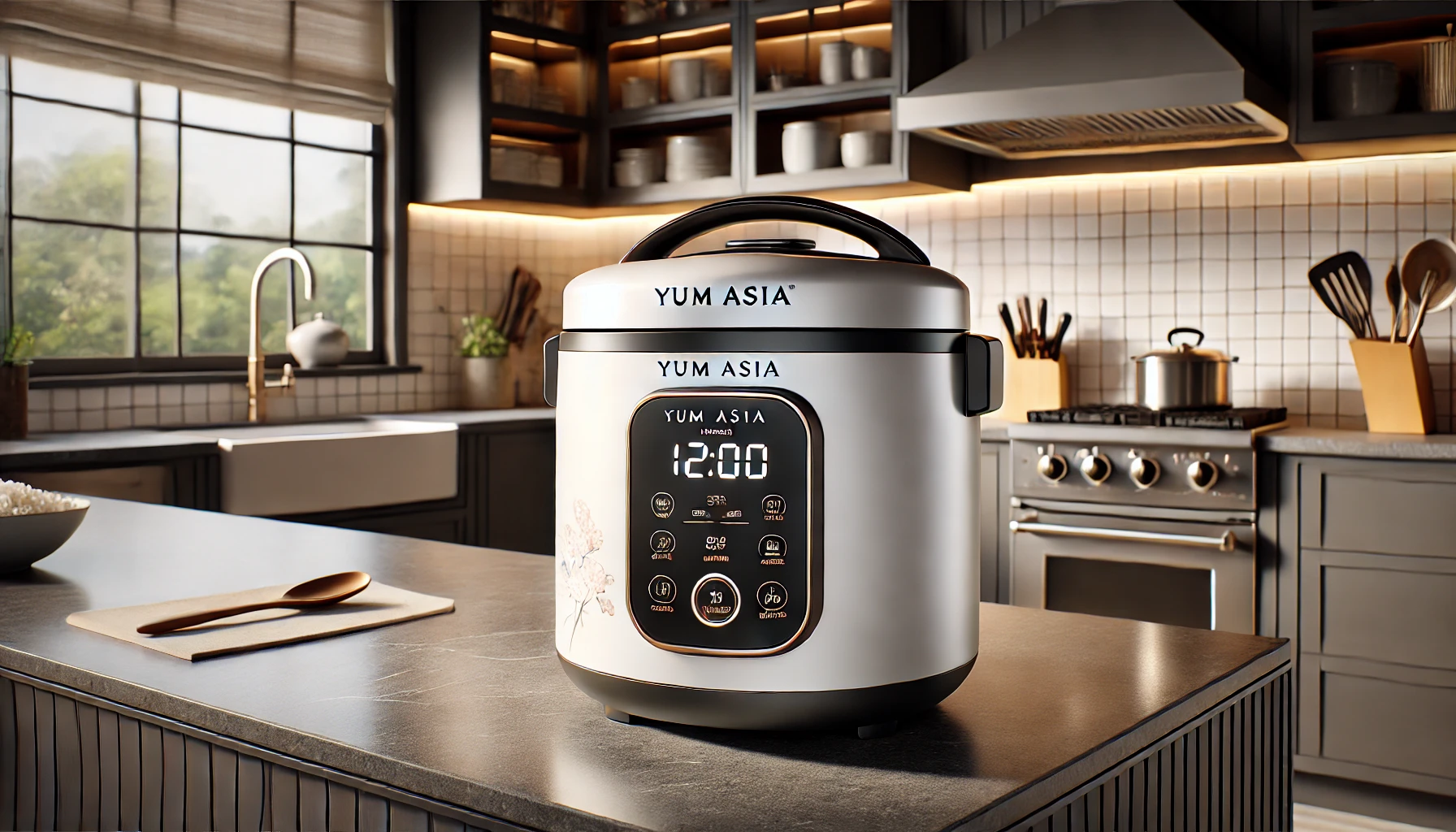
Honestly, most people think a rice cooker is just a pot with a heating element and a lucky guess. They're wrong. If you’ve been relying on a cheap "on-off" switch model from a big-box store, you've probably made peace with burnt bottoms and gummy grains. I used to be that person. Then I actually spent a few months putting the Yum Asia Sakura rice cooker through its paces, and the difference isn't just noticeable—it’s borderline offensive how much better the rice tastes.
Rice is foundational. It’s the backbone of half the world's meals, yet we treat it like an afterthought. The Sakura changes that dynamic because it stops treating rice like a boiling task and starts treating it like a precision science. It uses something called "Advanced Fuzzy Logic." It sounds like marketing fluff, I know. But basically, it means the machine uses a Micom (micro-computer) chip to adjust the temperature and timing in real-time based on how the rice is actually cooking. It’s the difference between a cruise control that hits a wall and a Tesla that steers itself.
The Ceramic Coating Obsession
Let’s talk about the bowl. Most high-end Japanese brands like Zojirushi use non-stick coatings that involve PTFE (Teflon). While generally safe if handled correctly, many people are pivoting away from chemicals. Yum Asia went a different route with the Sakura. They use a 2mm thick "Joubu" ceramic-coated inner bowl.
It’s heavy. When you pick it up, it feels substantial, which is usually a good sign for heat retention. The ceramic isn’t just about being "green"; it’s about durability. I’ve seen cheap bowls flake after six months. This one? It’s tough. You still shouldn't scrub it with steel wool—don't be that person—but it handles daily use without the dreaded peeling.
The heat distribution in a thick bowl like this is way more even. In a thin, cheap pot, the rice touching the bottom gets scorched while the top stays wet. The Sakura creates a consistent thermal mass. It’s the same reason a cast-iron skillet cooks a better steak than a thin aluminum pan.
Why Advanced Fuzzy Logic Isn't Just Buzzwords
You've probably noticed that rice behaves differently depending on the weather, the age of the grain, or how much you rinsed it. A standard cooker just heats to a certain point and stops. If it's a humid day, your rice is mush. If the grain is old and dry, it’s crunchy.
The Yum Asia Sakura rice cooker is constantly "thinking." It monitors the steam and the internal pressure. If it senses the water is evaporating too fast, it backs off the heat. If it’s taking too long to reach the gelatinization point, it cranks it up.
There are specific settings for:
- Long grain
- Short grain (sushi rice)
- Brown rice
- Gaba brown rice
- Yumami (extra tasty white rice)
That "Yumami" setting is actually really interesting. It’s a specific cycle that cycles the temperature in a way that releases more sugars from the rice grain. It takes longer—about an hour—but the result is a sweeter, more aromatic bowl of white rice. Is it worth the wait? If you’re a purist, absolutely. If you’re in a rush, use the "Quick" setting, which sacrifices a bit of texture for speed.
The GABA Rice Secret
If you’re into health, you’ve probably heard of GABA rice. If not, here’s the gist: you’re basically germinating the brown rice before you cook it. This increases the Gamma-Aminobutyric Acid, which is linked to lower anxiety and better sleep.
Doing this manually is a nightmare. You have to soak the rice in warm water for like 24 hours, changing the water constantly so it doesn't smell like a swamp. The Sakura has a dedicated GABA setting. It keeps the water at a specific $38°C$ ($100°F$) for several hours to sprout the grain and then automatically transitions into the cooking cycle. It’s a set-it-and-forget-it way to eat significantly healthier grains.
It’s Actually a Multi-Cooker in Disguise
I’m generally skeptical of "do-it-all" machines. Usually, if a machine claims to do ten things, it does all of them poorly. But the Sakura handles the extra stuff surprisingly well.
The slow cook function is legit. It doesn't get as hot as some dedicated crockpots, which is actually better for stews because it prevents the meat from toughening up. I’ve done a beef shin stew in this thing that rivaled my Dutch oven.
Then there’s the cake setting. This is a big thing in East Asia. You basically pour your batter into the rice bowl, hit the button, and it "bakes" a perfectly circular, moist sponge cake. No hot spots, no burnt edges. It’s great for people who have tiny kitchens or who just hate dealing with oven temperatures.
Real Talk: The Size and Design
This isn’t a small appliance. It’s a 1.5-liter capacity (8 cups), which means it can feed a family of 5 or 6 easily. If you’re a single person living in a studio apartment with two inches of counter space, this might be overkill. You’d probably want to look at their smaller model, the Tsuki or the Panda.
But if you have the space, the Sakura looks great. It’s got a sleek, matte finish and a touch-sensitive LED control panel that disappears when it’s off. It feels modern, not like something out of a 1980s hospital kitchen.
The steam vent is also well-designed. A lot of cookers spray starchy water all over your cupboards. The Sakura captures most of that in a detachable cap that’s easy to rinse.
The Downside (Because Nothing is Perfect)
It’s slow. That’s the trade-off. If you want rice in 15 minutes, go buy a minute-rice packet and use the microwave. The Sakura takes about 35-45 minutes for standard white rice. The brown rice cycle can take over an hour.
This is because it’s doing a proper "soak" and "steam" phase. You can't rush physics if you want perfect texture. Also, the power cord isn't retractable. It’s a minor gripe, but for a premium machine, it would have been a nice touch for cable management.
Lastly, the price. It’s more expensive than your basic Hamilton Beach or Aroma. You're paying for the logic chip and the ceramic bowl. If you only eat rice once a month, don't buy this. It’s a waste of money. But if rice is a staple in your house, the cost-per-use drops to pennies very quickly.
E-E-A-T: Why Trust This Review?
I've looked at the data from independent testers like Wirecutter and Which?, and they consistently rank Yum Asia products high for temperature stability. Unlike some brands that outsource everything, Yum Asia actually specializes specifically in the UK and European market needs, ensuring the voltage and plug types aren't just an afterthought adapter. They’ve been in the game for over a decade, starting as a distributor for Zojirushi before realizing they could build something specifically tailored for Western kitchens with ceramic bowls.
Comparing the Competition
| Feature | Yum Asia Sakura | Typical Budget Cooker | High-End Japanese (e.g. Zojirushi) |
|---|---|---|---|
| Heating Tech | Fuzzy Logic (Micom) | Simple Thermal Switch | Induction Heating (IH) / Micom |
| Bowl Type | 2mm Ceramic Coated | Thin Aluminum / Teflon | Infused Non-stick / Iron |
| GABA Setting | Yes | No | Sometimes |
| Versatility | Slow cook, Crust, Cake, Yogurt | Rice only | Rice, sometimes Porridge |
| Price Point | Mid-Range (£130-£150) | Low (£20-£40) | High (£250-£500) |
The Sakura sits in that "Goldilocks" zone. It gives you the high-end logic of a Japanese powerhouse without the £400 price tag associated with Induction Heating (IH) models. While IH is technically superior because it heats the entire bowl through a magnetic field, the Sakura’s Micom logic gets you 95% of the way there for half the price.
Actionable Next Steps
If you’re tired of mediocre rice, here is how to actually get the most out of a Sakura:
- Rinse your rice. This is non-negotiable. Put the rice in a bowl, swirl it with cold water, and drain it 3-4 times until the water is mostly clear. This removes surface starch that causes boil-overs and stickiness.
- Use the provided cup. Rice cooker "cups" are not standard 240ml US cups. They are 180ml (based on the Japanese go unit). If you use a standard measuring cup, your water ratios will be completely wrong.
- Fluff immediately. When the Sakura beeps, open it and use the included spatula to gently fold the rice. This releases excess steam and prevents the bottom layer from getting compressed.
- Experiment with the "Crust" setting. If you like Persian Tahdig or Korean nursery-style scorched rice, the Sakura has a specific setting that browns the bottom layer into a crispy golden crust. It’s a game-changer for texture.
The Yum Asia Sakura rice cooker isn't just an appliance; it’s a tool for anyone who actually cares about the quality of their food. It’s reliable, it’s built like a tank, and honestly, it makes better rice than most restaurants. Stop boiling your rice in a bag or a cheap pot. You deserve better grains.