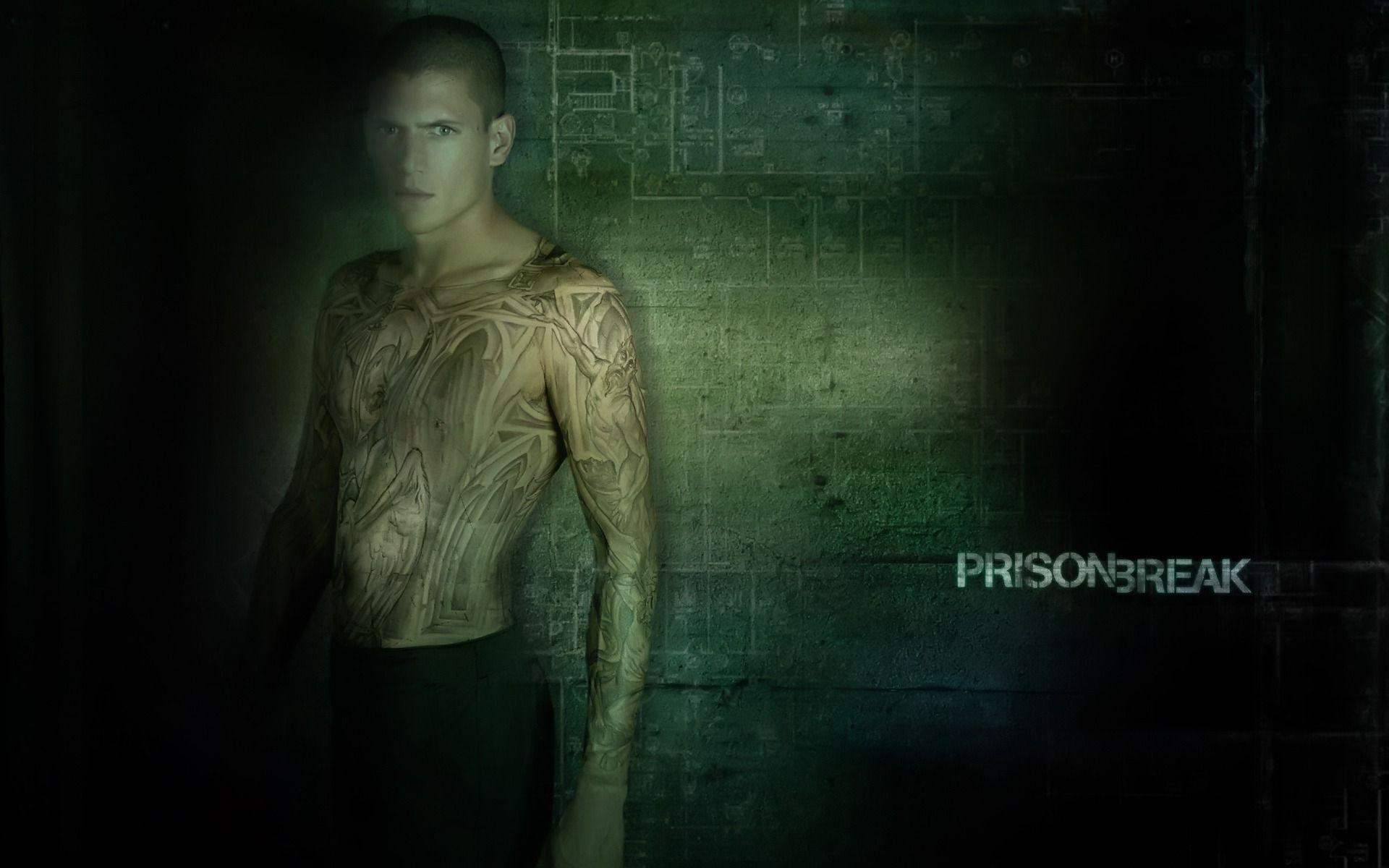
Michael Scofield didn't just walk into Fox River with a plan. He wore it. For fans of the mid-2000s breakout hit Prison Break, that massive, gothic-inspired ink sprawling across Wentworth Miller’s torso wasn't just a stylistic choice for a brooding protagonist. It was a literal map. A blueprint. A masterwork of engineering hidden in plain sight under the guise of "lowbrow" body art. Honestly, looking back at it now, the prison break scofield tattoo remains one of the most ambitious plot devices ever conceived for television, even if it caused the production team a massive headache every single day of filming.
The premise was simple but insane. Michael Scofield, a structural engineer with a genius-level IQ and a "low latent inhibition" clinical diagnosis, discovers his brother Lincoln Burrows is being framed for a crime he didn't commit. To get him out, Michael needs the blueprints for Fox River State Penitentiary. Since he can't exactly stroll in with a rolled-up architectural drawing, he spends months working with a tattoo artist to hide the entire facility's layout within a dense, complex mural of demons and angels. It’s brilliant. It’s also completely ridiculous if you think about it for more than ten seconds, but that was the magic of the show.
The Brutal Reality of Applying the Ink
You might think Wentworth Miller actually sat through hundreds of hours of needlework. He didn't. Obviously. But the process of getting him camera-ready was almost as grueling as a real tattoo session. The prison break scofield tattoo was actually a series of around 200 individual decal-like pieces that had to be applied to Miller’s skin like a giant, high-stakes jigsaw puzzle.
Tom Berg was the man behind the design. He’s a real-world tattoo designer who has worked on films like Red Dragon. When he was tasked with creating Michael’s skin-map, he had to balance two conflicting needs: it had to look like credible art to the prison guards, and it had to be legible enough for the audience to follow along when Michael stared at his arm in a dimly lit cell.
It took a team of two or sometimes three makeup artists roughly four to five hours to apply the full piece. Imagine that. Every single day Michael had a shirtless scene, Miller had to show up to set in the middle of the night just to stand there while people glued plastic to his chest. On days when he wore long sleeves, they’d only do the hands and neck. It was a logistical nightmare. In fact, by the later seasons, the writers basically gave up on the tattoo entirely because the application process was too expensive and time-consuming. They eventually had Michael get it surgically removed in a plot twist that many fans still find a bit lazy, though from a production standpoint, it was a mercy killing.
Hidden in Plain Sight: Decoding the Blueprint
The tattoo wasn't just a map of the hallways. It was an encyclopedia of the entire escape plan. Each section of the prison break scofield tattoo corresponded to a specific step in the "PI" (Prison Industries) work schedule or a physical obstacle within the walls of Fox River.
One of the most famous hidden details was the "Allen Schweitzer 11121147" inscription. To a casual observer, it looked like a memorial or a random name. In reality, "Allen" was the brand of a hex key Michael needed, and "Schweitzer" was the brand of the toilet he had to unscrew. The numbers? They were the model numbers.
Then there was the "Cute Poison" chemical formula. Michael used a mnemonic device hidden in the tattoo—$CuSO_{4} + H_{3}PO_{4}$—to remember the chemicals needed to create a corrosive reaction that would eat through the pipes in the infirmary. If you look closely at the ink on his arms, you see the image of a devil’s face. When Michael projected the light through the tattoo onto the wall using a makeshift lens, the eyes of the devil lined up perfectly with the drill points he needed to weaken a structural wall. This wasn't just "cool" TV writing; it was a clever use of the Moiré interference pattern, a real physical phenomenon.
Beyond the Map: The Aesthetic Choices
Why demons and angels? Berg chose a "Christ-like" theme mixed with Bosch-esque imagery. The front of the tattoo—the chest—featured an image of an angel slaying a demon. This represented Michael’s internal struggle: he was doing a "bad" thing (breaking into prison, breaking laws) for a "good" reason (saving his brother). The back was the opposite, depicting a demon attacking an angel.
- The angels represented the path of least resistance.
- The demons represented the obstacles, like the guards and the "Scylla" conspiracy.
- The gothic architecture served to mask the straight lines of the prison's plumbing and electrical grids.
If the lines were too straight, the guards would have noticed. By wrapping the blueprints in the wings of a fallen angel or the curves of a gargoyle, Michael effectively "encrypted" the data. It's basically the 2005 version of a hidden folder on a hard drive.
Why It Still Resonates with Fans
There is something deeply satisfying about the "competence porn" of the first season of Prison Break. We live in a world where things feel chaotic. Seeing a man who has mapped out every contingency—down to the exact diameter of a bolt—on his own skin provides a weird sense of order.
The prison break scofield tattoo also tapped into the mid-aughts obsession with tattoos as storytelling. This was the era of LA Ink and Miami Ink. Tattoos were moving from the fringes of society into the mainstream. Scofield’s ink was the ultimate expression of that: it was "meaningful" in the most literal sense possible.
People actually try to get this tattoo in real life. I've seen the forums. Let's be clear: getting the full Scofield tattoo is a terrible idea for most people. Not because of the prison associations, but because of the sheer scale. A full bodysuit of that density takes years to finish and costs tens of thousands of dollars. Plus, unless you are actually planning to break out of a specific Illinois correctional facility built in the late 19th century, the "map" part is pretty useless.
The Legacy of the Ink
Even though the show eventually moved away from the tattoo—and the revival seasons barely mentioned it—the image of Michael Scofield standing with his arms outstretched, revealing the blueprint of his own cage, remains the definitive image of the series. It changed how showrunners thought about body art. It wasn't just a character trait anymore; it could be the entire plot.
Without Scofield, do we get the intricate, mystery-solving tattoos of Blindspot? Probably not. The prison break scofield tattoo set a benchmark for how much information you could hide in plain sight.
If you're looking to pay homage to the show without tattooing your entire torso, consider these smaller, more manageable nods to Scofield's genius:
- The Origami Crane: Michael’s "calling card" is a much more subtle tattoo option that represents his connection to his brother and his meticulous nature.
- The Allen Schweitzer Script: A small text-based tattoo of the bolt coordinates is a "if you know, you know" reference for hardcore fans.
- The Greek Letter 'Alpha': Used in later seasons as part of the Scylla plot, it’s a clean, minimalist way to reference the show’s mythology.
How to Appreciate the Art Today
If you’re rewatching the series, pay attention to the scenes in the first ten episodes. You can actually see the transition points between the different "sheets" of the temporary tattoo if the lighting is just right. It makes you appreciate the craft of the makeup artists even more. They weren't just applying art; they were maintaining continuity for one of the most complex visual props in television history.
The prison break scofield tattoo wasn't just a gimmick. It was the heart of the story. It represented the lengths a person will go to for family—transforming their own body into a tool for liberation. It’s messy, it’s over-the-top, and it’s slightly illogical, which is exactly why it’s iconic.
To truly understand the design, you have to look past the ink and see the architecture. Every line had a purpose. Every shadow was a hallway. Michael Scofield didn't just wear his heart on his sleeve; he wore the walls of Fox River on his skin, and in doing so, he gave us one of the most memorable visual hooks in the history of the medium.
Next Steps for Enthusiasts:
Start by researching the work of Tom Berg. His original sketches for the Scofield piece are often available in "Art of the Show" books or online archives. Studying the original sketches reveals how the layout of Fox River was "deconstructed" before being "reconstructed" as art. If you are considering a tribute tattoo, find an artist who specializes in Black and Grey Fine Line or Gothic Realism to ensure the architectural details don't blur into a dark smudge over time.