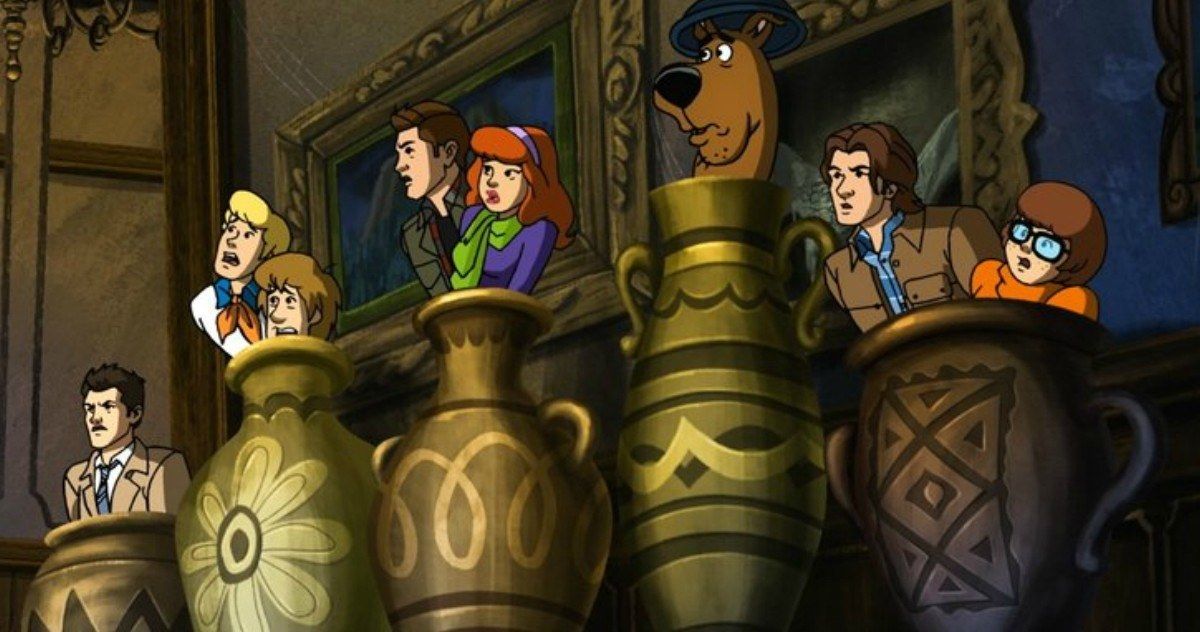
It shouldn't have worked. Seriously. On paper, mixing a gritty CW show about childhood trauma and literal Hell with a Saturday morning cartoon about a talking Great Dane sounds like a recipe for a career-ending disaster. But when the Supernatural crossover with Scooby Doo—officially titled "Scoobynatural"—hit screens in March 2018, it didn't just work. It became a cultural touchstone for the Winchester fandom.
I remember the skepticism back then. People thought Supernatural was finally jumping the shark in its thirteenth season. We’d seen the boys turn into dolls, go to a fan convention, and even enter a meta-fictional version of our own world, but "cartoon land" felt like a bridge too far.
Then the episode aired.
The tonal whip-lash of seeing Dean Winchester try to flirt with Daphne Blake while Sam stood by looking bewildered was comedic gold. But more than that, it was a love letter to two very different eras of television. It wasn't just a gimmick; it was a deeply researched, beautifully animated piece of television history that respected the lore of both universes.
How the Winchester Brothers Ended Up in Coolsville
The plot kicks off with a classic Supernatural setup. After a nasty fight with a cursed plushie in a pawn shop, the shop owner gives Sam and Dean a free television as a thank-you. Dean, being Dean, creates his ultimate "Man Cave" and turns the TV on, only to be sucked into the screen.
Suddenly, they're animated.
The writers, Jim Krieg and Jeremy Adams, knew exactly what they were doing here. Instead of creating a generic cartoon world, they dropped the Winchesters into a specific 1970 episode of Scooby-Doo, Where Are You! titled "A Night of Fright Is No Delight." If you're a hardcore fan, you'll recognize the setup: Scooby is named a beneficiary in a millionaire's will, provided he can spend the night in a haunted mansion.
Dean is ecstatic. He grew up on these cartoons. For a kid who lived on the road and hunted monsters, the Scooby-Doo gang represented the only "normal" childhood he could fathom. He knows every beat of the episode. He knows where the hidden doors are. He even knows which sandwiches Shaggy is going to make.
But things go sideways fast.
When the "Guy in a Mask" Becomes a Real Ghost
The brilliance of the Supernatural crossover with Scooby Doo lies in the collision of stakes. In Scooby’s world, the ghost is always a real estate developer in a sheet. In the Winchesters' world, the ghost is a vengeful spirit that rips people’s lungs out.
When the first "corpse" shows up in the mansion—a real, bloody death that the Scooby gang isn't equipped to handle—the episode shifts. We see the Mystery Machine crew experience a total existential breakdown. Velma starts trying to debunk the blood with logic. Fred enters a catatonic state of denial. It’s a dark, hilarious deconstruction of the "meddling kids" trope.
Supernatural was always good at meta-humor, but this took it to another level. The animation team at Warner Bros. Animation did an incredible job mimicking the specific, slightly jerky 1970s Hanna-Barbera style while integrating the likenesses of Jared Padalecki, Jensen Ackles, and Misha Collins. Castiel’s deadpan delivery in animated form is particularly inspired.
The Breakdown of the Scooby Gang's Innocence
One of the most poignant, albeit funny, moments is when the Winchesters realize they’ve broken the Scooby gang. Dean is desperate to keep them "pure." He doesn't want them to know that the world is actually a terrifying place filled with demons and monsters.
He wants Fred to keep being a lovable, trap-building doofus.
But you can’t hide a bloody ghost forever. Eventually, Sam and Dean have to do what they do best: hunt. They salts-and-burn the situation, but the emotional fallout for the cartoons is real. The episode manages to balance this weird line between being a goofy romp and a genuine commentary on the loss of innocence.
The way they "fix" the trauma at the end—by convincing the gang that it was all just a "very elaborate prank" by a criminal—is a perfect nod to the original show's formula. It restores the status quo while leaving the audience (and the Winchesters) with a lingering sense of "what just happened?"
Behind the Scenes: The Long Road to Animation
This wasn't a rush job. Development for "Scoobynatural" began nearly two years before it actually aired. Most people don't realize that voice recording for animation takes significantly longer than filming a standard live-action episode.
The Supernatural cast recorded their lines in early 2017. They worked alongside legendary voice actors like Frank Welker (the voice of Fred and Scooby) and Grey Griffin (Daphne). Matthew Lillard, who has voiced Shaggy since the live-action films, also brought his A-game.
The animation process itself was grueling. Every frame had to be hand-checked to ensure the colors matched the original 1970s palette. They even used the same sound effects—the classic "galloping" noise when they run and the distinct creak of the doors.
It’s that attention to detail that helped it rank as one of the highest-rated episodes in the show’s fifteen-year run. On IMDb, it consistently sits near the top, often compared to legendary episodes like "The French Mistake" or "Changing Channels."
Why the Crossover Worked (And Why Others Fail)
Crossovers are usually cheap marketing ploys. We’ve seen it a thousand times—two characters from different shows meet in a hallway, nod at each other, and go back to their respective plots. It’s boring.
"Scoobynatural" succeeded because it used the crossover to tell us something about Sam and Dean. It highlighted Dean’s longing for a simpler life and Sam’s intellectual curiosity. It also leaned into the horror.
By bringing actual death into the Scooby-Doo universe, the writers acknowledged the fundamental difference between the two shows. One is about the mystery; the other is about the trauma. By smashing them together, they created something entirely new.
Honestly, the humor landed because the actors played it straight. Jensen Ackles didn't treat it like a cartoon; he treated it like Dean Winchester was actually losing his mind over meeting his childhood hero. That sincerity is the secret sauce.
Common Misconceptions About the Scooby-Doo Crossover
A few things usually get mixed up when people talk about this episode.
First, no, it wasn't a dream. In the logic of Supernatural, it actually happened. The brothers were magically transported.
Second, many fans think this was the first time Supernatural did animation. It wasn't. There was a Supernatural: The Anime Series produced by Madhouse in 2011, though it didn't feature the original voices for the most part (Jensen only voiced the final few episodes).
Third, people often ask if there will be a sequel. With Supernatural having concluded its run and the various Scooby-Doo iterations moving in different directions (like the polarizing Velma series), a direct follow-up is unlikely. However, the success of this episode paved the way for more "weird" crossovers in the industry.
Actionable Insights for Fans and Creators
If you're a writer or a fan looking to understand why this specific piece of media resonates so well, consider these takeaways:
- Respect the source material. The reason "Scoobynatural" didn't feel like a parody is that it treated the 1970 Scooby-Doo episode with reverence.
- Juxtaposition is key. The humor came from the "R-rated" world of Sam and Dean bleeding into the "G-rated" world of Scooby. Contrast creates conflict.
- Character motivation matters. Dean’s obsession with Scooby-Doo gave the episode an emotional anchor. It wasn't just a random trip; it was a character study.
For those looking to revisit the episode, it’s Season 13, Episode 16. It’s best watched after seeing the original 1970 "A Night of Fright Is No Delight" just to see how many Easter eggs you can spot.
To dive deeper into the legacy of the Supernatural crossover with Scooby Doo, you should check out the "Behind the Scenes" featurettes on the Season 13 Blu-ray. They show the cast in the recording booth, and seeing Misha Collins try to find Castiel’s voice in an animated space is worth the price of admission alone. Also, keep an eye on animation festivals; the creators often speak about the technical hurdles of this specific project.
Ultimately, "Scoobynatural" proved that even after thirteen years, a show could still surprise its audience. It reminded us that at its heart, Supernatural was always about a family in a car, driving through the dark, trying to figure out what’s bumping in the night. Whether that "bump" is a guy in a mask or a literal demon from the pits of Hell doesn't really change the mission.