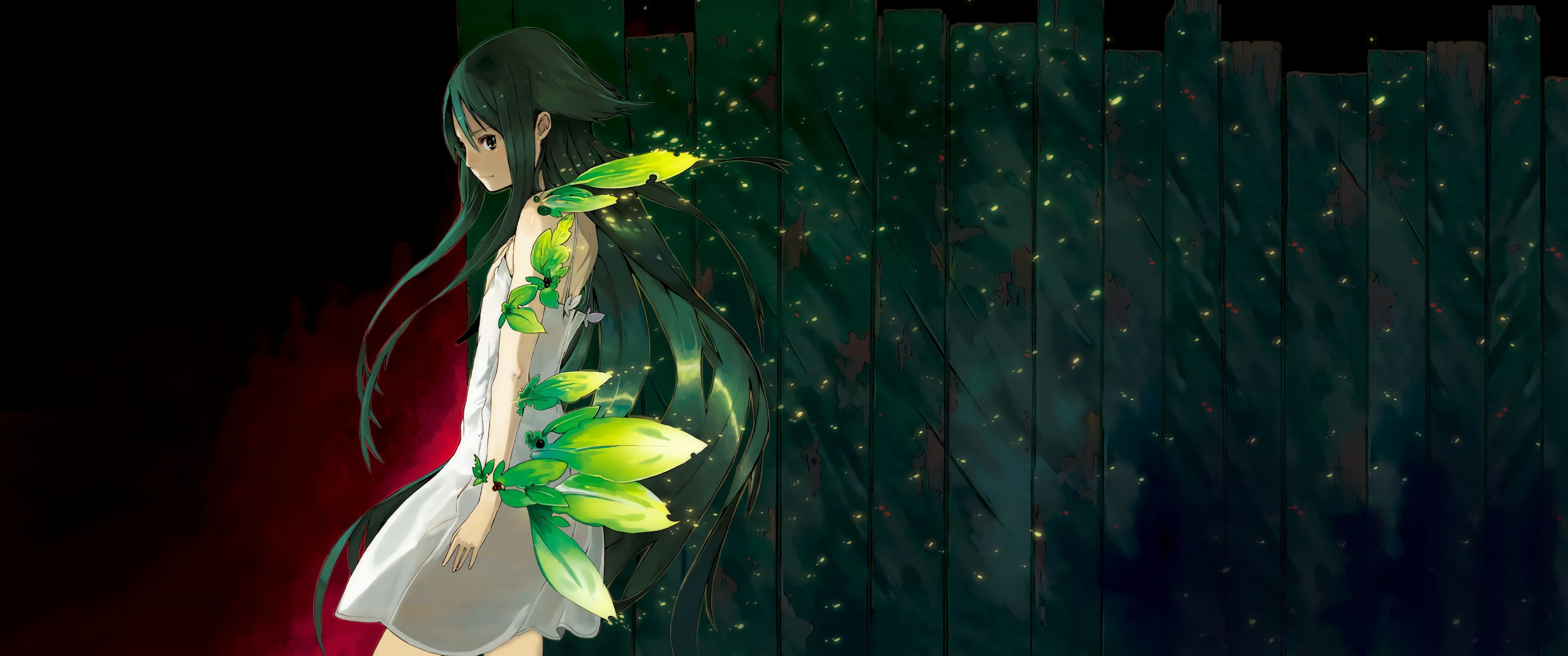
It is a nightmare. Truly. Most people who stumble into the world of Gen Urobuchi’s 2003 visual novel masterpiece expect a typical horror story, but what they get is a visceral, stomach-churning shift in perspective that redefines what "monstrous" even means. At the center of this psychological meat grinder is the mystery of the Saya no uta true form. We see her as a small, delicate girl with green hair and a white dress. Fuminori sees her that way because his brain is broken. He sees the rest of the world as a pulsating, rusted slaughterhouse.
But what is she, really?
If you've played the game, you know the "meat vision" Fuminori suffers from after his experimental brain surgery is the only reason he can even stand to look at her. To him, she is the only beautiful thing in a world made of intestines and bile. To everyone else—to the "normal" characters like Ryōko or Kōji—she is an unspeakable cosmic horror.
The Anatomy of the Saya no Uta True Form
The game is famously coy about showing us exactly what Saya looks like to a "normal" person. We get glimpses. We get descriptions of slime, tentacles, and a scent that smells like rotting fruit mixed with chemicals. It’s basically Lovecraftian biology 101, but with a reproductive twist that makes it feel way more invasive.
Gen Urobuchi didn't just invent a monster; he invited a biological outsider. Saya isn't a ghost or a demon in the traditional sense. She’s an extraterrestrial or extra-dimensional entity whose very existence is an affront to terrestrial physics. When we talk about the Saya no uta true form, we aren't just talking about a scary costume. We are talking about a mass of pulsating organs, sensory stalks, and reproductive systems that don't belong on our evolutionary tree.
What the CGs Don't Tell You
The visual novel uses its medium perfectly. Because we almost always see the world through Fuminori’s eyes, the "true form" is a shadow. It’s a silhouette in a dark room. It’s the sound of squelching footsteps.
There is a specific moment where Ryōko Tanohara, the doctor who becomes the "final girl" of sorts, describes the entity. She doesn't just see a monster; she sees a biological impossibility. It’s a collection of wings that shouldn't lift, eyes that shouldn't see, and a mouth that shouldn't be able to form human speech. Yet, through some horrific mimicry or perhaps a high-level intelligence we can't fathom, Saya learns to communicate.
Honestly, the horror isn't that she's ugly. The horror is the scale.
Why the Human Brain Can't Process Her
There’s a theory in the fan community, backed by the game’s dialogue, that the Saya no uta true form isn't even meant to exist in three dimensions. Fuminori’s "madness" acts as a filter. By breaking his ability to perceive human reality, the surgery inadvertently allowed him to perceive Saya’s "beauty" because his brain remapped the horrific into the aesthetic.
Think about it this way.
If you saw a pile of raw, decaying meat, your brain screams "danger." If you see a beautiful girl, your brain says "safety/attraction." Fuminori’s wires are crossed. To him, the human form is the decaying meat. Therefore, the alien form—the Saya no uta true form—takes the place of the beautiful girl. It’s a tragic, disgusting irony.
The Biological Imperative
One of the most disturbing aspects of the true form is its purpose. Saya isn't here to kill us. Not really. She’s here to bloom.
The "True End" of the game (the "Bloom" ending) shows us the ultimate expression of her biology. She isn't just an individual; she’s a spore. She’s a seed. When she finally "flowers," she covers the entire planet in her essence. To Fuminori, it’s a world of white feathers and soft light. To the rest of humanity, it’s the end of our species as we are digested and reformed into something else.
Examining the Influence of H.P. Lovecraft
You can't talk about Saya without talking about The Dunwich Horror or The Shadow Over Innsmouth. Urobuchi is a massive fan of cosmic horror, and it shows in how he treats the Saya no uta true form.
In Lovecraftian lore, the monster is often "indescribable" not because the author is lazy, but because the human eye literally lacks the hardware to process the geometry of the creature. Saya fits this perfectly. When characters look at her, they don't just feel fear; they feel nausea. Their lizard brains recognize that she is a predator from a different food chain.
Cultural Impact of the Reveal
Even decades later, this game ranks high on "disturbing" lists because of the disconnect between what we see and what we know is there. It plays with our empathy. You want to root for Saya because she loves Fuminori. She’s lonely. She’s vulnerable.
Then you remember she’s a mass of tentacles that just ate a neighbor.
Misconceptions About Her Appearance
A common mistake new players make is assuming Saya is just a "blob." That’s too simple. If she were just a blob, she wouldn't be able to perform the delicate tasks she does—like using a computer or performing "surgery" on Fuminori's neighbor, Yoh.
The Saya no uta true form must have incredible dexterity. It must have appendages capable of fine motor control. The fan art often depicts her as a tangle of fleshy vines, but the narrative suggests something more organized, even if that organization is alien to us.
The Scent of the Alien
Wait, let's talk about the smell. Characters frequently mention a cloyingly sweet, chemical odor. This is a classic biological trick. In nature, some of the most beautiful-smelling flowers are actually carnivorous or rely on the scent of decay to attract flies. Saya’s true form uses pheromones and scents to navigate a world she wasn't built for.
How to Approach the Story Today
If you’re looking into the Saya no uta true form for the first time, you have to look past the shock value. Yes, it’s a "ero-ge" (erotic game) by classification, but the sex scenes are widely considered some of the most depressing and narratively vital parts of the story because they highlight the physical reality of Fuminori’s delusion.
He is embracing something that would make any other person's heart stop from pure terror.
Key Takeaways for Fans
- Perspective is Everything: The girl we see is a hallucination. The "monster" is the reality.
- Biological Colonization: Saya’s goal is reproduction, which makes her "form" more of a life-cycle stage than a static body.
- The "Gift": Fuminori’s madness is the only thing that allows for a "happy" ending, even if it’s a global catastrophe.
The enduring legacy of the Saya no uta true form is its ability to make us question our own senses. If our brains can be tricked into seeing beauty in horror, what else are we missing? What else is "true" that we simply choose not to see?
If you want to experience this firsthand, the "remastered" versions on platforms like Steam (with the necessary patches to restore the original vision) offer the clearest look at the art and the narrative. Just be prepared. It isn't a game that leaves you feeling good. It’s a game that leaves you checking the corners of your room for things that shouldn't be there.
To truly understand the narrative depth, focus on the "Ryōko" path. It provides the most clinical, objective view of what the entity actually is. Reading her notes in the game gives you the closest thing to a "scientific" breakdown of Saya’s biology. This contrasts perfectly with Fuminori’s poetic, doting descriptions, giving you the full, horrific picture.
Don't just look at the CGs. Read the descriptions. The horror is in the text.
Next Steps for Deep Research:
- Check out the Nitroplus 10th Anniversary art books. They contain some of the original concept sketches for the "meat" world and subtle hints at the creature's silhouette that weren't fully rendered in the original engine.
- Read "The Shadow Over Innsmouth" by H.P. Lovecraft. It’s the primary DNA for the "hybridization" themes found in the later stages of Saya's story.
- Compare the original 2003 script to the JAST USA translation. Some nuances regarding the "scent" and "texture" of the true form are more vivid in specific translations, heightening the sensory horror.