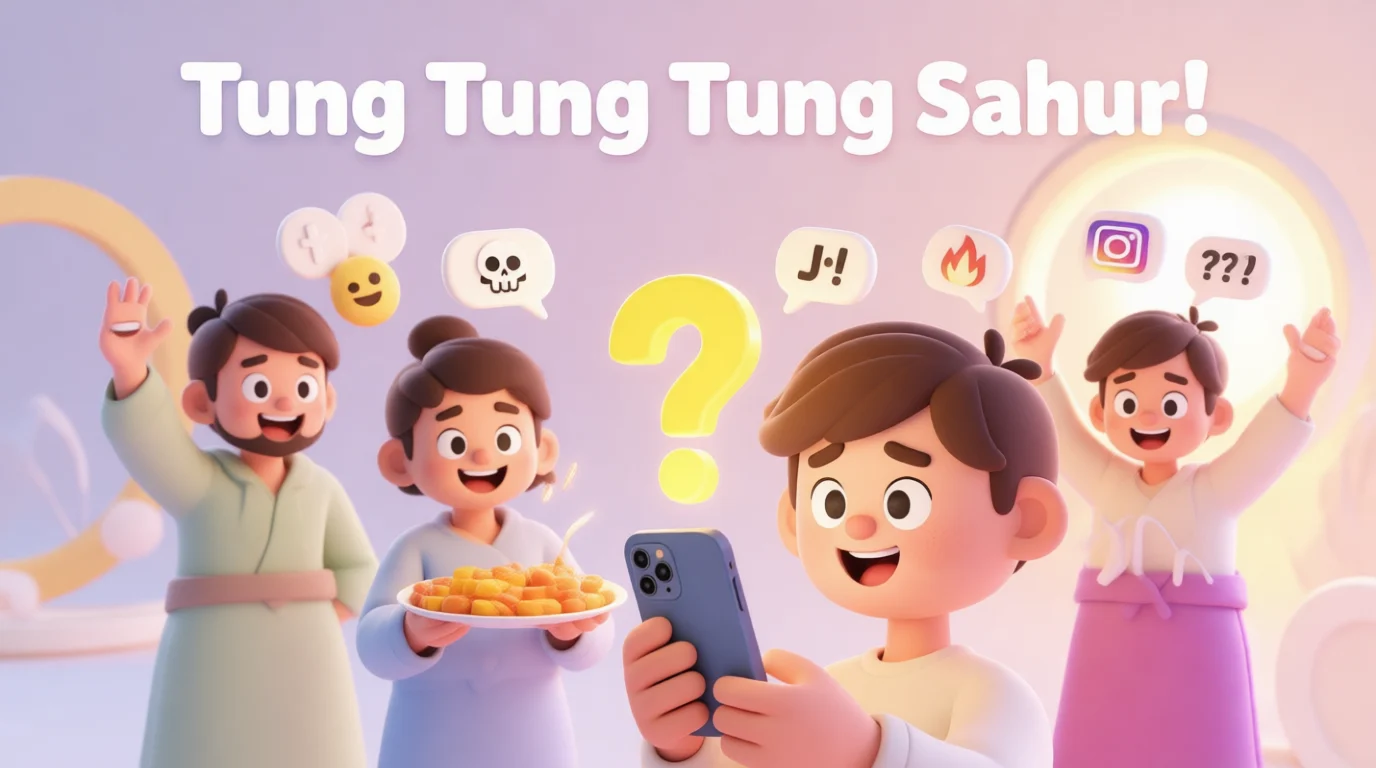
If you’ve ever spent a night in a residential neighborhood in Indonesia during the month of Ramadan, you know the sound. It usually starts around 2:00 AM or 3:00 AM. It’s rhythmic. It’s loud. It’s persistent. It is the sound of tung tung sahur, a grassroots cultural phenomenon that serves as a human alarm clock for millions of people.
But what does tung tung sahur mean, exactly?
At its most basic level, it’s an onomatopoeic phrase. "Tung tung" mimics the hollow, percussive sound of a kentongan (a traditional slit drum made of bamboo or wood) or a plastic gallon water jug being struck with a stick. "Sahur" refers to the pre-dawn meal Muslims eat before starting their fast. Together, it describes the act of "building people up for sahur." It’s loud. It’s chaotic. Honestly, it’s one of the most polarizing yet beloved aspects of Indonesian life.
The Cultural Roots of the Noise
You won't find a formal definition of "tung tung sahur" in an academic dictionary, mostly because it’s street slang for a tradition formally known as Obrog or Pembangun Sahur. In places like Cirebon or rural Java, this has been happening for centuries. Back then, village elders used the kentongan to signal everything from fires to prayer times.
During Ramadan, that utility shifted.
Small groups of teenagers and young children—often called the remaja masjid (mosque youth)—gather in the middle of the night. They aren't just hitting drums. They bring out anything that makes noise. We’re talking empty biscuit tins, buckets, and those ubiquitous five-gallon Le Minerale or Aqua jugs. The "tung tung" is the heartbeat of the neighborhood. It’s a rhythmic reminder that time is running out to eat.
Why Do People Still Do This?
You might wonder why anyone bothers with this in 2026. We have smartphones. We have smart watches. Everyone has an alarm.
Tradition is sticky.
There’s a social element here that technology can’t replicate. For the kids involved, it’s a rare moment of nighttime freedom. They roam the streets, chanting "Sahur! Sahur!" in a way that feels like a festival rather than a chore. In many neighborhoods, especially in "kampung" areas, the absence of the "tung tung" sound would feel eerie. It would feel like Ramadan is missing its soul.
It’s about community surveillance, too. Not the creepy kind. The kind where your neighbors are actively looking out for your spiritual obligations. If the "tung tung sahur" crew doesn't pass by, the neighborhood feels less connected.
The Evolution of the "Tung Tung" Sound
The sounds have changed. While the phrase remains "tung tung," the actual audio landscape has evolved into something much more complex.
- Traditional Bamboo: The classic kentongan produces a sharp, high-pitched "tek-tek" or "tung-tung" sound. It’s the OG method.
- The Plastic Gallon Revolution: Most kids today use plastic water gallons. If you hit the side, it’s a deep bass. If you hit the bottom, it’s a snare. It’s basically a portable drum kit.
- The Bedug: Occasionally, a group will wheel out a massive bedug (traditional large drum) on a cart. This is the heavy artillery of sahur waking.
- The Gen Z Twist: Lately, you’ll see groups carrying portable Bluetooth speakers blasting "koplo" remixes of popular songs, interspersed with shouts of "Sahur!" This is where the controversy usually starts.
The Great Sahur Debate: Is It Too Loud?
Honestly, not everyone loves it.
Imagine you’re a nurse who just finished a double shift. Or maybe you’re a parent who finally got a colicky newborn to sleep at 1:30 AM. Then, at 2:15 AM, a dozen teenagers start banging on a galvanized iron bucket right outside your window.
It’s a flashpoint for tension.
In recent years, the Indonesian Ministry of Religious Affairs and the Indonesian Ulema Council (MUI) have actually had to weigh in on this. While the intention is good, the execution can be problematic. There have been several viral videos of residents getting into heated arguments with sahur groups. The general consensus from religious scholars is that waking people up is a "sunnah" (recommended) act, but disturbing the peace or being excessively "lebay" (extra) is discouraged.
Even the legendary Indonesian singer Rhoma Irama once highlighted the importance of etiquette in religious expression. The consensus is shifting: keep it rhythmic, keep it moving, and don't stand in one spot for ten minutes.
The Psychology of the Chant
The "Sahur! Sahur!" chant is usually delivered in a specific cadence. It’s rarely just a shout. It’s a song.
"Sahur... sahur... ibu-ibu, bapak-bapak, sahur!"
It’s an invitation. There is something deeply psychological about hearing a human voice call you to eat in the dead of night. It’s communal. It’s a reminder that millions of other people are currently stumbling into their kitchens to fry an egg or heat up some rendang leftovers at the exact same time. It makes the struggle of fasting feel shared.
Regional Variations You Should Know
While "tung tung sahur" is the common term in Jakarta and West Java, other regions have their own versions that are just as fascinating.
In Gorontalo, they have Koko'o. It involves hitting bamboo, but it's much more organized. In some parts of Sumatra, the tradition involves more melodic instruments. But regardless of the name, the "tung tung" element—that percussive, raw, DIY noise—is the common thread across the archipelago.
It’s also worth noting that this isn’t unique to Indonesia, though the "tung tung" style is uniquely Southeast Asian. In the Middle East, you have the Musaharati. This is usually a single person who walks the streets with a small drum, calling out names of families. The Indonesian version is much more "communal chaos" by comparison.
How to Handle the "Tung Tung" If You're a Visitor
If you’re staying in an Indonesian residential area during Ramadan, you have to embrace the noise.
Trying to stop it is like trying to stop the tide. It’s better to understand it as a temporary cultural heartbeat. Most groups are finished by 3:30 AM as they head back to their own homes to eat before the Imsak (the time when fasting begins).
If you're a light sleeper, earplugs are your best friend. But if you can, just once, open your window and watch them go by. There’s a raw, unmanufactured joy in a group of kids making a massive racket for the sake of tradition. It’s one of the few things left that hasn't been completely sanitized by corporate interests or social media aesthetics.
What Most People Get Wrong
People often think this is an official "job." It isn't. These kids aren't paid. Occasionally, toward the end of Ramadan, they might go door-to-door for a small tip (THR), but for 90% of the month, they do it for the vibes.
Another misconception is that it’s strictly religious. While it’s tied to a religious month, the act of "tung tung sahur" is purely cultural. It’s a folk tradition. You won’t find instructions for "banging on plastic jugs" in any scripture. It’s the people’s tradition.
Practical Tips for Surviving and Respecting the Noise
- Don't get angry. It’s considered quite rude to yell at a sahur group. They see themselves as doing a public service. If the noise is truly unbearable, it’s better to speak to the local RT (neighborhood head) during the day.
- Join the rhythm. If you're awake, many people actually leave a few snacks or drinks out for the kids. It turns a "disturbance" into a moment of charity.
- Adjust your schedule. During Ramadan, the entire country shifts its clock. If you can, try to sleep earlier so the 2:00 AM wake-up call doesn't ruin your day.
- Listen for the "Imsak" siren. Usually, after the "tung tung" stops, a siren or a long call from the mosque will signal the end of the meal time. That’s your cue that the noise is over and silence will return.
The Future of Tung Tung Sahur
Will it survive until 2030? Probably.
Even as Indonesia becomes more urbanized and "modern," the impulse to gather and make noise remains strong. We see it in the way "tung tung" sounds have moved to TikTok and YouTube. There are now "Sahur Remix" videos with millions of views. The medium is changing, but the "tung tung" is forever.
It represents a resistance to the quiet, isolated life of the modern city. It’s loud, it’s messy, and it’s unapologetically Indonesian.
To truly understand what "tung tung sahur" means, you have to look past the noise. It’s not about the drums or the plastic jugs. It’s about the fact that in a world of digital notifications, people still choose to wake each other up with their own two hands and a bit of wood.
If you find yourself in the middle of a "tung tung" session this year, don't just reach for your pillow to cover your ears. Listen to the rhythm. It’s the sound of a community making sure no one eats alone, even in the middle of the night.
Next Steps for You:
If you're currently in Indonesia, check with your local neighborhood head (RT) about the specific hours the sahur groups are allowed to operate. To experience the most traditional version, head to a "Kampung" area in Yogyakarta or Cirebon where the kentongan is still the primary instrument. For those looking to support the tradition, preparing small "takjil" or snacks for the youth groups on Friday nights is a great way to participate in the local culture.