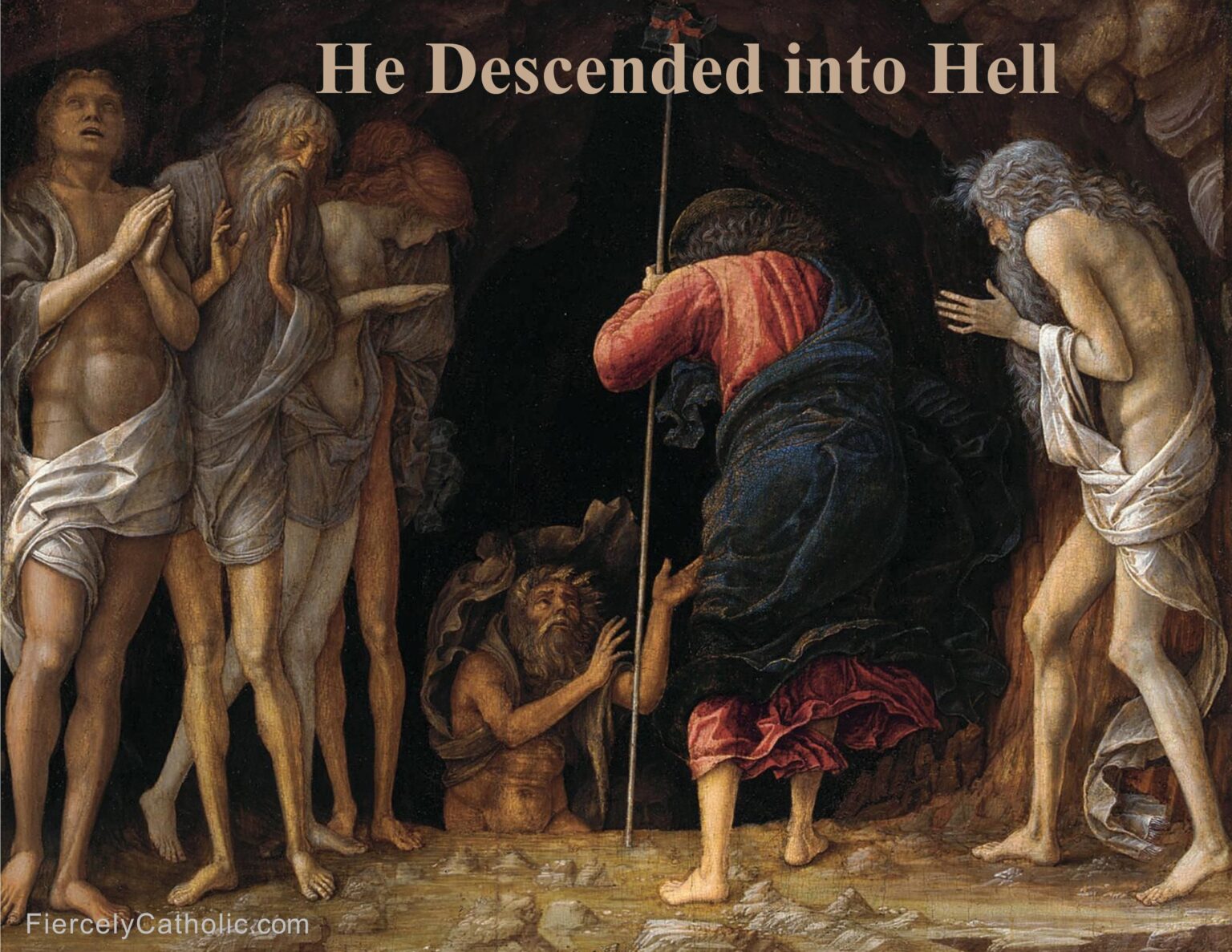
You've probably heard the line in the Apostles' Creed. It’s that brief, almost jarring phrase: "He descended into hell." It sounds like something out of a medieval epic or a dark fantasy novel, doesn't it? But for millions of people, this isn't just a spooky plot point. It’s a core theological mystery. People often wonder, what did Jesus do when he descended into hell, and the answers vary wildly depending on who you ask—and which ancient text they’re holding.
Most of us imagine hell as a lake of fire, thanks to Dante and a few centuries of vivid Sunday School illustrations. But the "hell" mentioned in these early traditions isn't exactly the Gehenna of eternal punishment. It’s Sheol or Hades. Basically, the waiting room for the dead. It was the place everyone went, regardless of how they lived.
So, why would Jesus go there?
He didn't just go to take a tour. The traditional view, often called the "Harrowing of Hell," suggests he went on a rescue mission. Think of it as a divine jailbreak. While his body laid in the tomb between Good Friday and Easter Sunday, his spirit was reportedly very busy.
The Rescue Mission for the Saints
One of the most common beliefs about what did Jesus do when he descended into hell is that he went to liberate the "righteous dead."
Imagine being King David or Abraham. You’ve been waiting in the shadows of Sheol for centuries. You’re not being tortured, but you’re not in the presence of God either. Then, suddenly, the gates burst open.
Early church fathers like Irenaeus and Tertullian wrote about this extensively. They argued that Jesus preached the Gospel to those who had died before his birth. It wasn't about giving people a "second chance" at salvation, which is a common misconception. Instead, it was about fulfilling the promise to those who had already been faithful under the Old Covenant. He was the bridge they had been waiting for.
He walked in and said, "The debt is paid."
It’s a powerful image. It shifts the perspective of death from a dead-end street to a transit hub. This idea is why you see those incredible icons in Eastern Orthodox churches showing Jesus pulling Adam and Eve out of their graves by their wrists. He’s not just greeting them; he’s yanking them into eternity.
Breaking the Gates of Brass
If you look at the Gospel of Nicodemus—which isn't in the Bible but was huge in the early church—the description gets even more cinematic. It describes a literal confrontation. Jesus arrives, and the personified "Hades" and "Satan" start panicking. They try to lock the doors. They use iron bars and brass gates.
But it doesn't work.
According to these ancient narratives, Jesus shattered the gates. He bound the devil. He made it clear that the keys to death and the grave now belonged to him. This is where we get the vivid imagery of the "Harrowing." To harrow means to pillage or despoil. Jesus didn't just visit; he robbed the place of its power.
Actually, the Bible is pretty quiet on the specific details. We have 1 Peter 3:19, which mentions Jesus going to "proclaim to the imprisoned spirits." Some scholars, like those following the Augustinian tradition, argue this happened through Noah during the building of the ark. But the more popular, historic view is that this was a literal descent.
Whether you take it literally or metaphorically, the impact remains the same: death was no longer an inescapable prison.
Why the Descent Matters Today
You might be thinking, "This is cool history, but who cares?"
Honestly, it matters because it addresses the deepest human fear: being forgotten in the dark. The idea of Jesus descending into hell means there is nowhere—literally nowhere—where God isn't present. It suggests that even the deepest, darkest "hells" of human experience aren't outside his reach.
Church historian J.N.D. Kelly noted that the belief in the descent was almost universal in the early centuries. It wasn't a fringe theory. It was the "vince" of the victory. Without the descent, the resurrection is just a guy coming back to life. With the descent, it’s the total overthrow of the cosmic order.
There are different camps, of course.
- The Catholic and Orthodox view: He went to bring the righteous to heaven.
- The Reformed view (Calvin): He suffered the "pains of hell" on the cross, making the descent a metaphorical description of his spiritual agony.
- The Lutheran view: It was a victory march, showing the powers of darkness that they had lost.
Misconceptions About the Descent
A big mistake people make is thinking Jesus went to hell to be punished further. That's not the case in traditional theology. The punishment happened on the cross when he cried out, "It is finished."
The descent was about authority. It was about reclaiming the human race.
Another misconception is that he went to save everyone, including those who had rejected God. Most theologians throughout history have been pretty clear that the mission was specific to the "saints" or those who were "asleep in Christ." It wasn't a universal reset button on judgment. It was a fulfillment of the law.
Analyzing the Timeline
- Friday Afternoon: Death on the cross.
- Friday Evening to Sunday Morning: The Descent. The "quiet" Saturday wasn't actually quiet.
- Sunday Morning: The Resurrection.
What’s wild is how this shaped art and literature. Without this concept, we wouldn't have some of the greatest scenes in the Divine Comedy. We wouldn't have the rich tradition of "Harrowing of Hell" plays that were the blockbusters of the Middle Ages. People loved the idea of a hero breaking into the villain’s lair to save the captives.
The Theological Weight of the "Waiting Room"
Let’s talk about Limbus Patrum, or the Limbo of the Fathers. This is the specific "neighborhood" of hell where the righteous were said to be waiting. It wasn't a place of fire. It was more like a holding cell with a decent view of the future.
When Jesus showed up, he essentially closed that department.
If you want to understand what did Jesus do when he descended into hell, you have to understand the change in geography. Because of his actions, the "bosom of Abraham" (as mentioned in the story of the Rich Man and Lazarus) was relocated, so to speak. The righteous dead were no longer separated from God by a great chasm; they were brought into the beatific vision.
Practical Takeaways and Insights
If you're digging into this for personal study or just out of curiosity, keep a few things in mind. First, don't get caught up in the "fire and brimstone" imagery. That’s usually reserved for the final judgment, not the Sheol Jesus visited. Second, realize that the silence of the Saturday between the cross and the empty tomb is where the real work happened.
- Check the sources: Read 1 Peter 3:18-22 and 1 Peter 4:6. These are the primary "seeds" for the doctrine.
- Look at the art: Search for "Anastasis icons." These are the Eastern Orthodox paintings of the resurrection. You'll see Jesus standing on two crossed doors—the gates of hell—and pulling people out. It’s the best visual representation of this theology.
- Embrace the mystery: There is no "eye-witness" account of what happened down there. We rely on the logical progression of the Gospel: if he died, he went where the dead go. If he is God, he went there as a victor.
The next time you hear the Creed or read about the resurrection, remember that Saturday wasn't a day off. It was the most active day in the history of the underworld. The descent into hell is the ultimate "no man left behind" story. It’s about a God who goes to the absolute bottom of the pit to find his people.
If you want to explore the historical development of this belief, look into the Creeds of Christendom by Philip Schaff. It’s a dense read, but it tracks how these words moved from oral tradition into the formal statements of faith we have today. Understanding the descent helps bridge the gap between the tragedy of the cross and the triumph of the resurrection.