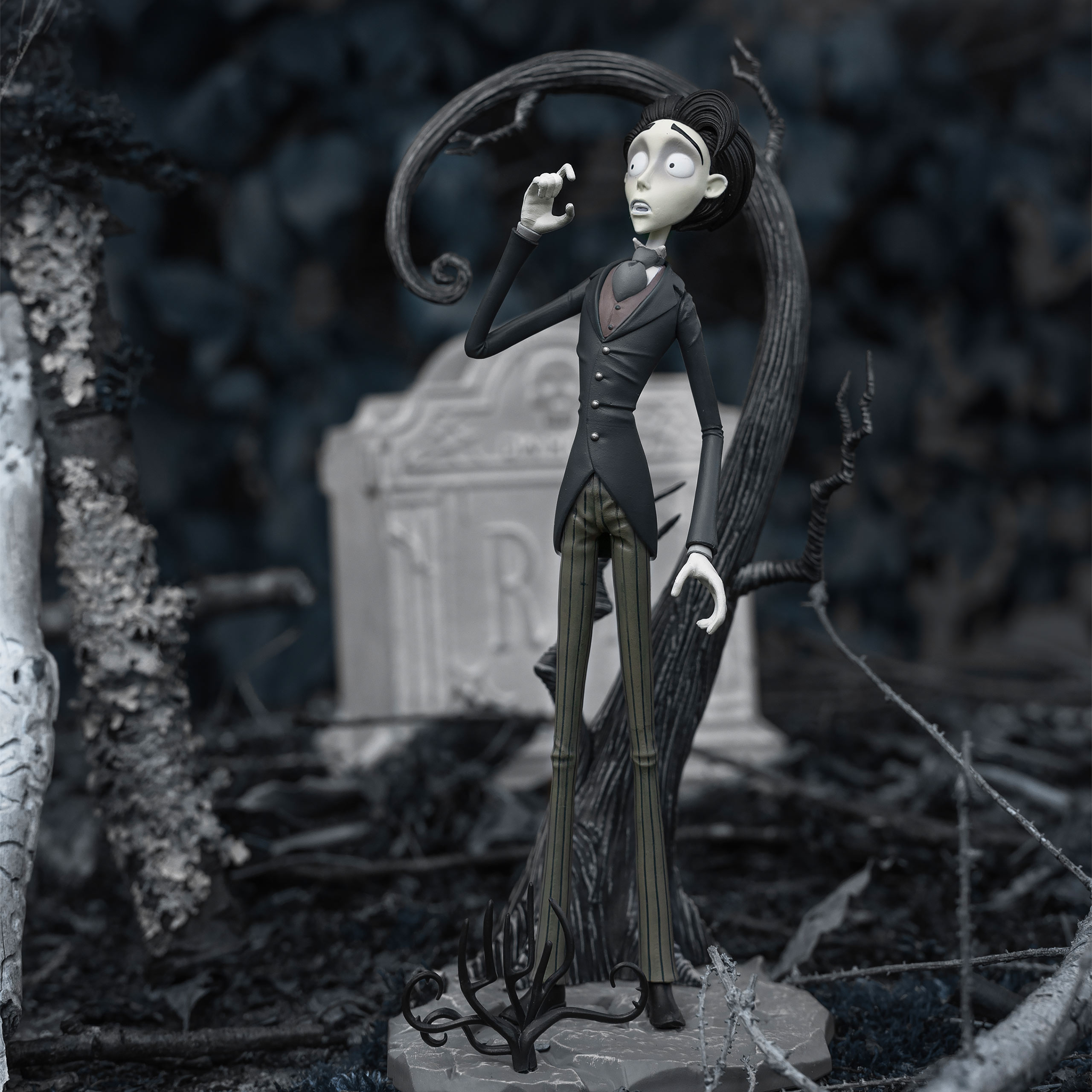
Stop me if you've heard this one before. A nervous guy goes into the woods, accidentally marries a dead woman, and then has to decide if he should literally kill himself to stay with her. It sounds like a horror movie, but for anyone who grew up in the mid-2000s, it’s just Corpse Bride. Tim Burton’s 2005 stop-motion masterpiece isn't just about creepy puppets and blue skin tones. It’s actually a pretty intense look at class, duty, and the weird ways we define "true love."
Most people remember the aesthetic. The spindly fingers. The contrast between the grey, boring world of the living and the neon-colored, jazz-filled Land of the Dead. But if you look closer at the relationship between Victor and Emily, things get complicated. Fast.
Honestly, the movie is kind of a tragedy disguised as a fairy tale. While everyone talks about "The Nightmare Before Christmas," this film actually dives way deeper into the psychological mess of being forced into a marriage you didn't ask for. It’s been decades, and fans are still arguing: did Victor actually love Emily, or was he just caught up in the magic of it all?
The Messy Reality of the Victor and Emily Connection
Victor Van Dort is a mess. Let’s just be real about that for a second. He’s clumsy, socially anxious, and basically a pawn for his social-climbing parents. When he meets Victoria Everglot, there’s an instant spark, sure. But then he messes up his vows and runs into the forest. That’s where he meets Emily, the titular Corpse Bride.
The dynamic here is fascinating because Emily isn't a villain. She’s a victim. She was murdered by Lord Barkis Bittern for her dowry, and she’s been waiting under a tree for someone to set her free. When Victor accidentally places the ring on her finger, she takes it seriously. Very seriously.
You’ve got to feel for Victor. One minute he’s nervous about a wedding rehearsal, the next he’s being dragged into the underworld by a woman who’s missing a few layers of skin. But as the movie progresses, the tone shifts. Victor starts to see Emily’s pain. He sees her talent for music—that piano duet scene is still one of the best moments in animation history—and he starts to feel a genuine connection.
But is it love? Or is it guilt?
Expert analysts and film historians often point to the "duet" as the turning point. In that scene, Emily and Victor don't even speak; they communicate through the piano. It’s a moment of pure, shared loneliness. It’s also where the audience starts to realize that Emily might actually be a better "fit" for Victor’s artistic soul than Victoria, who is lovely but stuck in a world that hates art.
Why the Climax of Corpse Bride Still Hits Different
The third act of this movie is wild. Victor actually agrees to die so he can be with Emily. Think about that. He’s willing to drink the "Wine of Ages"—which is essentially poison—to legally (and lethally) bind himself to her. This is where the Victor and Emily ship gets polarizing.
Some fans think this proves Victor loved her more. Others think he was just trying to do the "honorable" thing because he felt bad for her.
Then comes the twist. Emily sees Victoria watching from the shadows. She realizes that by taking Victor’s life, she’s becoming the same kind of monster who took hers. She stops him. She chooses his life over her own happiness.
The Real Meaning Behind the Butterflies
When Emily dissolves into a cloud of butterflies at the end, it’s not just a cool visual effect. It’s a literal representation of her soul being set free from the "limbo" of her trauma. By letting Victor go, she finally gets the peace she was looking for.
But let’s talk about the fallout. Victor stays with Victoria. They’re happy, I guess? But there’s always been this lingering feeling that a part of Victor stayed in the Land of the Dead. He’s a character who never quite fit into the "Living" world to begin with.
What People Get Wrong About the Victor and Victoria Dynamic
It’s easy to dismiss Victoria Everglot as the "boring" option. She doesn't have a cool backstory involving a secret murder or a catchy jazz song. But Victoria is incredibly brave in her own way. She’s the only person in the "Living" world who actually tries to save Victor. She goes to the priest, she tries to tell her parents, and she even risks being married off to the murderous Lord Barkis just to survive her family’s poverty.
The contrast between the two women is what makes the movie work.
- Emily is the romanticized past: full of passion, music, and tragedy.
- Victoria is the grounded future: representing hope, quiet strength, and shared struggle.
Most people assume Victor’s choice was between "The Dead Girl" and "The Living Girl." But it was actually a choice between staying stuck in a cycle of grief or moving forward into an uncertain, but real, life.
The Technical Wizardry Behind the Characters
If you want to understand why we care so much about these puppets, you have to look at the tech. This wasn't just standard stop-motion. They used gear-driven heads with "paddles" and "screws" inside the silicone skin. This allowed the animators to create incredibly subtle facial expressions.
When Victor looks at Emily with that mix of pity and admiration, that’s not an accident. It’s the result of hours of micro-adjustments. According to Mike Johnson, the co-director, the goal was to make the puppets feel more "human" than the actual human characters. The living characters are stiff and caricatured. The dead characters are fluid and expressive.
It’s a deliberate design choice. It makes the audience want to stay in the Land of the Dead just as much as Victor does.
Breaking Down the "Lord Barkis" Connection
We can’t talk about Victor and Emily without mentioning the man who ruined everything. Lord Barkis isn't just a generic bad guy. He represents the predatory nature of the upper class. He’s a mirror to Victor’s parents and Victoria’s parents. While the parents are trying to "sell" their children for status, Barkis is literally killing for it.
The final confrontation in the church is poetic justice. Barkis drinks the poison intended for Victor, thinking it’s just wine. He dies, and because he’s now "dead," the ghosts can finally get their revenge. It’s a rare moment where a Burton movie gets truly dark, but it’s necessary for Emily’s closure.
Actionable Insights for Fans and Creators
If you’re revisiting this movie or looking to analyze it for a project, keep these things in mind:
- Watch the Color Palettes: Notice how the colors shift when Victor is around Emily versus Victoria. The "Dead" world is actually more "alive" than the "Living" one. This is a classic Burton trope, but it’s perfected here.
- Listen to the Score: Danny Elfman’s music does the heavy lifting for the character development. "Victor’s Piano Solo" tells you more about his internal state than any line of dialogue in the first twenty minutes.
- Analyze the "Vows": The movie is built on a misunderstanding of a legal contract. It’s a commentary on how Victorian society viewed marriage as a business deal rather than a romantic union.
- Character Arcs: Victor starts the movie unable to speak in front of people and ends it being willing to sacrifice his life. That’s a massive jump that usually gets overlooked because of the "spooky" vibes.
The legacy of Victor and Emily isn't just about Halloween aesthetics or "Goth" culture. It’s a story about the weight of promises. It teaches us that you can’t build a future on a foundation of pity, and sometimes, the most loving thing you can do is let someone go.
If you're planning a rewatch, pay close attention to the eyes of the puppets. The way Victor’s eyes soften when he’s around Emily during the "Tears to Shed" sequence is a masterclass in visual storytelling. It’s those small details that keep this movie ranking as a top-tier piece of cinema decades later.
Take a moment to look at the concept art by Carlos Grangel if you can. It shows how the characters evolved from skeletal sketches to the expressive figures we see on screen. Seeing the evolution of Emily’s design—from a terrifying corpse to a tragic beauty—explains exactly why Victor (and the audience) fell for her in the first place.