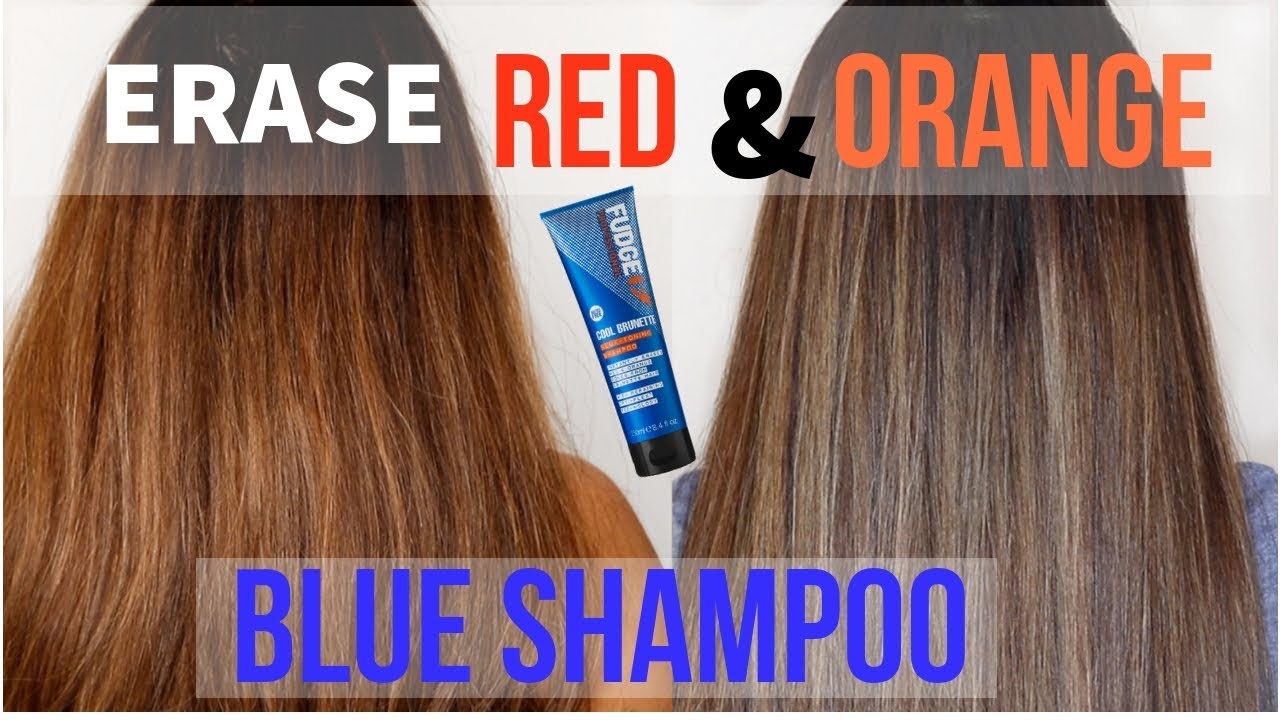
You’re standing in the shower, staring at a bottle of dark, ink-colored liquid that looks more like a fountain pen refill than hair care. If you have brunette hair with highlights, or maybe you’ve recently tried to go from box-black to honey brown, you know the struggle. It’s that weird, rusty, Cheeto-dust orange that starts creeping in after about three washes. Honestly, the before and after blue shampoo results you see on TikTok can look like magic tricks, but there is a lot of science—and a fair amount of user error—behind whether it actually works for you.
Color theory is a bit of a headache.
If you look at a standard color wheel, blue sits directly across from orange. This means they are complementary colors that effectively "cancel" each other out when mixed. When your brown hair is lifted or lightened, it reveals the underlying warm pigments. For brunettes, those pigments are stubbornly orange. Unlike blondes who deal with yellow "brassiness" (which requires purple shampoo), brunettes deal with "orange-red" brass.
Applying blue shampoo is basically like putting a sheer, cool-toned filter over a warm-toned photo. It doesn't lighten your hair. It just shifts the tone.
Why the Before and After Blue Shampoo Results Vary So Much
Most people buy a bottle, scrub it in for thirty seconds, and then wonder why their hair still looks like a sunset. It’s frustrating. But the reality is that blue shampoo isn't a dye; it’s a deposit-only toner.
The biggest factor in your results is the porosity of your hair. If your hair is highly porous—meaning the cuticle is wide open because of bleach or heat damage—it’s going to soak up that blue pigment like a sponge. Sometimes, it soaks up too much. I've seen people go from a brassy chestnut to a muddy, swampy green because they left the shampoo on for twenty minutes.
On the flip side, if your hair is healthy and the cuticle is tight, the blue might just slide right off.
The Chemistry of the Tint
Let’s talk brands for a second because they aren't all created equal. Matrix Total Results Brass Off is a cult favorite because it has a very high pigment load. Then you have things like Fanola No Orange, which is so strong it can actually stain your fingernails if you don't wear gloves. If you use a "gentle" sulfate-free blue shampoo, your before and after blue shampoo transition might be barely noticeable. It’s a balancing act. You want enough pigment to neutralize the copper, but not so much that you look like you’ve been swimming in an inkwell.
Another thing: if your hair is actually yellow, not orange, blue shampoo will make it look green. Yellow + Blue = Green. Basic elementary school art. This is why you have to be honest about what color your "brass" actually is. If it’s the color of a banana peel, go buy purple. If it’s the color of a copper penny, stay with blue.
The Right Way to Use It (According to Pros)
Most stylists, including experts like Justin Anderson who works with some of the biggest brunettes in Hollywood, will tell you that the "shampoo" part of the name is a bit misleading. You shouldn't really use it to clean your hair.
- Wash your hair first with a normal, clarifying shampoo to get rid of oil and product buildup.
- Towel-dry your hair slightly so it’s damp, not dripping. This prevents the blue pigment from being diluted by excess water.
- Apply the blue shampoo. Work it in thoroughly.
- Let it sit. For a mild change, three minutes. For a "wow" before and after blue shampoo transformation, you might need ten.
- Rinse with cool water to seal the cuticle.
It’s messy. Your shower will look like a Smurf exploded in it. Just make sure to rinse the tiles immediately, or the pigment can settle into the grout, and that’s a whole different project you don't want.
Real Expectations vs. Filtered Reality
You see these photos online where a girl goes from bright orange to a cool, ashy mushroom brown in one wash. Usually, there’s a ring light involved.
In real life, the change is subtle. It’s the difference between your hair looking "unrefined" and looking "expensive." Blue shampoo won't make your hair lighter. If you are a dark brunette, it will actually make your hair look a tiny bit darker because you are adding cool tones, which reflect less light than warm tones.
Common Mistakes That Kill the Vibe
People treat blue shampoo like a daily ritual. Don't do that. Overusing it leads to "color buildup," where your hair starts to look dull and lifeless. Once a week is usually the sweet spot.
Also, watch out for your ends. The ends of your hair are older and usually more damaged, meaning they take color faster than the roots. If you apply the shampoo to your whole head at once, your ends might turn a weird grayish-blue while your roots stay orange. Try applying it to the mid-lengths first and only running it through the ends in the last minute of the process.
Then there's the moisture issue. Blue shampoos are notorious for being drying. The pigments are heavy, and the formulas often lack the conditioning agents found in high-end moisture shampoos. You must follow up with a deep conditioner or a dedicated blue mask.
Does it work on virgin hair?
Sorta. If you have naturally dark hair that has turned a bit reddish from the sun, blue shampoo can help cool it down. However, the results are much more dramatic on color-treated hair because the hair shaft is already "open" and ready to receive the tint. If you have never dyed your hair, don't expect a massive shift. It's more of a "glaze" than a transformation.
Actionable Steps for Your Hair Journey
If you’re ready to try for that perfect before and after blue shampoo result, stop guessing and start being methodical.
- Identify your undertone: Is it orange or yellow? If it’s orange, proceed.
- Do a strand test: Pick a small section of hair near the nape of your neck. Apply the shampoo, wait five minutes, and rinse. This tells you exactly how much time your specific hair needs.
- Protect your hands: If the shampoo is dark blue or violet-blue, use gloves. Stained cuticles are a dead giveaway of a DIY toning session.
- Balance the pH: Use a leave-in conditioner after you hop out of the shower. This helps lay the cuticle back down after the "rougher" blue shampoo treatment.
- Wait for the fade: If you accidentally go too blue, don't panic. Wash your hair twice with a strong clarifying shampoo or an anti-dandruff shampoo like Head & Shoulders. It will strip the blue pigment right out.
The goal isn't to change your hair color entirely, but to maintain the investment you made at the salon. Toning at home is about preservation. Keep your expectations grounded, watch your timing, and keep the hydration levels high.