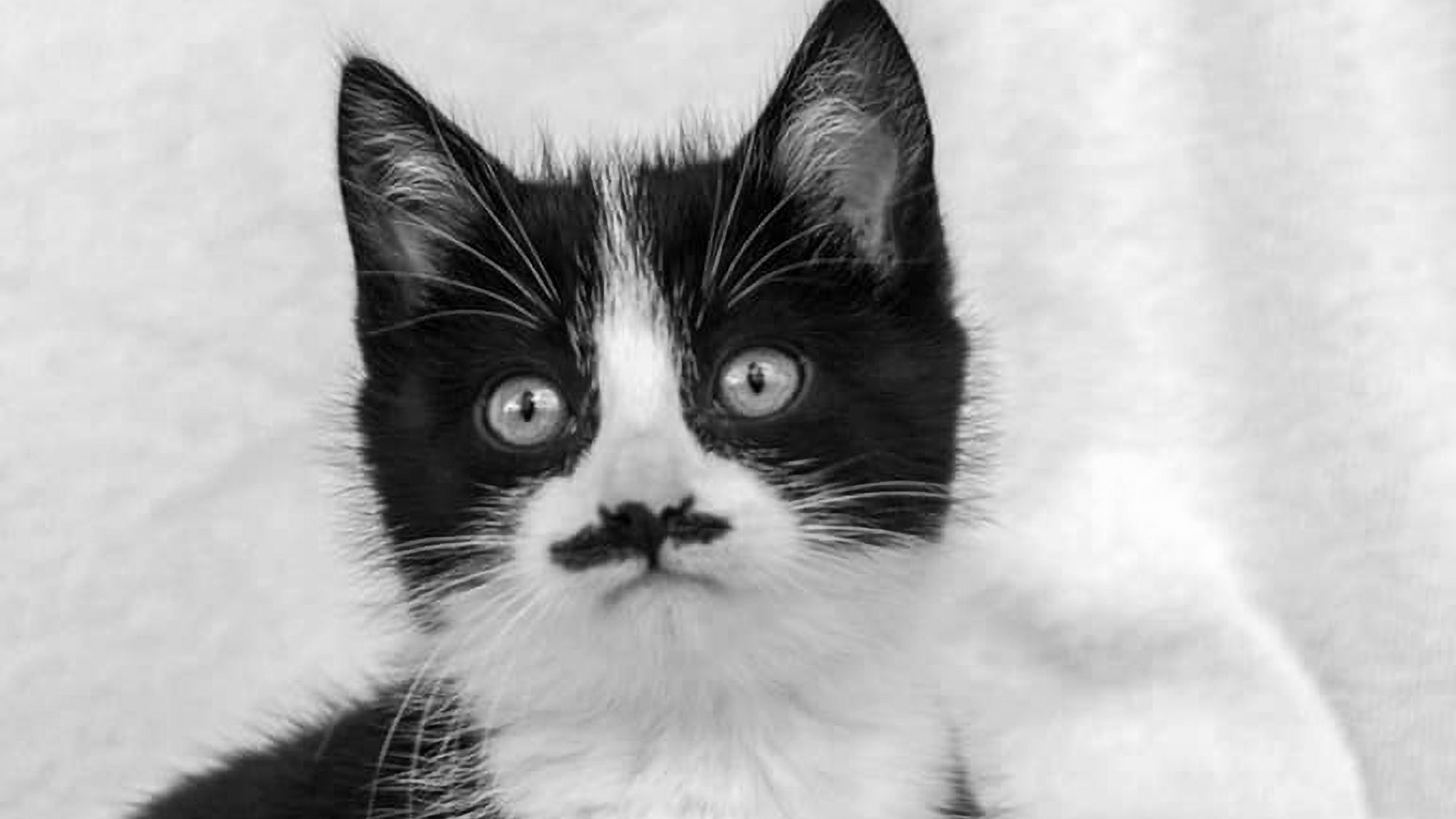
You’ve seen them. You’re scrolling through Reddit or maybe some obscure corner of Instagram, and there it is—a fluffy, white cat with a perfectly centered, rectangular black smudge right under its nose. It looks exactly like him. You laugh, you feel a little guilty for laughing, and then you probably share it with a friend. This specific look, widely known as a cat with hitler moustache markings, has become one of the internet's most enduring and weirdly controversial archetypes.
It’s a strange thing, honestly. We are talking about a biological quirk of feline genetics that somehow collided with the darkest chapter of 20th-century history.
Cats don't choose their fur patterns. They don't have political affiliations or an understanding of geopolitical atrocities. They just want treats and a warm spot to sleep. Yet, because of our human brain’s obsession with facial recognition—something scientists call pareidolia—we can’t help but project one of history’s most hated faces onto a creature that spends its afternoon licking its own butt.
The Science of the Smudge: Why They Look Like That
If you’re looking for someone to blame for your cat's unfortunate facial hair, look at their genes. Specifically, the "piebald" gene. This isn't some rare mutation or a sign of a cursed lineage; it’s actually a very common genetic trait.
Biologically, these cats are known as bicolor cats. Most "Kitlers"—the colloquial term that popularized the cat with hitler moustache aesthetic—are black and white. The process starts while the kitten is still a tiny embryo. Pigment cells, called melanocytes, start at the back (the neural crest) and migrate across the body to give the cat its color. Sometimes, those cells don't make it all the way. They stop short, leaving the belly, paws, and parts of the face white.
When those pigment cells "clump" or fail to spread evenly around the mouth and nose area, you get that distinct rectangular mark.
In 2016, researchers from the Universities of Bath and Edinburgh actually looked into this. Dr. Ian Jackson and his team found that the piebald spotting isn't caused by slow-moving cells, as previously thought, but by cells that fail to multiply enough to cover the whole body. It’s basically a math error in the womb. No evil intent, just a bit of biological randomness that happens to mimic a very specific style of facial hair.
The Kitler Website that Started it All
We have to go back to 2006 to understand why this became a "thing" in the first place. This was the era of "I Can Has Cheezburger" and the dawn of viral pet content. A site called https://www.google.com/search?q=Catsthatlooklikehitler.com launched, and it changed how we viewed these specific felines forever.
The site allowed owners to upload photos of their cats for "evaluation." It was satirical, slightly edgy for the time, and surprisingly popular. Thousands of photos were submitted. People started ranking them. It was the first time the internet collectively decided that a cat with hitler moustache wasn't just a stray with a weird spot, but a bona fide meme.
Psychological Pareidolia: Why Our Brains Do This
Our brains are hardwired to find faces in everything. It’s an evolutionary survival mechanism. If you can spot a face in the tall grass, you survive the tiger. Today, that same mechanism makes us see a dictator in a house pet.
This phenomenon is called pareidolia. It’s why we see a man in the moon or Jesus on a piece of toast. Because the human face is so symmetrical, even a slight smudge that mimics a nose or a moustache triggers a massive recognition response in our visual cortex.
The "moustache" on these cats is particularly striking because it’s usually black against a white muzzle. The high contrast draws the eye immediately. You can’t unsee it. Once your brain makes the connection, that cat ceases to be "Fluffy" and becomes a caricature.
Does the Mark Affect Their Personality?
No. Obviously not. But there is a weird social ripple effect.
Shelter workers have often noted that cats with "unfortunate" markings can sometimes take longer to get adopted. It’s a real-world consequence of a digital joke. Potential owners might worry about the optics of having a cat with hitler moustache sitting in their window when the neighbors walk by.
However, the opposite is also true. For a specific subset of internet-savvy adopters, these cats are highly prized. They are seen as "conversation starters." There is a strange irony in owning a creature that looks like a tyrant but acts like a tiny, purring baby who is afraid of cucumbers.
The Cultural Impact and the "Kitler" Controversy
Not everyone thinks it’s funny. Over the years, there have been various "outrages" regarding these cats. Some argue that making light of the imagery—even on an animal—trivializes the history behind it. Others argue that it’s the ultimate insult to the dictator: being reincarnated as a pet that is forced to wear a tiny bell and chase a laser pointer.
Famous Kitlers in the News
There have been actual news stories about these cats. In 2011, a kitten named Baz in the UK made headlines because he was allegedly attacked due to his markings. His owner, Kirsty Sparrow, claimed he was targeted because of the "moustache." While it’s hard to prove the motive of a stray cat fight or a cruel passerby, it highlighted how much weight we put on these visual patterns.
Then there was the case of a cat in a Dutch shelter that sat for months without a home because of its facial markings until a social media campaign went viral. People finally saw past the "tache" and saw the cat.
It’s a weirdly human problem projected onto an animal that literally doesn’t know what a "Germany" is.
Managing the Look: What to Do if Your Cat Has "The Stache"
If you find yourself the proud owner of a cat with hitler moustache, you’ve basically inherited a living meme. Honestly, most owners lean into it or go the completely opposite direction.
- The Naming Game: Some people go for ironic names like "Adolf" or "Alfie," while others desperately try to pivot to something like "Chaplin." Remember, Charlie Chaplin had the moustache first, and he used it to mock the very person the cat is now associated with.
- Social Media: These cats are gold for TikTok and Instagram. The "mean look" combined with a sweet personality is a classic content trope.
- The Ethics of Humor: Use common sense. A cat with a funny spot is a cat with a funny spot. Most people get the joke, but being sensitive to the historical weight of the imagery in certain contexts is probably wise.
Why the Fascination Won't Die
We are obsessed with the juxtaposition.
Cats are the embodiment of chaos and independence, but they are also vulnerable and domestic. Hitler represents the antithesis of that—rigid, authoritarian, and destructive. When you put the "face" of one on the body of the other, it creates a cognitive dissonance that we resolve through laughter.
Also, it’s just plain weird. The randomness of nature is fascinating. Out of all the places a black spot could land on a white cat, it lands right there? The odds are low, yet it happens thousands of times a year.
Actionable Advice for Prospective Owners
If you are looking to adopt a cat and you see one with these markings, don't let the internet's obsession sway you too far in either direction.
- Check the Temperament First: A "Kitler" can be the sweetest lap cat or a total terror, just like any other feline. The fur doesn't dictate the feistiness.
- Be Prepared for the Comments: Every time a guest comes over, they will say it. Every. Single. Time. If you don't want to talk about 1940s history while serving coffee, maybe pick the tabby.
- Support Local Shelters: Many cats with "asymmetrical" or "unusual" markings are overlooked in shelters in favor of "prettier" calicos or purebreds. If you see a cat with hitler moustache in a cage, know that they might be struggling to find a home because of a literal smudge on their face. They need love just as much as the "Instagram-perfect" kittens.
Nature is random. It’s messy. Sometimes it has a dark sense of humor. Whether you find these cats hilarious or a bit "too much," they are a permanent fixture of our digital culture. They remind us that we see the world not as it is, but as we are—constantly searching for familiar patterns in the most unlikely of places.
Next time you see a cat with hitler moustache, just remember it’s just a bunch of melanocytes that didn't feel like moving very far. Give it a treat and move on. Or, you know, take a picture. The internet probably hasn't seen enough of them today anyway.