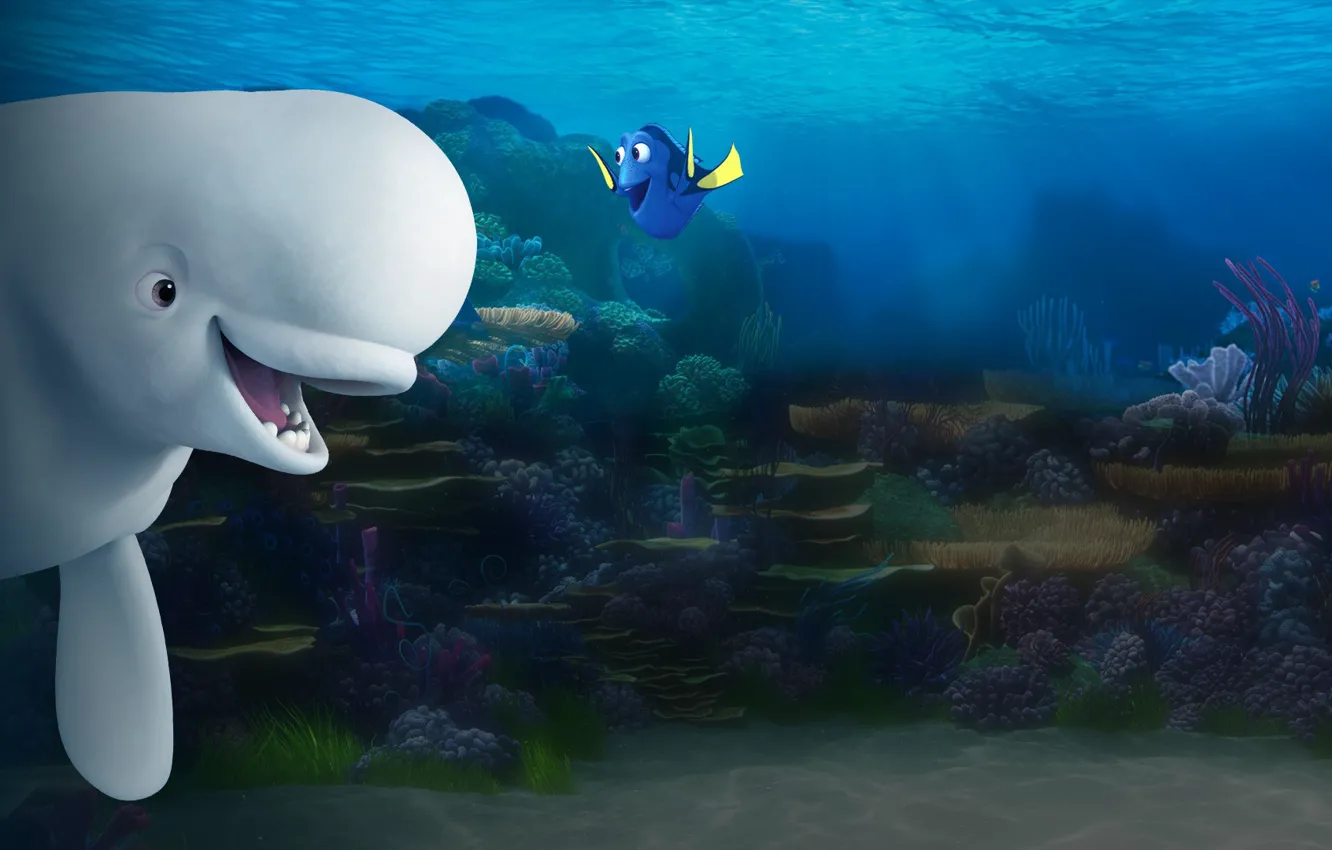
Everyone remembers the "world's most powerful pair of glasses." That’s how Bailey, the beluga whale Finding Dory introduced to the world, described his biological sonar. It’s a catchy line. It makes for a great cinematic moment when a neurotic whale finally finds his confidence to save a blue tang and a clownfish from a fish-stick truck. But if you're looking at the actual science behind that bulbous forehead, the reality is way weirder than a Disney script.
Pixar’s 2016 sequel took us to the Marine Life Institute. It gave us Hank the septopus and Destiny the nearsighted whale shark. But Bailey? He was the neurotic heart of the film. Voiced by Ty Burrell, he’s a beluga who thinks his echolocation is broken because of a "head injury." Honestly, it’s a relatable character arc. Who hasn't felt like their brain wasn't firing on all cylinders? However, when you peel back the animation, you find a mix of marine biology and creative license that confuses as much as it entertains.
The "Oooooh" Factor: What is a Beluga’s Melon Anyway?
In the movie, Bailey’s "melon"—that squishy bump on his head—is the source of his struggle. He thinks it’s defective. In real life, that organ is basically a giant acoustic lens. It’s made of fatty tissue (lipids). Unlike humans, who have rigid skulls, a beluga can actually change the shape of its melon by blowing air through its sinuses. This allows them to focus sound waves like a flashlight beam.
When you see Bailey straining in the film and the animators show those yellow "sound rings" coming out of his head, they’re actually visualizing something invisible and incredible. Real belugas use this to navigate the murky, ice-choked waters of the Arctic. They aren't just looking for fish; they’re mapping a three-dimensional world where light often can't reach. It's sophisticated. It’s complex. And no, a "head injury" wouldn't just make it stop working like a cracked iPhone screen—it would be a catastrophic health issue for a wild whale.
Pixar’s Creative License vs. Marine Reality
Let's get into the weeds.
The movie suggests Bailey can "see" all the way across California into the pipes of the highway system. That’s a bit of a stretch. Okay, it’s a massive stretch. Echolocation is powerful, but it’s not X-ray vision that spans miles of dry land and concrete. Sound travels about 4.5 times faster in water than in air. Once that sound hit the glass of his tank or the air above the surface, the signal would bounce back or dissipate. The idea that he could track a truck on a highway is pure movie magic.
Also, the sound effect they used? That rhythmic zip-zip-zip? That’s actually pretty close to the "clicks" belugas make. They can produce up to 1,000 clicks per second when they’re closing in on a target. It’s called a "terminal buzz." If you’ve ever heard a recording of a real beluga, they’re called the "canaries of the sea" for a reason. They whistle, chirp, grunt, and scream. Bailey’s voice in the movie is deep and bumbling, but real belugas are high-pitched chatterboxes.
Why Bailey the Beluga Whale in Finding Dory Still Matters
Despite the scientific leaps, the character did something important for conservation. He highlighted the intelligence of cetaceans. Before the movie, most kids knew what a killer whale was (thanks, Free Willy), but the beluga was just "that white whale."
Bailey’s relationship with Destiny the whale shark actually mirrors some real-world ecosystem overlaps. While they wouldn't hang out in a rehabilitation center together in the wild, both species are heavily impacted by noise pollution. In the film, Bailey struggles with his internal "noise." In the real ocean, belugas in the St. Lawrence River or the Cook Inlet are struggling with actual noise from shipping and construction. This interferes with their ability to hunt and communicate. It’s a sad irony. The movie portrays a whale who can’t hear the world; in reality, we’re making the world too loud for them to hear anything at all.
Common Misconceptions Born from the Big Screen
People often ask if belugas are really that "squishy."
Yes.
If you’ve seen those viral videos of people gently pressing a beluga’s forehead (which you should never do to a wild animal, by the way), the melon moves like a bag of jelly. This isn't because they have soft brains. The brain is safely tucked behind a thick, heavy skull. The squishiness is just that fatty lens mentioned earlier.
Another big myth? That they can "talk" to other species like whale sharks. While cetaceans are social, their "language" is highly specific to their pods. A beluga talking to a whale shark—a fish that doesn't even use sound to navigate—is like you trying to explain the internet to a houseplant. They live in different sensory worlds.
How to Support Real-Life Baileys
If the beluga whale Finding Dory made you fall in love with these animals, the next step isn't just rewatching the movie. It’s looking at where they actually live. The Arctic is changing. Fast.
- Reduce Noise Pollution Awareness: Support organizations like the Ocean Conservancy that lobby for "quiet zones" in critical whale habitats. Shipping lanes can be moved. Speed limits can be enforced.
- Climate Action: Belugas rely on sea ice. It’s their cover from predators like Orcas. Less ice means more vulnerability. Small lifestyle changes that reduce your carbon footprint actually help maintain the thermal stability of the Arctic.
- Sustainable Seafood: Many beluga populations are threatened by the depletion of their prey. Look for the MSC (Marine Stewardship Council) blue label when you’re buying fish. It ensures that you aren't literally taking the food out of a beluga's mouth.
- Visit Responsible Sanctuaries: If you want to see a beluga, skip the circuses. Look for accredited facilities that focus on rescue, rehabilitation, and education rather than just performance. The Sea Life Trust Beluga Whale Sanctuary in Iceland is a prime example of moving captive whales to more natural open-water environments.
Bailey eventually learned to trust his "glasses." For us, the "glasses" are the data and the science we have about the ocean. We have to use them to see the problems we've created and fix them before the "canaries of the sea" go silent.
Take a moment to check out the NOAA Fisheries species directory for the most up-to-date population counts on Alaska’s belugas. Knowledge is the first step toward actual protection. Transition from being a fan of a cartoon whale to being a steward of a real one. It’s a lot more rewarding than just buying the plush toy.
Actionable Next Steps for Enthusiasts
- Download a "Whale Tracking" App: Use apps like Whale Alert to see where sightings are happening and learn about seasonal migrations.
- Check the Red List: Visit the IUCN Red List website to see the specific status of the various beluga sub-populations; some are "Least Concern," but others are "Critically Endangered."
- Support the Whale Sanctuary Project: Follow their progress as they work to create North America's first seaside sanctuary for whales being retired from entertainment parks.