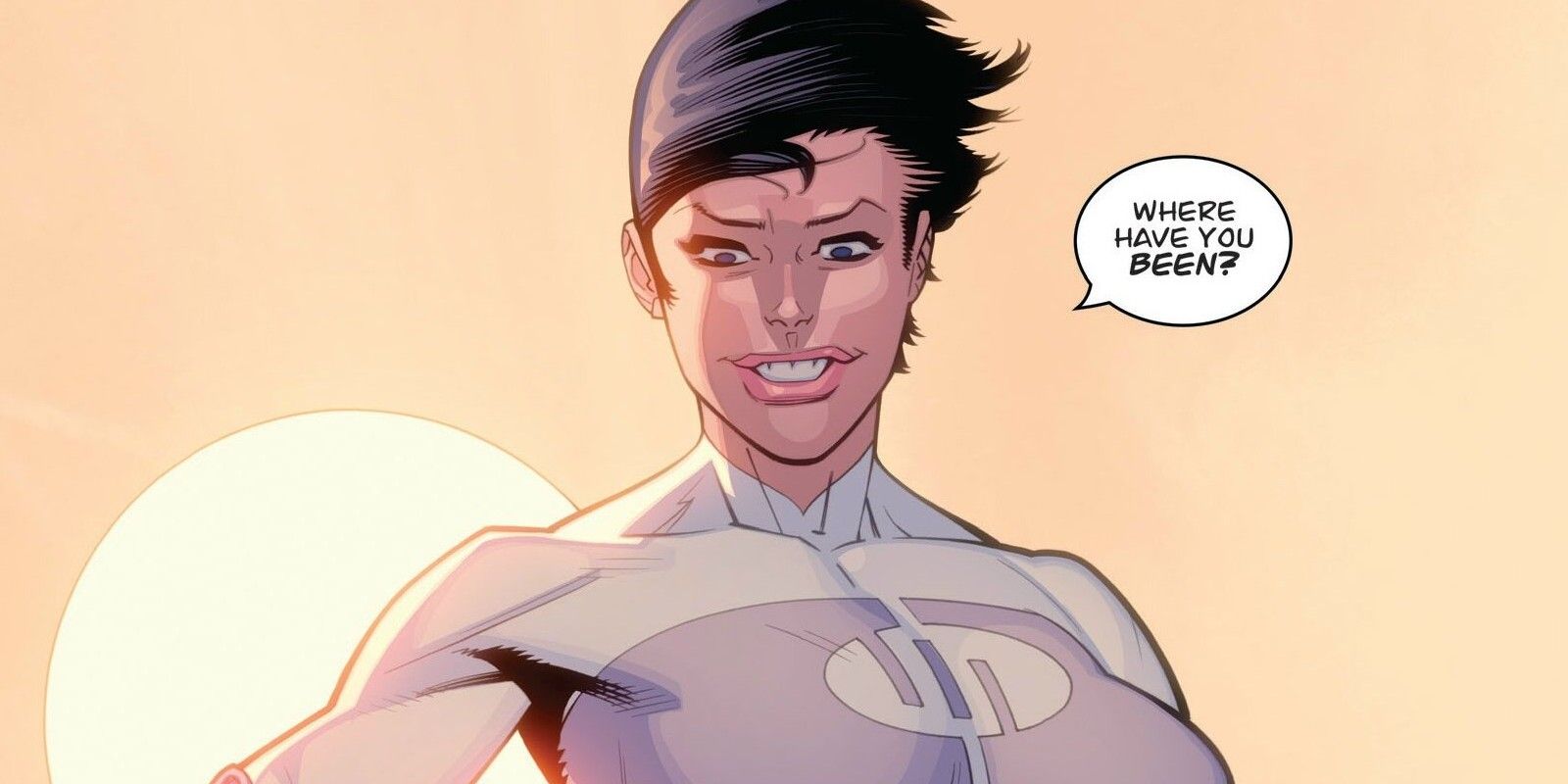
If you’ve read Invincible, you know it isn’t your typical Saturday morning cartoon. It’s messy. It’s violent. But there is one specific moment that stands completely alone in its ability to make a reader’s stomach drop. I'm talking about the Anissa and Mark comic scene from Issue #110. Honestly, calling it a "scene" feels like an understatement. It was a cultural landmine that exploded the moment it hit the shelves in 2014, and years later, the shockwaves haven't really settled.
Most superhero stories use violence to show how tough a hero is. This was different. This wasn't a fight Mark Grayson could win with a punch or a headbutt. It was a fundamental violation that stripped away his agency and left him—the guy who literally saved the world—shaking and crying in a field.
What Actually Happens in Issue #110?
The context matters here because Robert Kirkman, the creator, didn't just throw this in for a "gotcha" moment. Mark had just returned to Earth after being trapped in another dimension for six months. He comes home expecting open arms, but instead, he finds his life in shambles. Eve has moved on. She’s pregnant, depressed, and basically tells him it's over. Mark is at his absolute lowest emotional point. He is raw. He is vulnerable.
Then Anissa shows up.
She doesn’t care about his bad day. As a Viltrumite, she’s under orders to procreate and rebuild the species. But Anissa has a "standards" problem; she finds humans disgusting. To her, mating with a human is like a person mating with a pet. So, she sets her sights on Mark because he’s the only other Viltrumite around who isn't her direct superior.
The Anissa and Mark comic scene starts with a rejection. Mark says no. He says it repeatedly. But Anissa doesn't speak "no." She sees resistance as a challenge, a Viltrumite tradition of sorts. What follows is a brutal, one-sided physical struggle. Despite Mark's strength, his mental state is so fractured that he can’t effectively fight back. She overpowers him, pins him down in a remote field, and forces herself on him.
The imagery by artist Ryan Ottley is intentionally haunting. You see the sheer terror in Mark’s eyes. It’s not the look of a hero losing a fight; it’s the look of a person experiencing a soul-crushing trauma. When it’s over, Anissa simply tells him to "man up" and flies away, leaving him naked and broken.
Why the Power Scaling Conversation is the Wrong One
A lot of fans online get into these heated debates about power levels. "How could Anissa beat Mark if he beat Conquest?" That’s the wrong question. Honestly, it misses the entire point of the narrative.
Sexual assault isn't about who can bench press more. It’s about power, timing, and psychological breakdown. Mark wasn't just fighting a Viltrumite; he was fighting the exhaustion of his entire life falling apart. When your mind shuts down, your body follows.
The Long-Term Fallout: Marky and the Consequences
The story didn't just end there. That’s perhaps the most controversial part. A few issues later, we find out that the assault resulted in a pregnancy. This led to the birth of Markus Murphy (Marky).
How the characters handled it:
- Mark: He struggled with intense PTSD. He couldn't handle being touched for a long time. He felt a deep sense of shame, which is a tragically realistic portrayal of male survivors of assault.
- Eve: When she eventually found out, her reaction was a mix of horror and protective rage. She and Nolan (Omni-Man) actually threatened to kill Anissa if she ever went near Mark again.
- Anissa: This is where fans get divided. Anissa eventually undergoes a "redemption" of sorts. She falls in love with a human, becomes a mother, and even saves Eve’s life later on.
Some readers find this redemption arc insulting. They argue that a rapist doesn't deserve a "happily ever after" or a heroic death. Others argue that it shows the complexity of Viltrumite culture—that they are alien monsters who have to learn how to be human, and that process is ugly and imperfect.
Why This Scene Still Matters in 2026
We are currently in an era where the Invincible animated series is reaching these pivotal comic milestones. The show has already introduced Anissa, played brilliantly (and terrifyingly) by Shantel VanSanten.
The question everyone is asking is: Will they show it?
The Anissa and Mark comic scene was groundbreaking because it addressed female-on-male sexual assault in a medium that usually treats it as a joke or ignores it entirely. By making the victim the strongest man on Earth, Kirkman forced the audience to realize that vulnerability isn't about physical weakness.
If the showrunners choose to adapt this, they have a massive responsibility. In the comics, the aftermath was sometimes rushed. Marky's existence became a plot point, but the deep psychological scars on Mark were often sidelined for the next big intergalactic war. The TV series has the chance to sit with that trauma longer, to show the messy, non-linear path of healing.
Critical Takeaways for Fans
If you're revisiting this arc or preparing for its potential TV adaptation, keep these things in mind:
- It isn't "fanservice." It is meant to be repulsive. If you feel sick reading it, the creators did their job.
- The "Viltrumite Way" isn't an excuse. While the comics explain that Viltrumites view procreation as a duty, the narrative clearly frames Anissa’s actions as a crime, even by her own species' evolving standards.
- Mark’s reaction is valid. The "why didn't he just fight harder" argument is a common myth used to discredit survivors. The comic explicitly shows that his lack of resistance was a result of psychological shock.
The legacy of the Anissa and Mark comic scene is one of discomfort. It’s a reminder that even "invincible" heroes have breaking points that have nothing to do with physical damage.
Next Steps for Readers:
To better understand the ripple effects of this moment, you should read Invincible Issue #111 through #115. These issues focus heavily on Mark's immediate psychological state and his attempt to reconcile with Eve. Additionally, look into the character of Marky in the later "Five Years Later" arc to see how the series handles the complicated relationship between a father and the son born from his assault.