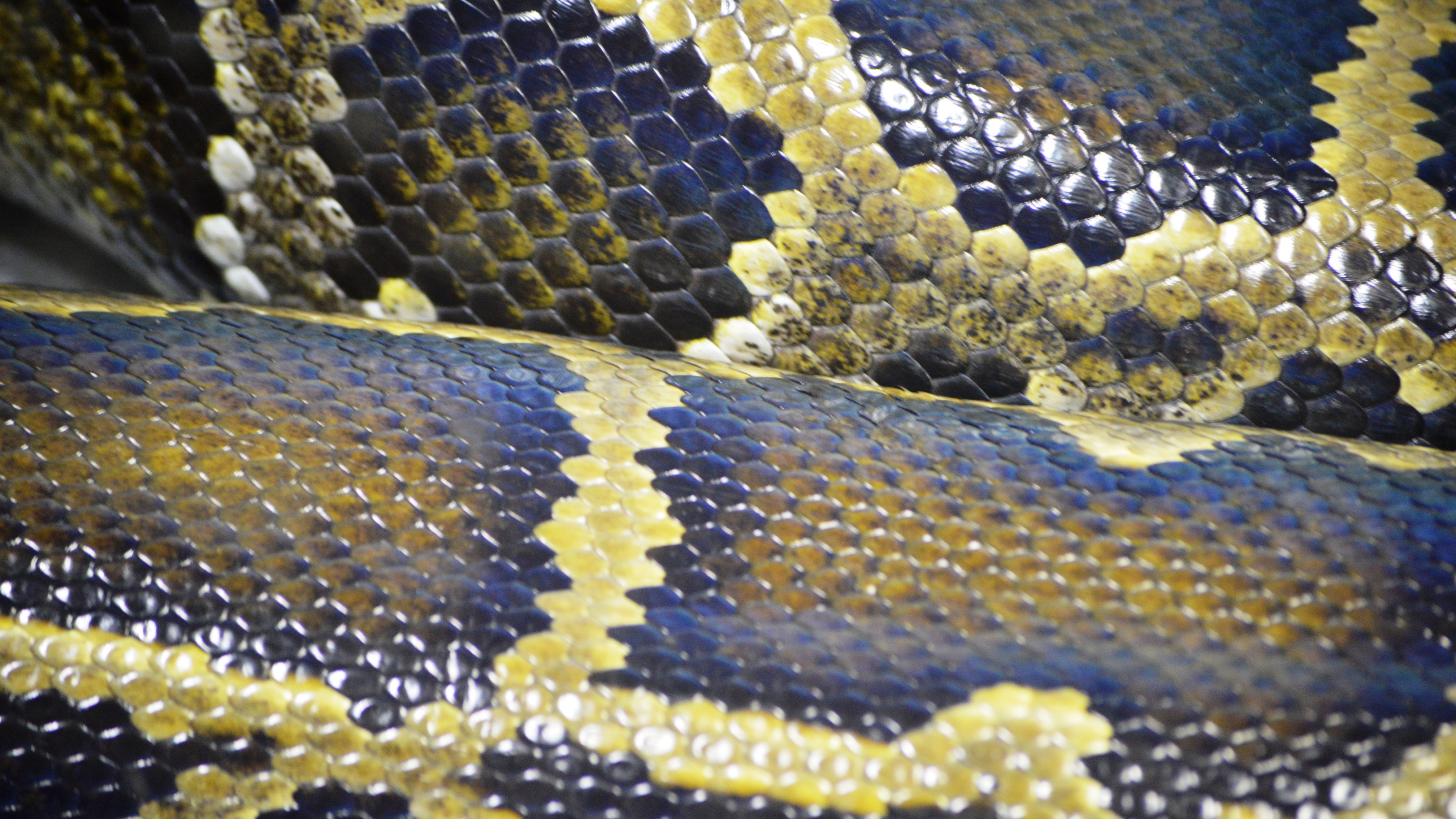
Cryptozoology is weird. Most people hear "giant snake" and immediately think of a low-budget horror flick or some grainy, fake footage from the depths of the Amazon. But the 50 foot Congo snake isn't just a campfire story. It’s a specific, documented sighting that has haunted herpetologists and aviation buffs for over sixty years. Honestly, the story is pretty chilling when you look at who actually told it. We aren't talking about a random tourist with too much tequila in their system; we’re talking about Colonel Remy Van Lierde.
He was a hero. During World War II, Van Lierde was a Belgian fighter ace who took down plenty of German aircraft. By 1959, he was a high-ranking officer in the Belgian Air Force, serving at the Kamina airbase in what was then the Belgian Congo. This wasn't a man prone to flights of fancy or hallucinations.
The Day the Jungle Looked Back
Imagine flying a helicopter over the Katanga region. It's hot, the air is thick, and the canopy below is a solid wall of green. Van Lierde was on a routine flight when he spotted something that simply shouldn't have been there. It was a snake. But not a normal snake. This thing was massive, sunning itself on a clear patch of earth near the trees.
He didn't just see it and fly away. He circled back.
He actually lowered the helicopter to get a better look, hovering maybe 30 or 40 feet above the ground. That’s when things got intense. According to his later accounts, the snake reared up. It didn't slither away like most reptiles do when a giant, noisy metal bird approaches. It stood its ground. It rose about 10 feet into the air, looking like it wanted to take a bite out of the chopper. Van Lierde described the underside as being a grayish-white, with a brownish-green back and a head that looked roughly the size of a horse's head, or at least a very large dog.
He took photos. That’s the detail that keeps this mystery alive.
One of those photos eventually made it into the public eye. It shows a long, dark shape winding through the brush. Critics always point out that without a clear scale, it’s impossible to prove the size. But Van Lierde, an experienced pilot trained in aerial reconnaissance and distance estimation, was adamant. He estimated the length at approximately 50 feet. For context, the largest snake ever officially measured was a Reticulated Python that topped out at around 25 feet. We are talking about double the size of the world record.
Why the Math Doesn't Quite Work (and Why It Might)
Science is usually a party pooper. If you talk to a biologist about a 50 foot Congo snake, they’ll bring up the square-cube law. Basically, as an animal gets longer, it gets exponentially heavier. A snake that long would weigh several tons. Could a cold-blooded animal even move that much mass in the Congo heat without cooking its own organs? Probably not.
But then there’s the Titanoboa.
About 60 million years ago, a snake called Titanoboa cerrejonensis actually existed. We have the fossils to prove it. It reached lengths of 40 to 50 feet and weighed as much as a small car. The catch? It lived in a much hotter climate than we have today. The tropical regions of the Paleocene were steaming, which allowed such a massive ectotherm to maintain its metabolism.
Could a relict population of something similar survive in the Congo? The Congo Basin is the second-largest rainforest on Earth. It is 1.5 million square miles of swamp, dense jungle, and unexplored terrain. We are still finding new species of monkeys and large mammals there—the Lesula monkey was only "discovered" by science in 2007. If we missed a whole species of primate, is it that crazy to think a massive, ambush-predator snake could be hiding in the swamps?
Maybe.
Honestly, the biggest strike against the 50-foot claim is the food source. A snake that size needs a lot of calories. It would be eating crocodiles, hippos, or large forest elephants. While the Congo has those, a predator that large would likely leave a very messy, very visible trail.
Breaking Down the Van Lierde Photo
The photo itself is the "smoking gun," but it’s a bit of a Rorschach test. If you look at it and believe Van Lierde was at the altitude he claimed, the snake is terrifyingly large. If you think he was much higher, the snake is just a regular-sized python that looks big because of the perspective.
There are three main theories that skeptics use to debunk the 50 foot Congo snake:
- Perspective Distortion: The pilot was higher than he thought, and the "snake" is a standard 15-foot African Rock Python.
- The Termite Mound Theory: Some argue the "snake" is actually a specific formation of earth or fallen trees, and the movement was an illusion caused by the helicopter's vibration.
- The "New Species" Hypothesis: This is the middle ground. Perhaps it wasn't 50 feet, but maybe 30 feet? That would still be a world record and signify a subspecies or species unknown to Western science.
The African Rock Python (Python sebae) is the most likely candidate for a "misidentification." They are aggressive. They are huge. They have been known to eat antelope and, in rare cases, humans. But they don't reach 50 feet. Even the most generous estimates for a Rock Python max out at 20-23 feet.
What This Means for Modern Explorers
The 50 foot Congo snake represents the "Great Unknown" of our planet. We like to think we've mapped everything with satellites and drones, but the canopy hides secrets. If you’re interested in the reality of giant snakes, you don't have to rely on 1950s photos.
You can look at the ongoing research in the Everglades, where invasive pythons are reaching massive sizes, or follow the work of herpetologists like Dr. Brady Barr, who has spent years tracking the world's largest reptiles. They haven't found a 50-footer yet, but they find 18-to-20-footers more often than you'd think.
The Congo remains one of the most difficult places on Earth to conduct biological surveys. Political instability, dense terrain, and the sheer cost of expeditions mean that many mysteries stay mysteries. Van Lierde took his story to the grave, never recanting what he saw. He had no reason to lie. He didn't sell the story for millions; he just reported what he saw from his cockpit.
If you want to dig deeper into this, your next steps shouldn't be looking for "monster" videos on TikTok. Instead, look into the fossil records of the Titanoboa to understand the biological limits of reptiles. Study the African Rock Python's habitat and behavior. Or, better yet, read the original interview transcripts from Van Lierde’s appearance on the British show "Arthur C. Clarke's Mysterious World." It provides a much more sober, military-style account of the event than the sensationalized versions you find on paranormal blogs.
The truth is likely somewhere in the middle: a very real, very large animal, seen by a credible witness, in a part of the world that still knows how to keep a secret.
How to Evaluate "Giant" Sightings
- Check the Witness: Military pilots and professional guides are generally better at estimating size than casual observers.
- Look for Scale: Without a tree, a vehicle, or a person in the frame, a photo of a snake is just a photo of a snake.
- Consider the Ecosystem: Does the area have enough large prey to support a massive predator? In the Congo, the answer is a definitive yes.
- Biological Constraints: Remember that heat is the limiting factor for snake size. A 50-foot snake in a cold climate is impossible; in a tropical swamp, it's just highly improbable.
The story of the 50 foot Congo snake isn't just about a monster. It’s about the fact that even in the modern age, there are places where the map still says "Here be dragons," and sometimes, a colonel in a helicopter sees one.
Next Steps for Research:
- Research the Katanga region's specific biodiversity to see what large prey animals live there.
- Locate the high-resolution scans of the 1959 Van Lierde photograph to examine the surrounding foliage for scale.
- Study the Square-Cube Law in biology to understand why 50 feet is considered the "hard limit" for terrestrial snakes.