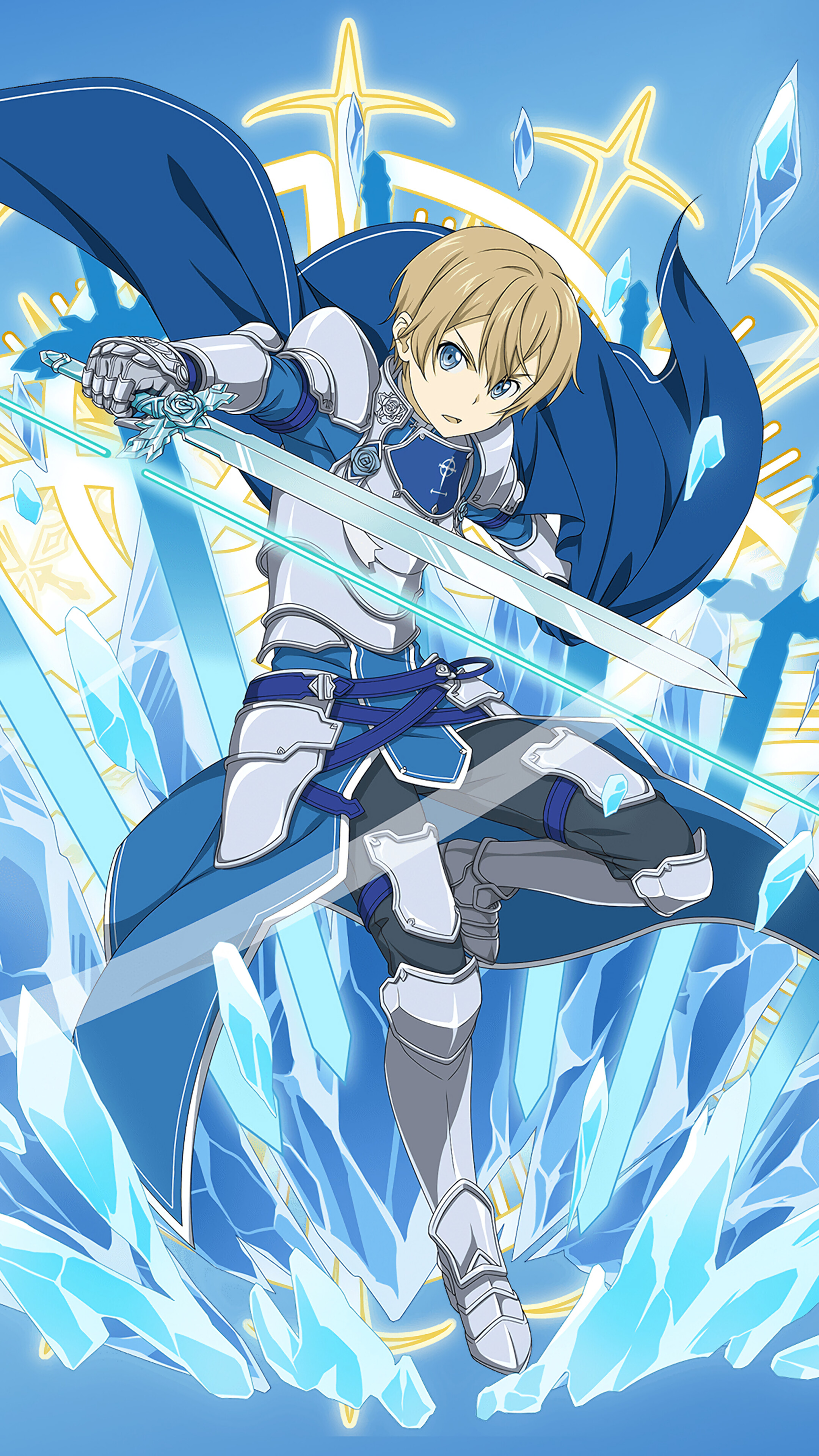
Honestly, if you ask any long-time fan of the series when Sword Art Online finally "grew up," they won’t point to the floor-clearing days of Aincrad or the fairy-flight of Alfheim. They’ll point to a blonde-haired boy swinging a heavy axe against a tree that wouldn't fall. Sword Art Online Eugeo isn't just a sidekick. He’s the emotional backbone of the Alicization arc, a character so deeply human that he managed to make Kirito—a protagonist often criticized for being too perfect—actually feel like a real person again.
It’s weird.
Most anime companions are there to fill a gap in the combat roster or provide comic relief. Eugeo was different. He was the first character who didn't just look up to Kirito; he grew alongside him, and in many ways, surpassed him in raw, emotional stakes. When we first meet him in the Underworld, he's basically a prisoner of his own destiny, bound by a "Calling" to chop down the Gigas Cedar. It’s slow. It’s grueling. It’s a metaphor for the entire rigid society of the Human Empire.
The Problem With Being an Artificial Fluctlight
We have to talk about what Eugeo actually is. He isn’t a player. He isn't a "bot" in the traditional sense either. Within the lore of Project Alicization, Eugeo is an Artificial Fluctlight—a soul grown from the template of a human infant but nurtured within a digital simulation. Reki Kawahara, the creator of SAO, really leaned into the philosophical horror of this. Is Eugeo real?
If you feel pain, if you love, and if you can break a law because your heart tells you it's the right thing to do, does the "digital" label even matter?
For most of the early episodes of the Alicization anime and the corresponding light novels, Eugeo is defined by his obedience. He follows the Taboo Index. He’s a "good boy." But the catalyst for everything—the reason the Sword Art Online Eugeo arc hits so hard—is the loss of Alice Zuberg. When the Integrity Knight Integrity Synthesis Thirty (who we know is Alice) takes her away, Eugeo is paralyzed by fear. He doesn't fight. He watches. That guilt drives every single decision he makes for the next six years of his life.
It's a heavy burden for a kid.
Why the Blue Rose Sword Matters
You’ve probably seen the merchandise. The Blue Rose Sword is iconic. But the backstory is actually kind of tragic and beautiful. It was found in the Mountain Range at the Edge, encased in ice that never melted. Eugeo didn't just find a cool weapon; he found a symbol of his own frozen potential.
The sword requires a "Life" or "Object Authority" level that Eugeo simply didn't have at the start. While Kirito brought his knowledge of "Skill Connect" and dual-wielding from the real world, Eugeo had to earn his power through the Aincrad Style—a curriculum Kirito taught him. This dynamic is what makes their brotherhood so peak. For the first time, Kirito is a mentor, not just a carry.
There's this specific moment during the fight against Quinella (Administrator) where the Blue Rose Sword’s "Release Recollection" is used. It’s not just an ice attack. It’s the manifestation of Eugeo’s desire to protect, to freeze time, and to keep the people he loves from being taken away again. It’s fundamentally different from Kirito’s "Night Sky Sword," which absorbs and reflects. Eugeo’s power is about endurance.
The Controversy of the Integrity Knight Transformation
Some fans really hated the "Eugeo Synthesis Thirty-Two" twist. I get it. Seeing our boy get brainwashed by Quinella felt like a cheap way to force a protagonist vs. best friend fight. But if you look closer at the subtext, it makes total sense.
Quinella didn't use brute force to turn him. She used his deepest insecurity: the feeling that he was never truly loved. She manipulated his memories, making him believe his parents and even Alice didn't care for him. It’s a brutal look at how trauma can be weaponized. When Eugeo becomes an Integrity Knight, he isn't a villain. He’s a broken person seeking a "love" that doesn't demand anything from him.
The battle between Kirito and Eugeo in the Central Cathedral is one of the high points of the entire franchise. It wasn't about who had the higher level. It was a clash of philosophies. Kirito represented the harsh reality of the outside world, while "Knight Eugeo" represented the seductive, painless lie of the Administrator's rule.
Addressing the Fate of Eugeo
Let's be real: the ending of the first half of Alicization is a tear-jerker. Eugeo’s death wasn't just "sad." It was a structural necessity for Kirito’s character development. When Eugeo merges with the Blue Rose Sword to become the "Blood-Red Sword" to strike down the Sword Golem, he's fulfilling a sacrifice that echoes the very beginning of the series.
But it left a massive hole.
The aftermath, where Kirito enters a catatonic state (the "Wheelchair Kirito" phase), happens because he literally cannot process the loss of his "soul brother." He lost Sachi in Aincrad, sure. But Eugeo was his equal. Losing Eugeo was like losing a part of his own identity.
There are plenty of "What If" scenarios in the SAO video games, like Lycoris or Last Recollection, where Eugeo survives. They’re fun. They give us that "happy ending" we crave. But they lack the weight of the canon story. In the canon, Eugeo’s death is the catalyst that allows Alice Synthesis Thirty to find her own humanity. He paved the way.
Common Misconceptions About Eugeo’s Power
People often debate if Eugeo could have beaten Kirito in a fair fight.
Honestly? No.
Kirito has years of muscle memory from death games. But Eugeo had something Kirito didn't: Incarnation. In the Underworld, your "Incarnation" (the power of your will) can rewrite the laws of the world. Eugeo’s Incarnation was occasionally more potent than Kirito’s because it was fueled by a singular, unshakeable goal. While Kirito was often distracted by the bigger picture of Rath and the real world, Eugeo was laser-focused on Alice. That focus allowed him to pull off feats—like the final strike against Quinella—that even Kirito couldn't manage alone.
Real-World Impact and Fan Reception
Since the Alicization arc aired, Sword Art Online Eugeo has consistently ranked high in character polls, often rivaling Asuna for the number two spot. Why? Because he’s relatable.
We aren't all "Black Swordsmen" who can solo bosses. Most of us are more like Eugeo. We’re stuck in a routine, doing a job we didn't choose, feeling like we missed our chance to save someone. Seeing him break those chains is cathartic.
If you're looking to dive deeper into his character, I highly recommend reading the Unital Ring arc in the light novels. While he’s gone, his influence is everywhere. The "Eugeo-shaped hole" in the narrative is a constant theme. Even the way Kirito fights in the later volumes is a tribute to the Aincrad Style they refined together.
How to Appreciate the Character More
If you want the full experience, don't just watch the anime. The anime cuts a lot of the internal monologue. In the light novels, you get to see Eugeo's inner struggle with the Taboo Index—the literal physical pain he feels when he tries to think outside the rules. It makes his eventual rebellion much more impactful.
- Watch the "War of Underworld" flashbacks: They provide extra context on his childhood that wasn't in the first cour.
- Listen to the Character Songs: Nobunaga Shimazaki, Eugeo's voice actor, puts an incredible amount of emotion into the tracks, particularly "Blazing Bullet."
- Check out the SAO Progressive link: There are subtle nods to how the "concept" of a partner evolved in Reki Kawahara's mind, moving from Asuna to Eugeo and back.
The legacy of Eugeo is one of friendship over mechanics. In a world made of code, he was the most "organic" thing about it. He proved that even if you were "made" in a lab, your choices are what define your soul. Stay cool, Eugeo.
To truly understand the impact Eugeo had on the series, you should look into the "Incarnate System" mechanics within the Light Novels (specifically Volumes 9 through 14). Understanding how willpower functions in the Underworld explains why Eugeo was able to perform miracles that defied his internal "System Command" level. Also, pay close attention to the visual cues in the anime—the way the Blue Rose Sword chips and cracks mirrors Eugeo's own mental state throughout the journey.