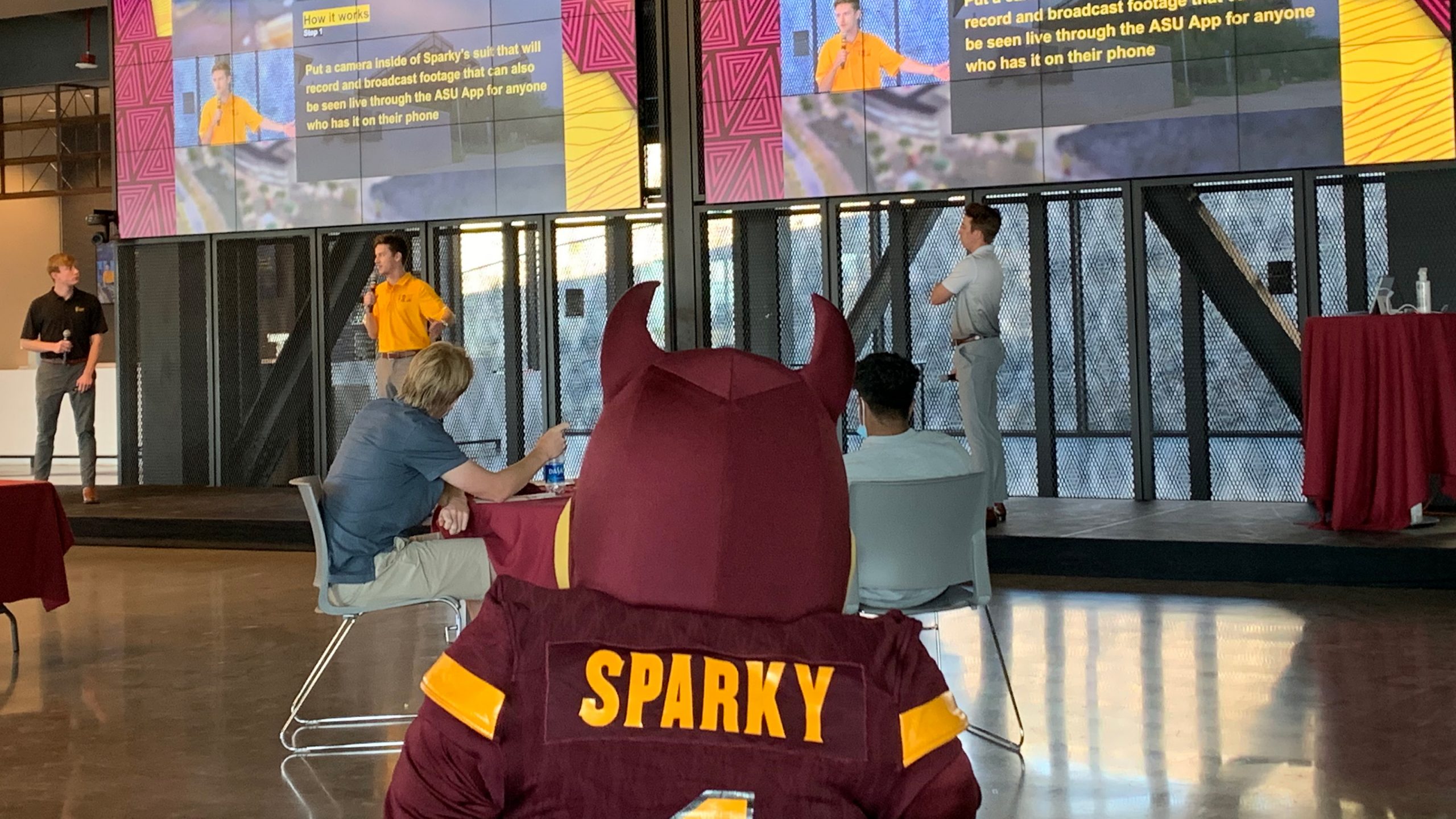
If you’ve ever walked across the Tempe campus on a Saturday in September, you’ve felt it. That oppressive, bone-dry Arizona heat that makes the pavement shimmer. It’s the kind of weather that makes you think of fire and brimstone. So, when people ask what is ASU mascot, the answer—a grinning, pitchfork-wielding imp named Sparky—actually makes a weird amount of sense.
He’s a Sun Devil.
But Sparky isn't just some random doodle a student mocked up in the 40s. He’s got a Hollywood pedigree that most college brands would kill for. He’s cheeky. He’s a bit mischievous. And honestly, he’s one of the most recognizable figures in the Pac-12 (or whatever the conference landscape looks like by the time you read this).
The Weird History of How ASU Got a Mascot
Arizona State wasn't always the home of the Sun Devils. Back in the day, when the school was still the Tempe Normal School, they were known as the Owls. Then they became the Bulldogs. Can you imagine? Just another Bulldog in a sea of collegiate Bulldogs. It was boring. It lacked the specific "desert-is-trying-to-kill-you" energy that defines Phoenix.
In 1946, the student body decided they’d had enough of being the Bulldogs. They voted to change the name to the Sun Devils.
Now, here’s where it gets interesting. The "Sun Devil" isn't a religious thing, despite what some might assume when they see the horns. It’s a reference to a dust devil—those spinning columns of sand and heat that whip across the Arizona basin. It’s a meteorological phenomenon with a spicy name.
Enter the Disney Connection
You can't talk about what is ASU mascot without talking about Walt Disney. Well, specifically, a guy named Berk Anthony. Anthony was a former Disney illustrator, and he’s the one who gave Sparky his face.
Legend has it—and historians like those at the ASU Heritage Center back this up—that Sparky was modeled after Walt Disney himself. If you look at the original sketches from the late 1940s, the resemblance is kinda uncanny. The arched eyebrows, the specific trim of the mustache, the mischievous glint in the eye. It’s all there. Sparky was officially born in 1946, and he’s been the face of the university ever since.
The Anatomy of a Sun Devil
Sparky is a vibe. He’s not a "tough guy" mascot in the traditional sense, like a snarling tiger or a stoic Spartan. He’s a trickster.
He wears a yellow jumpsuit (the "sun") and a red cape. He carries a "Pitchfork"—which has become the school’s primary hand gesture. If you see thousands of people in a stadium holding up their index, middle, and pinky fingers while tucking their thumb and ring finger, they aren't doing a weird version of the "rock on" sign. They’re "forking" the opponent.
He also has those distinctive pointed ears and a tail. But the most important part of Sparky isn't his costume; it’s his cardio.
The Push-Up Tradition
If you ever go to an ASU football game at Mountain America Stadium, watch Sparky after a touchdown. He doesn't just dance. He hits the deck.
For every point ASU scores, Sparky does that many push-ups. If the Sun Devils are having a high-scoring night and put up 50 points, Sparky is doing hundreds of push-ups by the fourth quarter. It’s a grueling tradition that requires the student inside the suit to be in peak physical condition. It’s not uncommon to see the cheer squad holding his legs or helping him count as he grinds out the reps in 100-degree heat.
The 2013 "New Sparky" Disaster
We have to talk about the time ASU tried to change Sparky. It was 2013, and the university partnered with Disney (full circle, right?) to modernize the mascot. They wanted something that looked more like a cartoon character for a kids' show on Disney XD.
The result? A bug-eyed, soft-featured version of Sparky that lacked the edge of the original.
The backlash was instant. And it was brutal.
Alumni hated it. Students hated it. The internet turned it into a meme within hours. People felt like the university was stripping away the history of the mascot for the sake of "marketability." It was a classic "if it ain't broke, don't fix it" situation.
ASU leadership listened. They didn't just pivot; they basically apologized. They held a vote, and the traditional Sparky won by a landslide. The "creepy" Sparky was banished to the shadow realm, and the classic, Disney-designed Sparky returned to the sidelines. It was a rare win for tradition in an era of constant corporate rebranding.
Why the Sun Devil Identity Matters
When people ask what is ASU mascot, they’re often trying to understand the culture of the school. Arizona State has spent decades fighting the "party school" reputation, and Sparky is part of that evolving identity. He represents a certain kind of desert resilience.
Think about the environment. Phoenix is a place that shouldn't exist, logically speaking. It’s a massive metropolis built in a place where water is scarce and the sun is relentless. Sparky embraces that. He isn't hiding from the heat; he's the personification of it.
The "Fear the Fork" Mentality
The mascot fuels the "Fear the Fork" marketing campaign, which has become a massive revenue generator for the school. It’s not just about sports anymore. You see the pitchfork on everything from research lab logos to graduation caps.
Sparky has also been ranked consistently as one of the best mascots in the country. In various polls by Sports Illustrated and ESPN over the years, he usually lands in the top ten. Why? Because he’s unique. He isn't a cat. He isn't a bird. He’s a specific, localized piece of folklore.
Behind the Mask: The Life of Sparky
The identity of the student playing Sparky is a closely guarded secret. It’s very "superhero secret identity" vibes. They don’t reveal who they are until graduation, often wearing the Sparky boots under their gown to tip off their friends and family.
Being Sparky is a full-time job. You’re at volleyball games, wrestling matches, community fundraisers, and local elementary schools. You have to learn the specific "Sparky walk"—a sort of confident, high-stepping strut. You can’t talk. You have to communicate entirely through exaggerated gestures and that permanent, frozen grin.
It’s exhausting work. The suit is heavy, and in the Arizona sun, the internal temperature can easily climb past 120 degrees. These students are elite athletes in their own right, even if they’re wearing a oversized head and a cape.
The Pitchfork Sign and Rivalries
You can't understand Sparky without understanding the rivalry with the University of Arizona's Wilbur and Wilma Wildcat. Down in Tucson, they have cats. Up in Tempe, we have a devil.
During the "Territorial Cup"—the oldest rivalry trophy in NCAA history—the tension is palpable. Sparky is often the focal point of the pre-game hype. If you ever see a photo of Sparky "slaying" a wildcat, you know it’s Duel in the Desert week.
The pitchfork sign itself—the "Fork 'em, Devils"—is the universal greeting for ASU fans. Whether you’re at an airport in Tokyo or a bar in New York, if you see someone in maroon and gold, you drop the pitchfork. It’s the shorthand for the entire Sparky mythos.
What Most People Get Wrong About Sparky
A common misconception is that Sparky is supposed to be "scary" or "evil." If you look at his face, he’s clearly having a great time. He’s a prankster. He’s more like a character from a Shakespearean comedy than a figure from a horror movie.
Another mistake? Calling him a "little devil" or just "the devil." He is a Sun Devil. That distinction matters because it ties him to the geography of the Salt River Valley.
Actionable Insights for Fans and Visitors
If you're heading to an ASU game or just want to appreciate the mascot properly, keep these things in mind:
- Don't call him a "mascot" to his face. He's Sparky. Period.
- Watch the push-ups. It is the most impressive physical feat in the stadium, especially during a blowout game.
- The Pitchfork is sacred. Learn the hand gesture correctly: index, middle, and pinky up. Thumb and ring finger down.
- Visit the statues. There’s a massive bronze Sparky at the south end of the stadium. It’s the go-to spot for photos, but be prepared to wait in line during homecoming.
- Check the gear. If you’re buying merchandise, look for the "Classic Sparky" logo. It’s the one with the most history and the one the fans fought to keep.
Sparky is more than just a guy in a suit. He’s a link to the school’s past, a product of Disney’s golden age of animation, and a symbol of a university that thrives in some of the harshest conditions on the planet. He’s a reminder that even when it’s 115 degrees outside, you can still have a sense of humor about it.
The next time you see that grinning face and those pointed horns, you’ll know exactly what you’re looking at. You're looking at a piece of Arizona history that refused to be rebranded.
Next Steps for the ASU Faithful
Check out the Arizona State University digital archives to see the original 1946 sketches by Berk Anthony. If you’re attending a game, make sure to arrive at the stadium early for the "Tiger Walk" (or the Sun Devil equivalent) to see Sparky lead the team off the bus. It’s the best way to see the costume up close and appreciate the detail that goes into maintaining the look of the desert’s most famous imp.