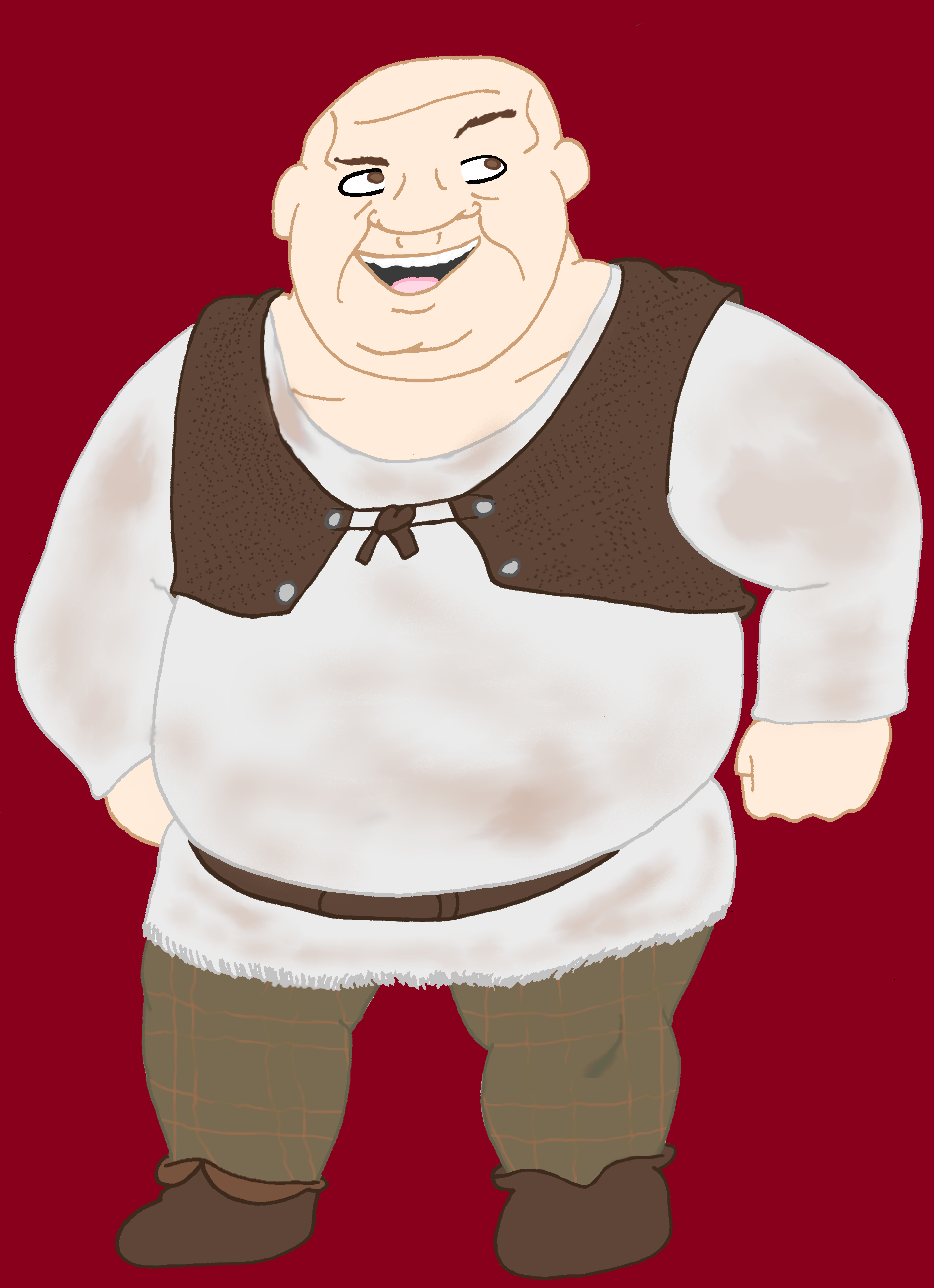
It was the ultimate "what if" moment. For exactly three minutes and forty-four seconds of screen time in 2004, the world saw Shrek as a human, and honestly, the internet has never quite recovered from it. When DreamWorks dropped Shrek 2, they weren't just making a sequel; they were pivoting the entire identity of their flagship character.
He wasn't an ogre. He was a guy. A tall, handsome, slightly generic-looking guy with a jawline that could cut glass and a thick head of chestnut hair. It was jarring.
People forget how much of a risk this was. Most animated sequels just recycle the same gags, but Shrek 2 went for the throat of the "happily ever after" trope by physically stripping the protagonist of his most defining feature. It wasn't just a visual gag. It was a deep, slightly uncomfortable exploration of insecurity. Shrek didn't drink that "Happily Ever After" potion because he wanted to be a model; he did it because he genuinely believed Fiona deserved a husband who didn't look like a walking thumb with green ears.
The Anatomy of the Transformation
Let’s look at the specifics. When Shrek wakes up in the barn after chugging the stolen potion from Fairy Godmother’s factory, the transformation is complete. Gone are the trumpet-shaped ears. Gone is the green skin.
He’s human.
The design team at DreamWorks, led by production designer Guillaume Aretos, had a massive challenge here. They had to make him handsome enough to fit the "Prince Charming" archetype while keeping him recognizable as the character we'd spent an entire movie getting to know. If you look closely at the human version, the nose is still a bit broad. The smile still has that slightly lopsided quality. It’s a masterclass in character design because it manages to be attractive without losing the "Shrek-ness" of the face.
Interestingly, Mike Myers’ voice performance shifts slightly here too. It’s subtle, but there’s a flicker of newfound confidence that quickly turns into awkwardness as he realizes he has no idea how to navigate the world as a "pretty" person.
Why the Design Worked
The human version of Shrek is often compared to a younger, more rugged version of the voice actor himself, or even a Renaissance-era nobleman. He’s broad-shouldered and imposing. The film leans into the absurdity of it—three peasant women find him in the barn and immediately start swooning. It’s the ultimate contrast to the first movie, where a simple "roar" would have sent them screaming for the hills.
The Potion Logic and the "Happily Ever After" Trap
The potion didn't just affect Shrek. The rules were clear: "to restored bliss, take a sip of this." It affected both the drinker and their true love. This is where the plot gets messy in the best way possible. While Shrek became a human, Fiona—who was already in human form at the time—stayed a human, but her curse was effectively "locked" until midnight.
What’s fascinating is how the film treats beauty as a curse of its own.
Being Shrek as a human didn't solve his problems. In fact, it made them worse. He spent the entire second act trying to reach Fiona, only to be gaslit by Fairy Godmother and Prince Charming. The movie argues that his human face was actually a mask. It was a disguise that allowed Prince Charming to swoop in and claim his identity. Without his ogre features, Shrek was just another face in the crowd, easily replaced by a blonde guy with better hair.
Fans Still Can’t Let Go
Check any corner of the internet today—TikTok, Reddit, Twitter—and you’ll see that the fascination with this brief transformation hasn't faded. There’s a specific brand of "Shrek-core" nostalgia that thrives on the human version of the character.
Why?
- The Uncanny Valley: He looks just human enough to be "real" but just stylized enough to remain a cartoon.
- Subverting Expectations: We’re conditioned to want the hero to stay "fixed" once they become handsome. Shrek 2 rejects that entirely.
- The Stallion: We can't talk about Shrek’s change without mentioning Donkey becoming a noble steed. The two transformations go hand-in-hand, representing a temporary abandonment of their true selves.
Some fans have spent years analyzing the physics of the transformation. If Shrek is roughly 7 or 8 feet tall as an ogre, his human form is likely well over 6'5". He’s a unit. The clothes he "borrows" from the carriage drivers barely fit his massive frame, which adds to the comedy. He’s literally a big man trying to fit into a small, superficial world.
The Cultural Impact of the Reveal
When you look at the box office numbers, Shrek 2 was a juggernaut, earning over $900 million. A huge part of that marketing was the mystery of the "new" Shrek. It was the "spoiler" everyone wanted to see.
But the real genius is the ending.
Most fairy tales end with the beast becoming the prince and staying that way. Think Beauty and the Beast. Disney’s 1991 classic ends with the Prince being restored to his human form, and frankly, a lot of kids were disappointed because the Beast was way more interesting. Shrek 2 does the opposite.
When the clock strikes midnight, Fiona has a choice. She can stay a beautiful human princess and live with her handsome human husband. Instead, she chooses the ogre. She chooses to go back to being green.
That choice validates everything about the franchise. Seeing Shrek as a human was necessary for the audience to realize that we didn't actually want him that way. We liked the swamp. We liked the onions. We liked the ogre.
Real-World Takeaways
There’s a psychological layer here that researchers often point to when discussing body image in media. The "Shrek as a human" arc is a textbook example of challenging the "What is beautiful is good" bias. Social psychologists like Dion, Berscheid, and Walster have long studied how we attribute positive traits to attractive people. By making Shrek "attractive" and then showing him at his most vulnerable and manipulated, the film actively deconstructs that bias.
It shows that "handsome" Shrek was actually less confident than "ogre" Shrek. He was out of his element. He was trying to be someone else to please a woman who already loved him for exactly who he was.
Misconceptions About the Transformation
People often get a few things wrong about this specific plot point:
- The Duration: Many remember him being human for half the movie. In reality, it’s a relatively short sequence in the grand scheme of the 92-minute runtime.
- The Voice: Some think the voice changed. It didn't. Mike Myers stayed in character, though the "growl" in his Scottish accent was slightly polished.
- The Clothes: He didn't magically grow clothes. He had to steal them from a carriage, which is a hilarious detail often overlooked.
Actionable Insights: Why This Matters for Storytellers
If you're a writer, a creator, or just someone interested in how pop culture works, the "Shrek as a human" trope offers some serious lessons.
Give the audience what they think they want, then show them why they’re wrong.
Audiences thought they wanted Shrek to have an easier life. By making him human, the writers showed that "easier" isn't "better."
Character beats are more important than visual upgrades.
The scene where Shrek looks in the mirror as a human isn't about him being happy; it’s about him being confused. Use visual changes to highlight internal conflict, not just to show off your animation budget.
Respect the "True Form."
If you have a character with a unique design, any departure from that design should be earned and temporary. The power of Shrek’s return to his ogre self is the climax of his emotional journey.
Next Steps for the Shrek Obsessed
If you want to dive deeper into the world of DreamWorks' character design, your next move should be looking at the original concept art for the human version. There are several iterations where he looked much more like Mike Myers, and others where he looked like a generic Ken doll. Seeing the middle ground they settled on gives you a huge appreciation for the art of 3D modeling.
You can also re-watch the "Changes" musical sequence—it’s a perfect distillation of the theme. David Bowie’s lyrics over Shrek’s literal physical change is one of the most cohesive uses of licensed music in cinema history.
Honestly, the human version of Shrek served its purpose. It was a mirror. It showed us that the "monster" was the human we liked all along, and the "handsome prince" was just a green guy in a very convincing suit. That's a lesson that still lands, twenty-plus years later.
To really appreciate the craft, look for the "Making of Shrek 2" featurettes. They specifically discuss the "Happily Ever After" potion's visual effects, which were cutting edge for 2004. Notice the way the light hits his skin—they had to develop new sub-surface scattering techniques just to make his human skin look translucent and "real" compared to the more matte, rubbery texture of his ogre skin.
The legacy of Shrek as a human isn't that he was handsome. It's that being handsome was the most boring thing he ever did.