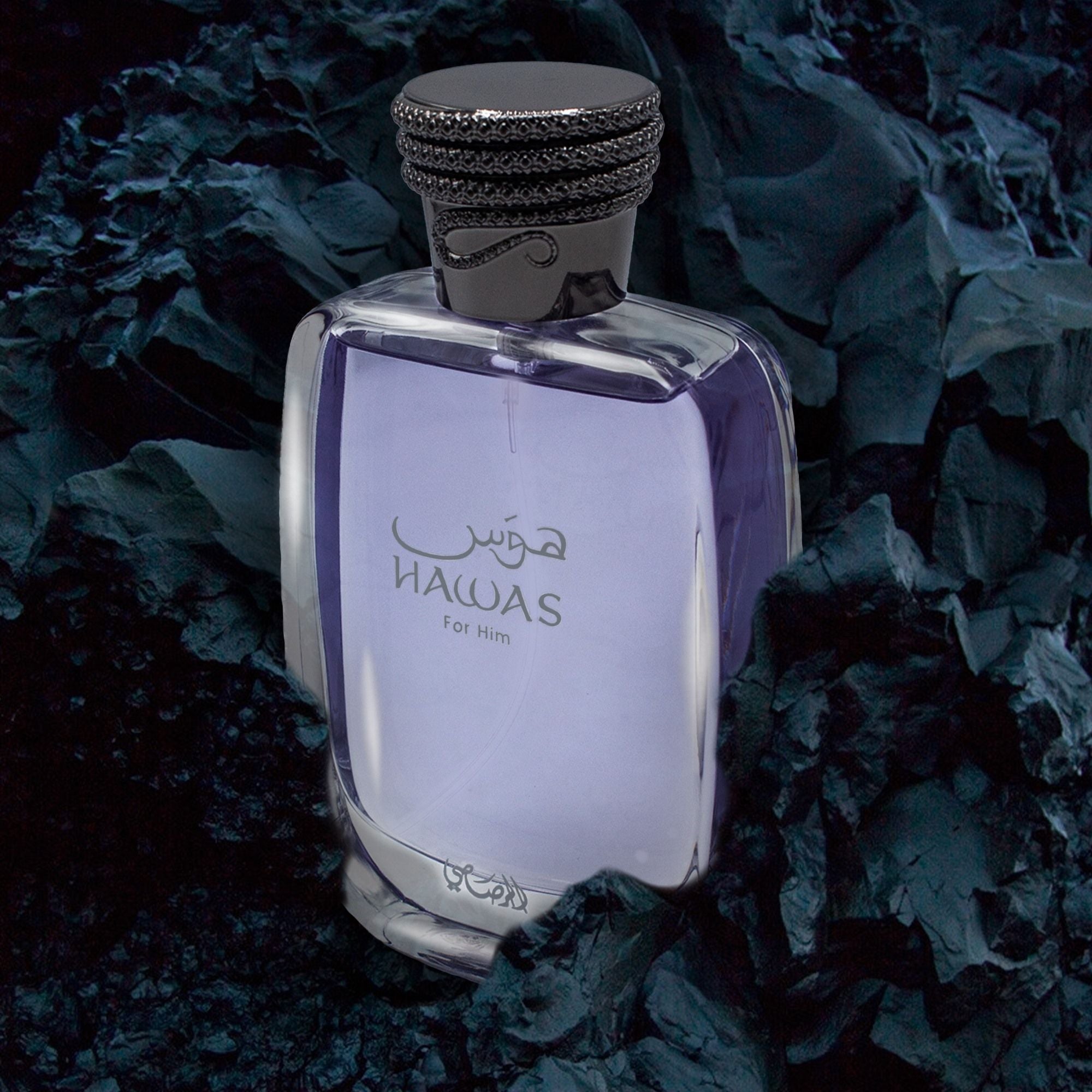
You’ve probably seen it. That distinct purple juice in a heavy glass bottle with a cap wrapped in a textured, snake-like motif. If you’ve spent more than five minutes on "Fragrance TikTok" or scrolled through r/fragrance, you know we’re talking about Rasasi Hawas. It is arguably one of the most discussed, hyped, and polarizing scents of the last decade. But here’s the thing: most people just call it an "Invictus clone" and move on. That is a massive oversimplification. Honestly, it’s kinda lazy.
Rasasi, a house based in Dubai, released Hawas for Him in 2015. At the time, the Middle Eastern perfume market was starting to flex its muscles globally, but nobody quite expected this specific bottle to become a permanent fixture in the "Top 10" lists of Western reviewers for nearly ten years straight. It’s not just a scent; it’s a phenomenon that changed how we look at "cheapies" and performance.
What Rasasi Hawas Actually Smells Like (And What It Doesn't)
Let's get the air cleared immediately. Yes, it shares DNA with Paco Rabanne Invictus. If you hate that "bubblegum" sweet, aquatic vibe, you’re probably not going to fall in love here. However, Hawas is much more complex than the trophy-shaped bottle it’s often compared to.
The opening is a literal blast. It’s loud. You get this incredibly sharp, fruity explosion of apple, bergamot, and a very prominent cinnamon note. That cinnamon is the "secret sauce." It adds a dry, spicy warmth that you don't find in typical aquatic scents. Most freshies die out after two hours because citrus molecules are light and volatile. But Hawas? It lingers.
As it settles, the aquatic heart takes over. Think of it as a "salty plum." It’s watery but dense. While Invictus stays very linear and sweet, Hawas leans into a woody, ambery base with a heavy dose of ambergris (or more likely, high-quality Ambroxan). It feels "thicker." It’s the difference between a glass of soda and a concentrated syrup. You can feel the oil concentration on your skin.
The Performance Myth vs. Reality
People talk about "Beast Mode" so much that the term has lost all meaning. But with Rasasi Hawas, the hype is actually backed by chemistry. Most eau de parfums in the fresh category give you maybe six hours of longevity if you're lucky. Hawas frequently pushes past the ten-hour mark.
I’ve talked to guys who sprayed this on a hoodie, threw the hoodie in the laundry basket, and could still smell the dry down three days later. It's aggressive. This brings up a major point of contention: the "Batch Variations."
There has been endless drama in the fragrance community about "Old Hawas" versus "New Hawas." In 2019 and 2020, rumors swirled that the juice had been reformulated and weakened. Some users pointed to the color of the liquid, claiming the original purple was darker than the newer, more grayish-blue batches. While IFRA regulations (the body that governs fragrance ingredients) do force companies to change formulas—often removing ingredients like Lilial—the consensus among long-term collectors is that Hawas remains a powerhouse.
If you think your bottle is weak, you’re probably just going "anosmic." This happens when your brain shuts off the ability to smell a scent because it’s too strong and too close to your nose. You might think it’s gone, but the person standing five feet away from you is definitely catching a whiff of that salty plum.
Why the Price Jump Happened
A few years ago, you could snag a bottle of this for $35. It was the ultimate "hidden gem." Then, the supply chain hit some snags and demand exploded. Suddenly, sellers were asking $75 or even $90.
Is it still worth it at $60+? That’s the real question.
When you compare it to designer scents like Chanel or Dior, which are now pushing $130-$150 for a standard bottle, Hawas still feels like a bargain. You’re getting niche-level performance at a designer price point. However, the "value king" crown is slipping. Other Middle Eastern houses like Lattafa and Afnan are coming out with bangers for $25 that are nipping at Rasasi’s heels.
The Versatility Factor
One reason this scent won’t die is that it works almost anywhere. It’s a "dumb reach."
- The Gym: One spray. No more. Seriously.
- The Office: It’s clean enough that it won't offend people, provided you don't overspray.
- Date Night: The sweetness makes it mass-appealing.
- Summer Heat: This is where it shines. The saltiness cuts through humidity beautifully.
It’s one of those rare fragrances that bridges the gap between a teenager’s first "real" cologne and a 40-year-old’s weekend scent. It doesn't smell "old man," but it doesn't smell like a middle school locker room either.
Addressing the Critics
Not everyone loves Rasasi Hawas. Some critics argue it’s "synthetic."
Well, yeah. It is.
Almost every modern aquatic fragrance is a cocktail of synthetic molecules. If you’re looking for the smell of a real, hand-squeezed lemon in an Italian orchard, go buy some Acqua di Parma. Hawas isn’t trying to be "natural." It’s trying to be a high-performance, attention-grabbing, modern accessory. It’s the fragrance equivalent of a pair of bright white sneakers. They aren't "organic," but they look sharp.
Another complaint is the "metallic" note in the dry down. Some people’s skin chemistry reacts with the ambergris notes and creates a scent that reminds them of pennies. It’s rare, but it happens. This is why you should never blind buy based solely on a YouTuber’s reaction. Get a 2ml sample first.
The New Kid: Hawas Ice
Recently, Rasasi released Hawas Ice. The community went into a frenzy. Is it better?
Hawas Ice is essentially a "tuned-up" version. It’s brighter, zestier, and lacks some of the heavy cinnamon warmth of the original. It leans more into the "frozen apple" and minty vibes. If the original Hawas is a sunset at a beach party, Hawas Ice is a cold drink on a boat in the middle of the afternoon.
Does it replace the original? Not really. It’s a flanker that solves the "too much cinnamon" problem for people who wanted something even fresher. But the original still has that "X-factor" that makes it memorable.
How to Wear It Without Annoying People
Because Rasasi Hawas is so potent, your application method matters.
Don't do the "spray and walk through" method. It’s a waste of juice. Instead, hit the pulse points. Two sprays on the neck—one on each side—is usually plenty for an indoor setting. If you’re going to be outside at a festival or a rooftop bar, you can push it to four. Five sprays is "war crime" territory. You will be that guy. Don't be that guy.
Key Takeaways for the Buyer
If you are looking for a fragrance that will get you noticed and last through a full work day plus a gym session, Hawas is a top-tier contender. It’s reliable. It’s loud. It’s fun.
The market is flooded with clones and "inspirations," but Rasasi managed to create something that feels like its own entity, even if it started by following a trend. It has outlasted dozens of other "hype" fragrances that disappeared after six months.
Actionable Next Steps
- Check your source: Because of its popularity, fakes exist. Buy from reputable discounters like FragranceNet, Jomashop, or verified sellers on Amazon. If the price is $20, it’s a fake.
- Test for "Skin Sink": Spray it on your wrist and let it sit for a full four hours before deciding. The opening is very different from the way it smells after the two-hour mark.
- Control your sprays: Start with two. See how people react. If no one can smell you, go to three. This is a concentrated juice; treat it with respect.
- Store it right: Keep the bottle in a cool, dark place. The "purple" juice can occasionally change color if left in direct sunlight, though this usually doesn't affect the scent immediately, it's better to be safe.
Rasasi Hawas isn't just a trend that happened to stick. It’s a masterclass in understanding what the general public wants: longevity, projection, and a smell that makes people ask, "What are you wearing?" Even in 2026, it remains a benchmark for what a high-performance aquatic should be. It’s not "niche," it’s not "artisanal," but it works. And sometimes, that’s exactly what you need.