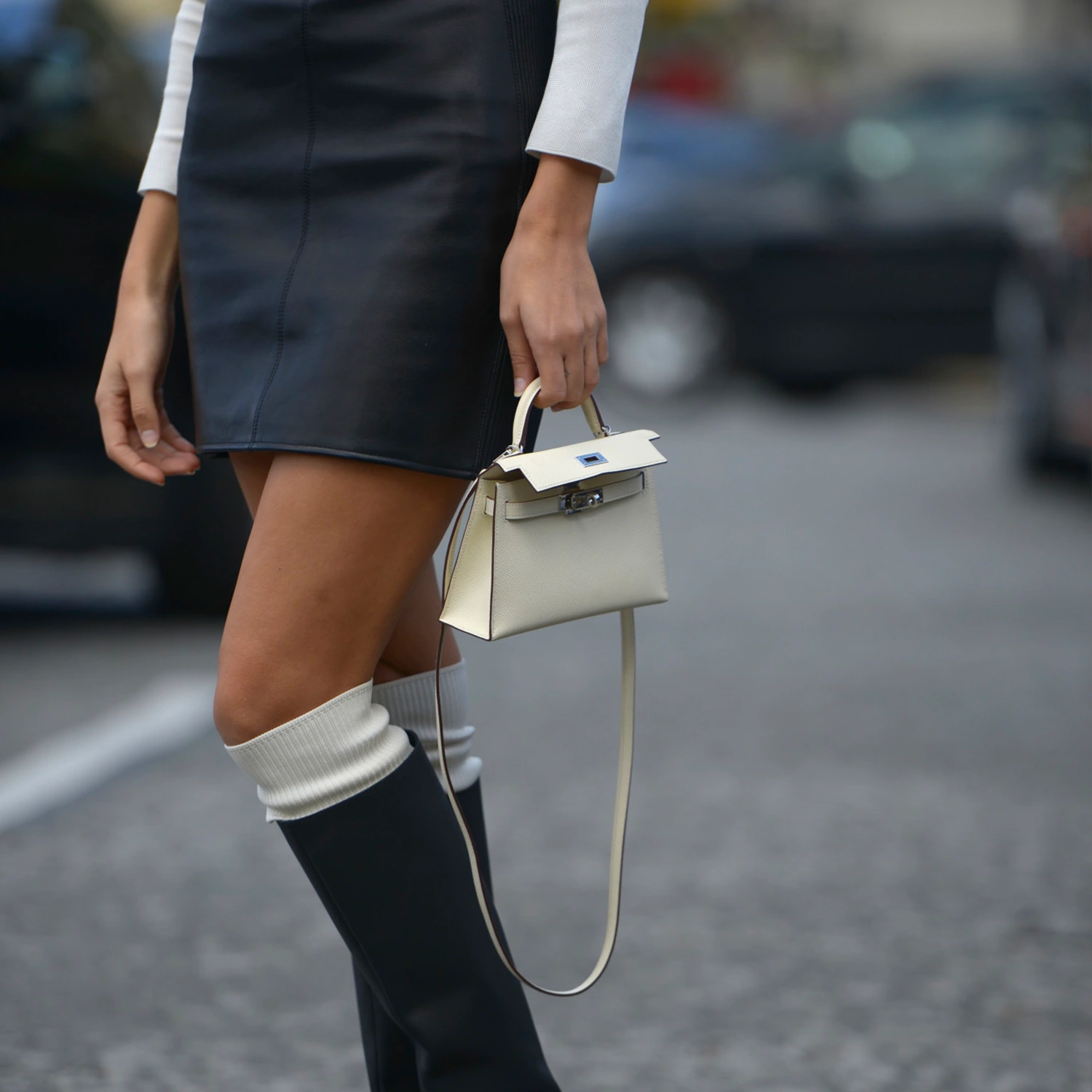
Let's be real. You don't need a $4,000 Birkin to look like you own a vineyard in Provence. Honestly, the whole "stealth wealth" thing has been slightly hijacked by brands trying to sell you a $600 plain white t-shirt, but when it comes to leather goods, the sweet spot is actually much lower than you’d think. You can absolutely find quiet luxury bags under $500 that make people ask, "Wait, where is that from?" instead of "How much did you overpay for that logo?"
The trick isn't just finding a bag without a monogram. That's the amateur mistake. True quiet luxury is about the grain of the leather, the weight of the hardware, and whether or not the stitching looks like it was done by someone who actually cares about their craft. It’s about a specific kind of anonymity. If the bag is screaming, it’s not luxury. If it’s whispering, you’re on the right track.
The Myth of the Four-Figure Price Tag
People think high-end fashion is a linear scale where more money always equals better quality. It’s not. There is a massive plateau. Once you hit the $400 to $600 range, you are often paying for the exact same calfskin used by heritage houses in Italy or Spain. Why? Because these smaller, "contemporary" brands often use the same tanneries as the giants. You’re just not paying for the multi-million dollar marketing campaign featuring a Hollywood actress in a desert.
Take Cuyana, for example. They built an entire business model around "fewer, better things." Their System Tote or the Paloma Bag usually sits well under the $500 mark. They use LWG-certified leathers, which basically means the environmental impact of the tanning process is regulated. It feels substantial. When you hold a Paloma, the leather has that slightly buttery, slightly rugged pull-up feel that usually costs a month’s rent elsewhere.
Then there’s the construction. A lot of cheap bags use "bonded leather"—which is basically the chicken nugget of the leather world, made of scraps glued together. Genuine quiet luxury at this price point uses full-grain or top-grain leather. It smells different. It ages. It develops a patina. If your bag looks better in three years than it does today, you bought actual luxury.
Why Branding is Actually a Liability
If you’re hunting for quiet luxury bags under $500, the first thing you have to do is train your eye to ignore logos. In fact, if a bag has a giant gold "G" or a "CD" on the front, it’s automatically disqualified from this category. Quiet luxury is about the shape. It’s about the architectural silhouette.
Think about Polène. Specifically the Numéro Un or the Béri. Based in Paris but handcrafted in Ubrique, Spain—a town famous for leatherwork—Polène has become the poster child for this movement. Their bags rarely exceed $500, yet the sculptural folds of the leather are something you typically only see in Loewe or vintage Celine. There is no visible branding on the front of most models, just a small, embossed name near the bottom. It relies on the craftsmanship to be recognizable. That is the ultimate flex.
I’ve seen people carry the Polène Dix into high-end restaurants and get more nods from the "old money" crowd than the person with the neon-pink logo bag. It’s a secret handshake. You’re signaling that you know about quality, not just about what’s trending on social media.
The "Under the Radar" Brands You Should Know
You’ve probably heard of Mansur Gavriel, and while some of their larger totes have crept up in price, their "mini" versions and iconic bucket bags still often fall into our $500 budget. Their vegetable-tanned leather is stiff at first—almost like wood—but it softens into something incredibly personal over time. It’s a very specific vibe.
But let's talk about Demellier London.
Founded by Mireia Llusia-Lindh, this brand is a favorite of the British Royal Family (Meghan Markle and Kate Middleton have both been spotted with them). The Vancouver bag is their heavy hitter. It looks like something that should cost $1,200. It has a vintage, equestrian feel with a sleek metal bar closure. It’s structured, it’s posh, and it stays under the $500 limit.
- Little Liffner: If you want something more "art gallery owner." They do weird, organic shapes and tulip-style totes that look like sculptures.
- Staud: Known for the Moon Bag and the Alec. They play with geometry. It’s playful but still fits the "quiet" aesthetic because the lines are so clean.
- Aesther Ekme: This is for the minimalists. No hardware. No fuss. Just incredibly high-quality skins in muted tones like charcoal, tan, and forest green.
Looking for Quality: The Checklist
How do you actually tell if a $450 bag is "luxury" or just an overpriced mall bag? You have to look at the edges.
Check the "inking" or "edge painting." This is the rubbery coating on the raw edges of the leather straps. On cheap bags, this will crack or peel within months. On a high-quality bag, it’s applied in multiple thin layers and sanded down until it’s seamless.
Next, look at the hardware. Is the zipper plastic or metal? Is the gold color "brassy" and yellow, or is it a soft, pale champagne? High-end hardware has a certain weight to it. If the clasp feels like a toy, the bag is a toy. Brands like OAD New York or Wandler (when on sale) excel at this. They use heavy, functional hardware that feels expensive to the touch.
The Resale Trap and How to Avoid It
A huge part of the quiet luxury bags under $500 market is actually the secondary market. If you are willing to look at "pre-loved" items, your options explode. You can find vintage Coach (the 1990s Bonnie Cashin-inspired styles) for under $200.
These vintage pieces are often better quality than modern luxury. The leather is thicker. The brass is solid. A vintage Coach City Bag in a rich mahogany brown is the epitome of quiet luxury. It doesn’t scream. It just exists, looking timeless and indestructible.
However, be careful with sites like The RealReal or Vestiaire Collective. "Quiet" doesn't mean "valueless." Just because a bag doesn't have a logo doesn't mean it isn't faked. Always check the interior labels and the quality of the lining. Cheap polyester linings are a dead giveaway for a low-quality bag, regardless of what the outside looks like.
Practical Steps for Your Next Purchase
If you're ready to pull the trigger on a new piece, don't just buy the first black tote you see.
First, evaluate your color palette. Quiet luxury thrives in neutrals—but not just beige. Think espresso, olive, burgundy, or a deep slate blue. These colors look more expensive than stark black, which can sometimes hide the texture of the leather too much.
Second, consider the "capacity vs. silhouette" trade-off. Often, the most "luxurious" looking bags are the ones that aren't stuffed to the gills. If you carry a lot, look for a structured tote like the Cuyana Tall Easy Tote. If you only need the essentials, a structured crossbody like the Polène Numéro Dix maintains its shape much better over time.
Finally, maintenance is non-negotiable. A $500 bag will look like a $50 bag if it’s covered in water stains and scuffs. Invest $15 in a good leather conditioner (like Bickmore Bick 4) and a horsehair brush. Buffing your bag once a month keeps the oils in the leather alive. That's how you get that "rich person" glow without the rich person price tag.
Stop looking for the most famous name. Look for the best leather. When you stop paying for the logo, you start buying the actual bag.
Your Action Plan
- Identify your "Shape Profile": Do you prefer architectural/stiff (Polène, Demellier) or soft/slouchy (Cuyana, Mansur Gavriel)?
- Audit the Hardware: Avoid anything with bright, shiny "fake gold" finishes. Seek out brushed gold, silver, or gunmetal.
- Check the Origin: Look for bags made in Spain, Italy, or Portugal. These regions have the infrastructure for high-end leather finishing that China-based mass production often lacks.
- Set a "Sale Alert": Brands like Wandler and Oroton often retail for $600-$800 but frequently drop to $350 during seasonal shifts. Use tools like Lyst or Google Shopping to track these price drops.
- Protect the Investment: Apply a leather protectant immediately upon unboxing to prevent salt or water damage.