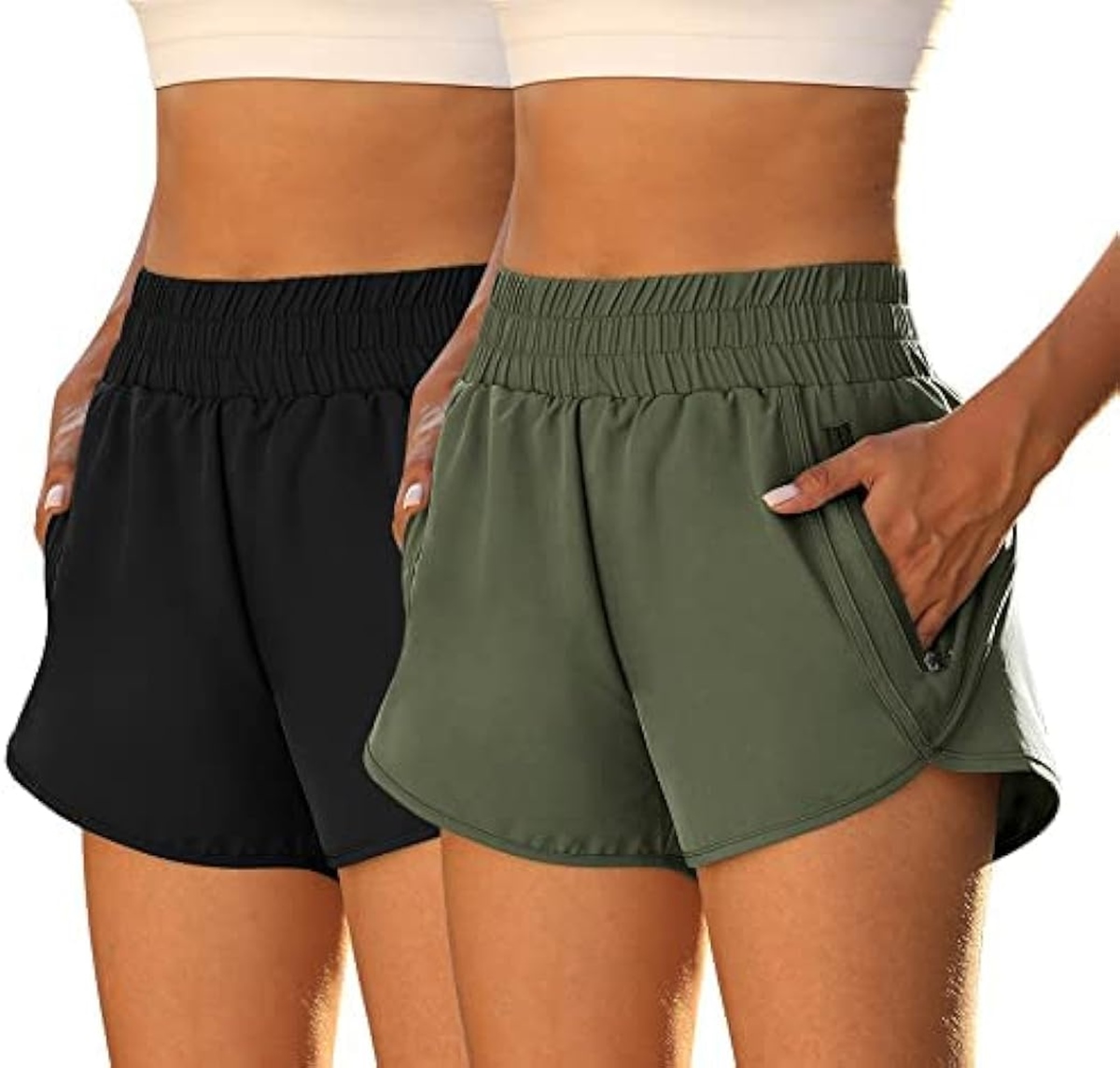
You're halfway through a heavy set of squats when you feel it. That slow, agonizing slide of your phone toward the floor. Or maybe you're sprinting, and your car key is rhythmically slapping against your thigh like a tiny, metal hammer. It’s annoying. Honestly, it's more than annoying—it’s a design failure that women have dealt with for decades. We finally got ladies workout shorts with pockets, but now we’re realizing that not all pockets are created equal. Some are too shallow. Some are too stretchy. Some are positioned so weirdly that your leg hits your phone with every single stride.
The struggle is real.
I’ve spent years testing gear, from high-end Lululemon drops to the random $12 pairs you find in the bins at discount stores. What I’ve learned is that "having a pocket" is the bare minimum. The real magic is in the engineering of the tension, the placement of the seams, and the fabric density. If the fabric is too thin, your phone bounces. If the pocket is too high, it digs into your hip bone. We need to talk about what actually works when you’re moving, not just what looks good in a mirror.
The Physics of the Bounce: Why Most Pockets Fail
Most people think a pocket is just a hole for your stuff. Wrong. In the world of athletic wear, a pocket is a structural load-bearing component. When you’re wearing ladies workout shorts with pockets during a high-impact activity like running or HIIT, gravity is your enemy.
Think about it. A standard iPhone weighs about 170 to 240 grams. When you run, you’re hitting the ground with three to four times your body weight in force. That phone isn't just sitting there; it's accelerating. If the pocket is made of a standard four-way stretch polyester without enough compression, the fabric expands under the weight. This is why you see women at the park constantly pulling up their waistbands. The weight of the phone is literally dragging the shorts down their hips.
Look for "top-loading" side pockets with a reinforced "hem" or binding at the opening. This little strip of extra elastic acts like a lid. It keeps the tension high at the top so the phone stays pressed against your quad rather than flopping outward. Brands like Brooks and Oiselle do this exceptionally well. They understand that a pocket isn't just a pouch; it’s a containment system.
Side Pockets vs. Waistband Pockets
You’ve basically got two main choices here.
Side pockets—often called "drop-in" pockets—are usually located on the outer thigh. These are great for quick access. You can grab your phone, change a song, and slide it back in without breaking your stride. However, they rely entirely on the compression of the leg fabric. If you have thinner legs or the shorts are a bit loose, the phone will bounce.
Then you have the "envelope" or "zippered" waistband pockets. These are usually centered on the small of the back. This is the most stable place on the human body for carrying weight during exercise. Why? Because the center of gravity is close to your spine and there’s very little fleshly movement there compared to your thighs.
I personally prefer a zippered back pocket for my keys and a side drop-in for my phone. It’s about diversifying the load. If you put everything in one side pocket, you’re lopsided. It sounds small, but over a six-mile run, that slight imbalance can actually mess with your gait.
Fabric Matters More Than You Think
If you buy shorts made of 100% polyester, you’re going to have a bad time. They’ll be "shiny," they’ll smell like a locker room after two washes, and the pockets will stretch out permanently within a month.
You need a Nylon/Spandex (or Elastane) blend. Nylon is stronger and more durable than polyester. It holds its shape. Look for a high percentage of Spandex—usually 15% to 25%. This provides the "snap" that keeps your gear secure.
Ever heard of "interlock" knit? It’s a technique where two layers of fabric are knitted together. It makes the shorts squat-proof (no see-through disasters) and gives the pocket enough structural integrity to hold a heavy Max-sized phone without sagging.
The Rise of the "2-in-1" Short
Not everyone wants to wear skin-tight spandex. I get it. Sometimes you want the breeze and the coverage of a loose, flowy short. This is where the 2-in-1 design changed the game for ladies workout shorts with pockets.
Basically, you have a tight compression liner underneath and a loose "vented" shell on top. The pocket is almost always located on the inner liner. This is brilliant because the outer shell hides the "bulk" of the phone. You don't look like you have a rectangular brick strapped to your leg, and the phone stays locked against your skin so it doesn't move.
The only downside? Heat. You’re wearing two layers of fabric. If you’re working out in 90-degree humidity, you might feel like you’re wearing a diaper. Look for 2-in-1s with "laser-cut" perforations in the outer shell to let the heat escape.
Real-World Testing: What to Look For in the Fitting Room
Don't just look at yourself in the mirror. That's what everyone does, and it's why they end up with gear they hate. If you’re trying on ladies workout shorts with pockets, you need to do a "stress test" right there in the dressing room.
- The Phone Slide: Put your phone in the pocket. Walk. If the shorts start to slide down even a centimeter, they’ll be at your ankles by the end of a treadmill session.
- The High-Knee Test: Bring your knee up to your chest. Does the phone dig into your hip crease? If it does, the pocket is positioned too high. You want the phone to sit on the flat part of your mid-thigh.
- The Sit Test: Sit down. Does the pocket opening gape open? If it does, you’re going to lose your credit card or house key the second you sit on a weight bench or a car seat.
Misconceptions About Pocket Placement
A lot of people think "more pockets = better shorts." Not necessarily. I’ve seen shorts with five or six pockets. It’s overkill. Every pocket adds a seam. Every seam is a potential point of irritation or "chafing."
If you’re doing long-distance movement, seams are the enemy. You want "flatlock" seams, which are sewn flat against the fabric so they don't rub your skin raw. If a pair of shorts has a bunch of decorative pockets with bulky seams, you’re going to feel it after three miles. Honestly, two deep side pockets and one small hidden waistband pocket is the "Goldilocks" zone for most women.
Also, let’s talk about the "hidden" internal pockets. You know, the tiny ones inside the front waistband meant for a single key? They’re mostly useless for modern car fobs. They were designed in the 90s for a flat house key. If you try to shove a modern Jeep or Tesla fob in there, it’ll create a weird bulge that presses right into your stomach. Skip those unless you’re just carrying a locker key.
Caring for Your Gear (So the Pockets Don't Die)
You spent $50 or $80 on a high-quality pair of shorts. Don't ruin the elasticity. Heat is the killer of Spandex. When you throw your workout gear in a hot dryer, the tiny elastic fibers snap. This is how pockets get "baggy."
- Wash cold. Always.
- Skip the fabric softener. Softener coats the fibers and kills the "wicking" ability, making the shorts feel slimy and less supportive.
- Air dry. It takes longer, but your pockets will keep their "snap" for years instead of months.
Practical Next Steps for Your Next Purchase
Stop settling for shorts that don't work. If you're ready to upgrade your workout experience, start by auditing your current gear. Which pairs do you actually reach for? Why? Usually, it's the ones where you "forget" you're carrying your phone.
When you go shopping next, prioritize Nylon-heavy blends and integrated liners. If you're a runner, look for a zippered back pocket for total security. If you're a lifter, side pockets are usually better so the phone doesn't get crushed when you're doing seated rows or lying on a bench.
Check the pocket depth. A pocket should be at least 6 inches deep to safely house a modern smartphone. Anything less is a recipe for a cracked screen. Invest in quality over quantity; two pairs of perfectly engineered shorts are worth more than ten pairs of cheap ones that bounce.