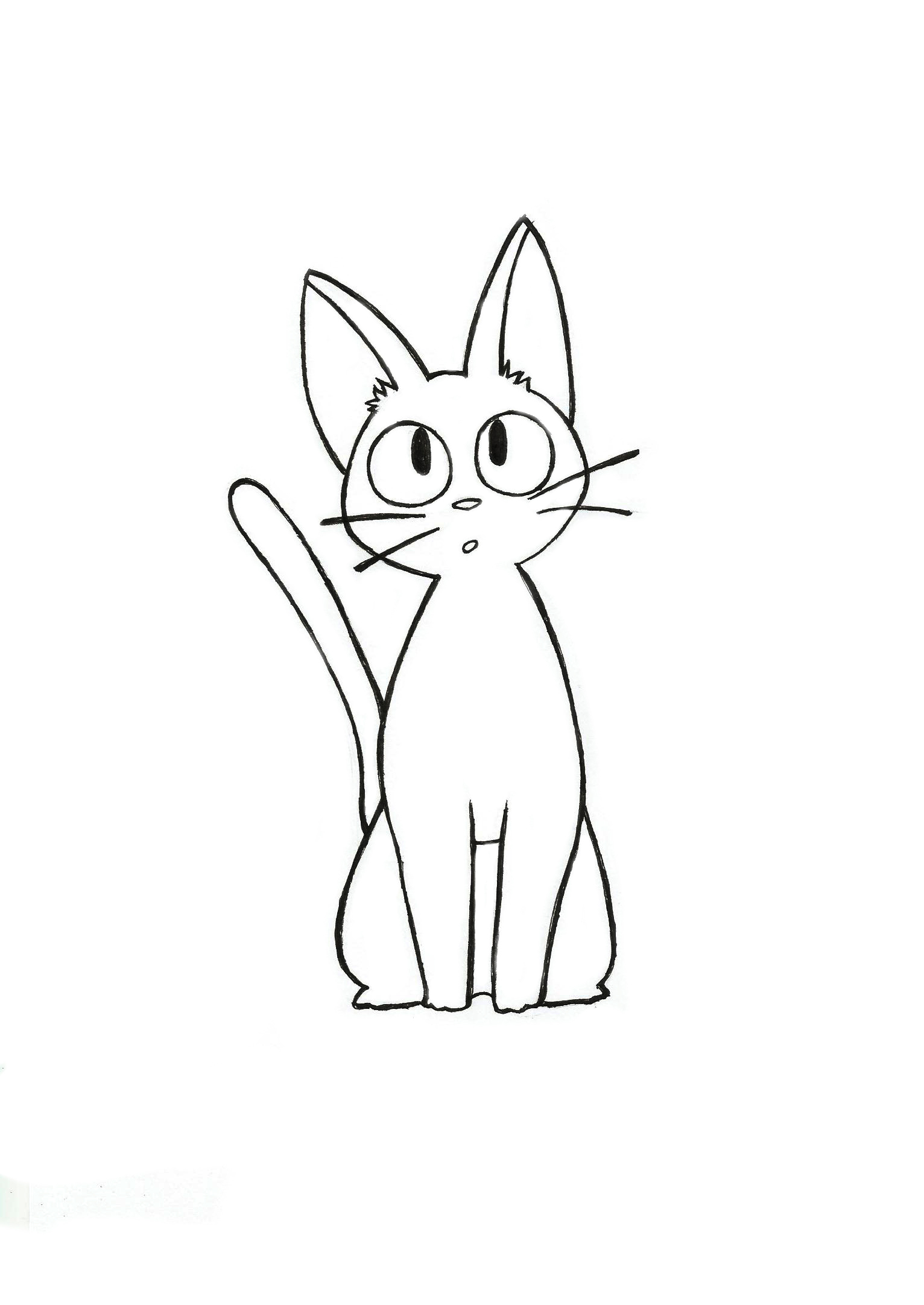
You remember that feeling, right? Sitting on the floor, watching a 13-year-old witch fly over a sun-drenched European city while her sarcastic black cat makes quips about the local crows. It’s cozy. It’s perfect. But then, about three-quarters of the way through Kiki’s Delivery Service, the vibe shifts. Kiki loses her magic, and suddenly, Jiji isn’t talking anymore. He’s just... a cat.
He meows. He drinks milk. He hangs out with the white cat next door.
And then the movie ends, and he still isn't talking. For a lot of us, that wasn't just a plot point—it was a childhood trauma. We waited for the big moment where he’d crack a joke and everything would be back to normal. It never happened. Honestly, it’s one of the most misunderstood endings in the history of Studio Ghibli. People have been debating this for decades, especially since the English dub and the original Japanese version basically tell two different stories.
The Big Jiji Mystery: Why Does He Stay Silent?
If you grew up with the 1998 Disney dub featuring the legendary Phil Hartman as Jiji, you probably remember him saying something at the end. In that version, right after Kiki saves Tombo from the dirigible, Jiji jumps on her shoulder and says, "Kiki, can you hear me?"
That line changed everything. It made it a happy, "magic is back" ending.
But here is the catch: that line isn't in the original Japanese script. Not even close. In Hayao Miyazaki’s vision, Jiji never speaks again. He just meows. For a long time, fans thought this meant Kiki’s magic was permanently broken or that she’d lost a piece of her soul.
The truth is actually way deeper and, frankly, a bit more bittersweet. Producer Toshio Suzuki has been pretty open about this in interviews. He explained that Jiji isn't just a pet; he's a projection of Kiki’s own immaturity. When they’re talking, she’s essentially talking to herself. As she grows up and gains actual confidence—not just "magic" confidence, but real-world independence—she doesn't need that external "inner voice" anymore.
It’s about growing up, not losing magic
Think about it. When Kiki first arrives in Koriko, she’s terrified. She’s an outsider. Jiji is her safety blanket. He’s the one who tells her she’s doing great (or sarcastically reminds her she isn't). Once she integrates into the town, makes real friends like Ursula and Osono, and saves a boy from a literal crashing airship, she’s no longer that scared kid.
Miyazaki once said that Kiki becoming unable to understand Jiji means she has "progressed to a new stage." She has outgrown the need for a talking cat. It’s like when you stop playing with imaginary friends. You didn't lose your imagination; you just changed how you use it.
The "Familiar" Problem: Book vs. Movie
There is a lot of lore about witches and their cats that the movie skips over, mostly because Miyazaki played fast and loose with Eiko Kadono’s original novel. In the book, the rules are a bit more specific.
- The Tradition: Witches and black cats are raised together from birth.
- The Language: They develop a special way of communicating that only they understand.
- The Split: As the witch matures, the bond naturally changes.
In the books, they don't necessarily stop talking forever, but the movie uses the silence as a powerful metaphor for the end of childhood. It’s supposed to sting a little. If it didn't hurt, it wouldn't be a Miyazaki movie.
What Most People Get Wrong About Jiji’s "New Life"
Some fans get really upset because they think Jiji "abandoned" Kiki to go start a family with Lily, the white cat next door. You see them at the end with kittens, and it feels like Jiji just moved on.
But that’s looking at it from a human perspective. Jiji is also a "person" (or a spirit, or an alter ego) going through his own coming-of-age. While Kiki is learning how to run a business and navigate rejection, Jiji is learning how to be an actual cat. He’s discovering his own instincts and desires outside of just being Kiki’s shadow.
The Voice Actor Legacy
We can't talk about Jiji without talking about Phil Hartman. For a generation of Western fans, Jiji is Phil Hartman. His sarcastic, slightly cynical performance gave the character a completely different energy than the higher-pitched, more "cute" Japanese voice.
Hartman finished his work on the dub just before he passed away in 1998. Because of the tragedy, Disney actually kept some of his ad-libbed lines and that final speaking moment in the first release as a tribute. Later versions (like the ones on HBO Max or newer Blu-rays) actually removed that final line to match Miyazaki’s original intent. It’s a weirdly polarizing thing—some people feel like the silent ending is "correct," while others feel like the speaking ending is the only one that doesn't ruin their day.
Actionable Takeaways for Ghibli Fans
If you’re planning a rewatch or introducing someone to Kiki’s Delivery Service, keep these things in mind to get the most out of the experience:
- Watch both versions if you can. The Japanese sub and the Disney dub are practically different movies because of how the dialogue changes Kiki and Jiji's relationship.
- Look at the background. Notice how Jiji’s behavior changes before he stops talking. He starts looking at Lily long before the magic "breaks." This shows his transition was happening naturally, not just because of a spell.
- Check out the book. If the movie’s ending leaves you feeling too sad, read Eiko Kadono’s Kiki's Delivery Service. It’s much more episodic and less focused on the "existential crisis" of losing magic.
- Visit the Ghibli Museum (if you're lucky). There are often exhibits specifically about the animation of Jiji. The way they animated his "cat-like" movements vs. his "human-like" movements is a masterclass in character design.
The silence of Jiji isn't a failure. It’s a sign that Kiki made it. She moved to a new town, she survived the rain and the crows and the rude teenagers, and she found her place. Jiji staying a cat is the ultimate proof that she doesn't need a witness to her life anymore—she’s finally living it for herself.