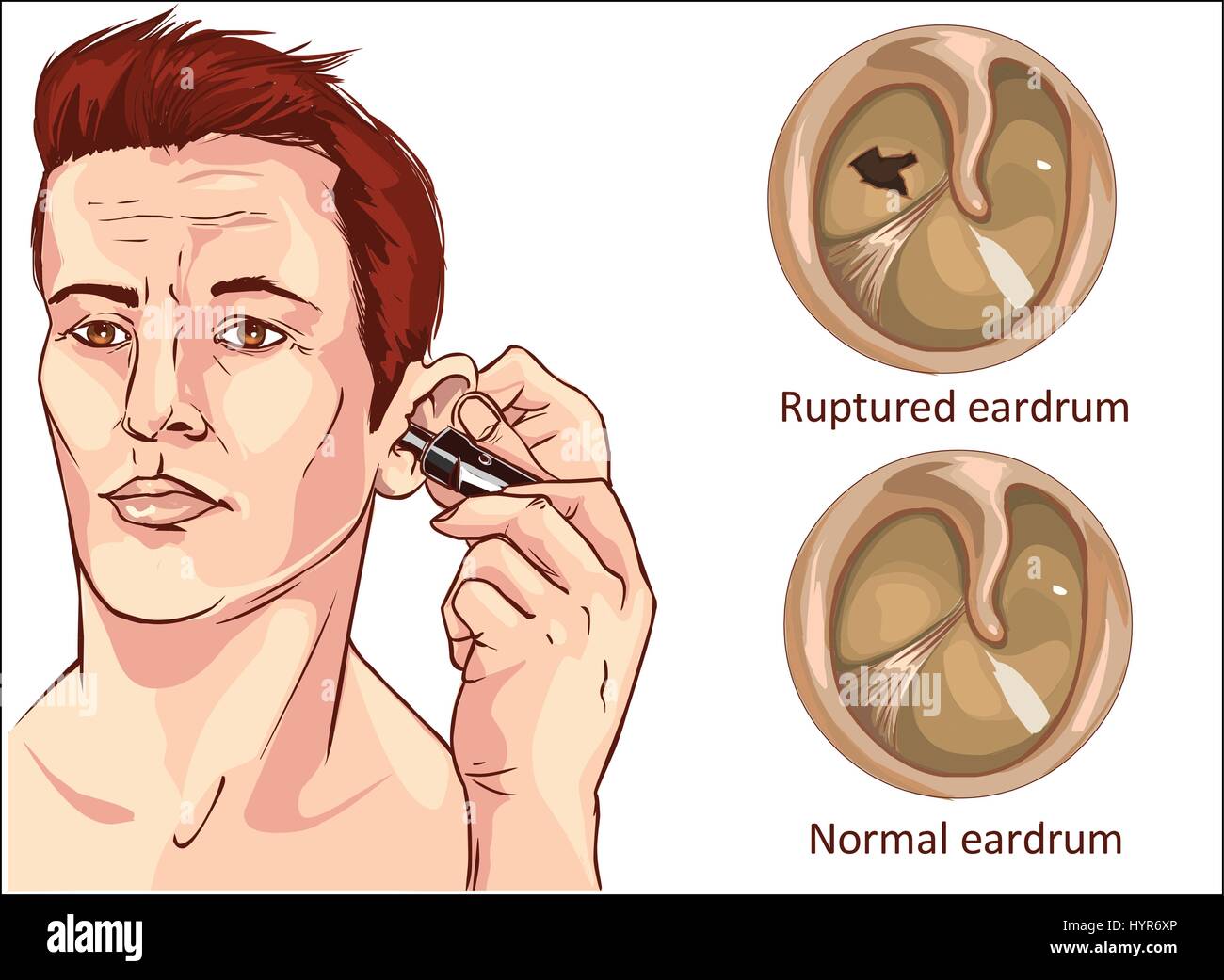
You’re likely here because your ear hurts, or maybe it’s doing that weird "wind whistling through a tunnel" thing. It’s unsettling. You’ve probably already tried to squint at some blurry images of a ruptured eardrum on a search engine, trying to figure out if that dark spot in your own ear canal is a crisis or just a bit of wax. Honestly? Looking at these photos can be a bit gross, but they’re incredibly helpful for understanding why your hearing suddenly feels like it’s underwater.
A ruptured eardrum—or a tympanic membrane perforation, if we’re being all medical about it—isn't always a bloody mess. Sometimes, it’s just a tiny, clean slit. Other times, it looks like a ragged hole in a piece of parchment paper.
Why Does It Look Like That?
The eardrum is a thin, semi-transparent membrane. It’s supposed to be taut, like a drumhead. When you look at high-resolution images of a ruptured eardrum taken with an otoscope, the first thing you notice is the color. A healthy eardrum is pearly gray. When it pops, that color profile changes fast. You might see bright red blood vessels, yellowish fluid leaking from behind the "curtain," or a literal gap where you can see the tiny bones of the middle ear—the hammer, anvil, and stirrup—peeking through.
It’s wild how much damage a simple change in pressure or a stray Q-tip can do. The anatomy here is delicate. I've seen cases where a person dove into a pool too fast, and the pressure hammered a hole right through the center. In those photos, the edges of the tear often look bruised or swollen.
Identifying the Types of Perforation
Not all holes are created equal. Doctors usually categorize what they see in those images of a ruptured eardrum based on where the hole is located.
There's the "Pars Tensa" perforation. This is the most common. It happens in the larger, tighter part of the drum. If you see a photo where the hole is right in the middle, that’s likely it. These usually heal pretty well on their own because the blood supply is decent there.
Then you have marginal perforations. These are trickier. They happen right at the edge where the eardrum meets the ear canal wall. If you see an image where the tear seems to be "peeling" away from the side, that’s a red flag. These are more prone to something called a cholesteatoma—a fancy word for a skin cyst that can grow into the middle ear and cause real trouble. This is why just looking at a picture isn't enough; the location matters more than the size.
The "Ooze" Factor: What the Fluid Tells You
If you’re looking at images of a ruptured eardrum and seeing liquid, pay attention to the color.
- Clear fluid: Usually suggests it’s just a pressure issue or early stages of an ear infection.
- Bloody discharge: This usually happens right after the trauma. If you poked it with a cotton swab, you’ll see bright red streaks.
- Yellow or Green pus: This is the classic sign of a "suppurative" otitis media. Basically, an infection got so pressurized behind the eardrum that it literally blew a hole through the membrane to escape. It’s gross, but in a weird way, the pain often drops significantly the second that "pop" happens because the pressure is gone.
Reality Check: It’s Harder to See Than You Think
Don’t go sticking a flashlight in your ear and expecting to see what the professional images of a ruptured eardrum show. You can't see your own eardrum in a bathroom mirror. Even those cheap "ear cameras" you buy online can be misleading. Shadows can look like holes. Earwax can look like a scab.
If you’re seeing a dark, circular void in a photo of an eardrum, that’s the classic "hole." But sometimes, the eardrum has just "retracted." It’s sucked inward because of a vacuum in the middle ear. To an untrained eye, a retracted eardrum and a ruptured one look almost identical in a 2D photo. One needs a tiny tube; the other might need a skin graft. Big difference.
Real-World Causes You Might Not Expect
Most people think of explosions or loud concerts. Sure, those happen. But honestly, a lot of the images of a ruptured eardrum in medical textbooks come from much more mundane accidents.
- The "Kiss of Death": This is a real thing. A sudden, sharp suction against the ear—like a "playful" kiss directly over the ear canal—can create enough of a vacuum to tear the membrane.
- The Slap: Getting hit with an open palm. It traps a column of air and shoves it against the drum.
- Barotrauma: Scuba diving or even a rough landing on a flight when you have a cold. If your Eustachian tubes are blocked, your eardrum is basically a sitting duck for pressure changes.
Treatment: Does It Need a "Patch Job"?
Most of the time, your body is a rockstar at fixing this. If you look at a series of images of a ruptured eardrum over a six-week period, you can actually see the skin migrating. It’s like a slow-motion timelapse of a wound closing. The edges of the hole crawl toward each other until they meet in the middle.
However, if the hole is too big—usually more than 50% of the drum—it might need help. Surgeons can do a "paper patch" procedure. They literally take a tiny piece of specialized paper and lay it over the hole to act as a bridge for the skin to grow across. For more severe cases, they do a tympanoplasty. They take a tiny snip of fascia (connective tissue) from behind your ear and use it as a "graft" to rebuild the drum.
What You Should Actually Do Now
If you suspect your eardrum has popped, stop what you're doing. Seriously.
First, keep it dry. This is the golden rule. No swimming. No "cleaning" it out with peroxide. If water gets through that hole into your middle ear, you are inviting a massive infection that could lead to permanent hearing loss or vertigo that makes the room spin for days. When you shower, shove a cotton ball coated in Vaseline into the outer ear to create a waterproof seal.
Second, avoid blowing your nose hard. You know how your ears "pop" when you blow your nose? That’s air traveling up the Eustachian tube. If there’s a hole in your eardrum, you’re basically blowing bacteria and mucus directly into a sterile space. Not good.
Third, get a professional to look at it. While looking at images of a ruptured eardrum online is a good way to educate yourself, an ENT (Ear, Nose, and Throat doctor) uses a microscope to see the 3D depth of the ear. They can tell if the tiny bones behind the drum are still aligned or if the "hammer" has been dislodged.
Summary of Actionable Steps
- Zero moisture: Use the Vaseline/cotton ball trick every time you’re near water.
- Hands off: Do not use Q-tips, hairpins, or even "ear drops" unless a doctor specifically told you they are "otic-safe" for perforations. Some standard ear drops are actually toxic to the inner ear if they get through a hole.
- Monitor for Vertigo: If you feel dizzy or like you're tilting, the damage might go deeper than just the drum. That’s an "urgent care" situation.
- Hearing Check: Most hearing loss from a rupture is temporary, but you need a baseline audiogram to make sure.
The eardrum is resilient. It's designed to vibrate, protect, and heal. Most people who look up images of a ruptured eardrum find that their situation looks scarier than it actually is. Keep it dry, keep it clean, and let your body do the heavy lifting of knitting that tissue back together.
Primary Sources & References:
- Mayo Clinic: Ruptured Eardrum (Tympanic Membrane Perforation) Diagnosis & Treatment.
- American Academy of Otolaryngology–Head and Neck Surgery: Earwax and Care.
- Clinical observations from Dr. Jennifer Derebery regarding barotrauma and pressure-related ear injuries.