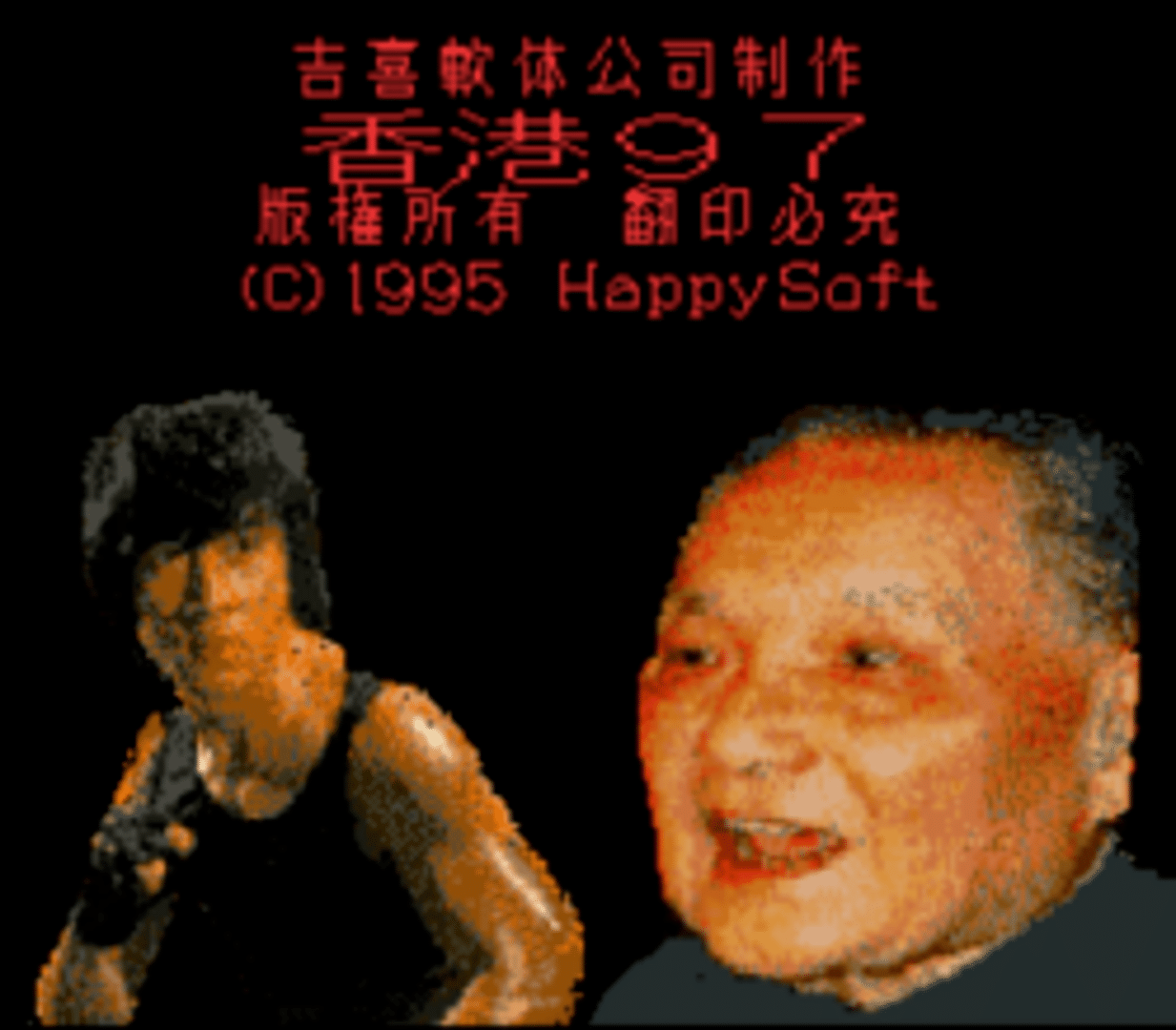
It starts with a loop. A frantic, tinny five-second snippet of "I Love Beijing Tiananmen" blares over and over until your brain feels like it’s melting. You’re playing as Chin, a "super-resilient" relative of Bruce Lee, tasked by the British government to wipe out all 1.2 billion people in mainland China before the 1997 handover. It’s messy. It’s poorly coded. But the real reason people still talk about this unlicensed Super Famicom disaster isn't the gameplay. It’s the Hong Kong 97 game over screen.
When you die—and you will, because the hitboxes are a joke—the music stops. You're hit with a static image of a real human corpse. No pixels. No stylized gore. Just a grainy, low-resolution photograph of a man with a shattered skull, lying in a pile of debris.
It’s jarring. Honestly, it’s one of the most unsettling things in retrogaming history. For years, the internet treated it like an urban legend or a "creepypasta" come to life. People wondered: who was that man? Was it a real murder? Why would anyone put that in a video game?
The story behind this screen is a rabbit hole of 90s cynicism, DIY game development, and the chaotic energy of Yoshihisa "Kowloon" Kurosawa.
The Mystery of the Hong Kong 97 Game Over Photo
For decades, the identity of the man on the Hong Kong 97 game over screen was the subject of intense forum debates. Some thought it was a victim of the 1989 Tiananmen Square protests, given the game's heavy (and incredibly offensive) political themes. Others guessed it was a stuntman or a victim of a car accident.
The truth, which eventually surfaced through dedicated internet sleuthing and an interview with Kurosawa himself, is a bit more bureaucratic but no less grim. The image isn't from a crime scene in Hong Kong or Beijing. It’s actually a still from a Japanese "shockumentary" (popular in the late 80s and early 90s) that documented real-life deaths. Specifically, it appears to be a victim from the Bosnian War or a similar conflict captured in the Jun-Teki or Death File series of tapes.
Kurosawa didn't have a grand political statement in mind when he picked it. He just wanted something "extreme." He was tired of the polished, corporate world of Nintendo and Sega. He wanted to make the most "vulgar, disgusting, and stupid" game possible. To him, using a real photo of a dead body was the ultimate middle finger to the industry.
Why the Game Exists in the First Place
Kurosawa wasn't a programmer. He was a journalist and an otaku who loved the "weird" side of Asian culture. In the mid-90s, he traveled to Hong Kong and became fascinated by the looming 1997 handover. The tension in the air was palpable. Everyone was worried about what would happen when the British left.
So, he decided to make a game about it.
He didn't use a dev kit. He didn't have a team. He literally hired an acquaintance who worked at an actual game company to code the thing over two days in a tiny apartment. They used a "Magic Computer" device—a backup unit that allowed people to play pirated games on the Super Famicom via floppy disks.
- The game was sold via mail-order.
- It cost about 2,000 to 3,000 yen.
- Advertisements were placed in underground magazines under pseudonyms.
The result was a disaster by design. The sprites are stolen from other games or scanned from movie posters. The background is a series of static images of Mao Zedong and Coca-Cola logos. And the gameplay? You move Chin around and shoot projectiles at people. That’s it. If you hit a civilian or an enemy, they explode into a mushroom cloud. If you touch anything, you see the Hong Kong 97 game over screen and have to restart the entire mess.
The Cultural Impact of the Game Over Screen
Why does this matter now? Because Hong Kong 97 became the "holy grail" of bad games. It’s the The Room of the 16-bit era. When the Angry Video Game Nerd (James Rolfe) reviewed it in 2015, the game exploded in popularity.
People were fascinated by the sheer nihilism of it. Most "bad" games are bad because of incompetence or a lack of budget. Hong Kong 97 is bad because it actively hates you. The Hong Kong 97 game over screen is the punchline to a very dark joke. It forces the player to confront a real-world tragedy immediately after playing a cartoonish, offensive parody of politics.
It’s the ultimate example of "transgressive art" in gaming, even if Kurosawa would probably just call it a prank.
Separating Myth from Reality
There are a lot of misconceptions floating around YouTube about this game. Let's clear some of them up.
First, despite the rumors, the game was never banned by the Japanese government. It wasn't "illegal" in the sense of a crime—it just didn't have a license from Nintendo. Nintendo didn't even know it existed for years because it was sold in such tiny quantities. Kurosawa has stated that he only sold about 30 copies originally, though more surfaced later as the floppy disk images were uploaded to the early internet.
Second, the music. That infamous loop isn't just random noise. It’s a snippet from a 1950s propaganda song. The irony of using a Maoist anthem in a game about killing "1.2 billion red communists" was entirely intentional.
Third, the "Ending." Is there one? Technically, no. The game just repeats. It’s an endless loop of violence until you inevitably see that dead body on the Hong Kong 97 game over screen. There is no win state. In a weird, accidental way, it’s a commentary on the futility of the conflict it portrays. Or maybe it’s just because the programmer wanted to go home after those 48 hours.
How to Find and Experience it Today (Safely)
If you're looking to see the Hong Kong 97 game over for yourself, you don't need to hunt down a rare floppy disk in a Tokyo back alley.
- Emulation: Most SNES/Super Famicom emulators run the ROM perfectly. Since it's such a simple game, even a browser-based emulator can handle it.
- YouTube: Honestly, this is the best way. Watch someone else suffer through the five-second music loop so you don't have to.
- Archive.org: The Internet Archive has preserved many of these "homebrew" or "unlicensed" titles for historical purposes.
Lessons from a 16-Bit Nightmare
What can we actually learn from Hong Kong 97?
It shows how the internet can turn a piece of obscure, "trash" media into a cultural landmark. It’s a reminder that gaming has always had an "underground" that didn't care about ESRB ratings or corporate polish.
The Hong Kong 97 game over screen remains a chilling artifact. It’s a bridge between the digital world of sprites and the harsh reality of the 20th century. It’s gross, yes. It’s offensive, definitely. But it’s also a fascinating look at what happens when a creator has zero filters and a lot of spite for the status quo.
If you're a student of game design or internet history, you have to acknowledge it. You don't have to like it. You don't even have to play it for more than thirty seconds. But you should understand why that one low-res image has more staying power than a thousand modern AAA jump scares.
Final Steps for Curious Historians
If you’re planning to dive deeper into the world of unlicensed or "bootleg" gaming, start by looking into the Taiwanese and Russian NES (Famicom) clones of the 90s. The company "Dendy" in Russia and various developers in Taiwan created an entire parallel universe of gaming that most Western players never saw.
Just be careful—the further you go into the world of 90s bootlegs, the weirder the "Game Over" screens get. Hong Kong 97 might be the most famous, but it definitely wasn't the only game trying to shock you out of your seat. Check out the history of the "Sachen" developer or the "Somari" port for more examples of this wild, unregulated era of play.