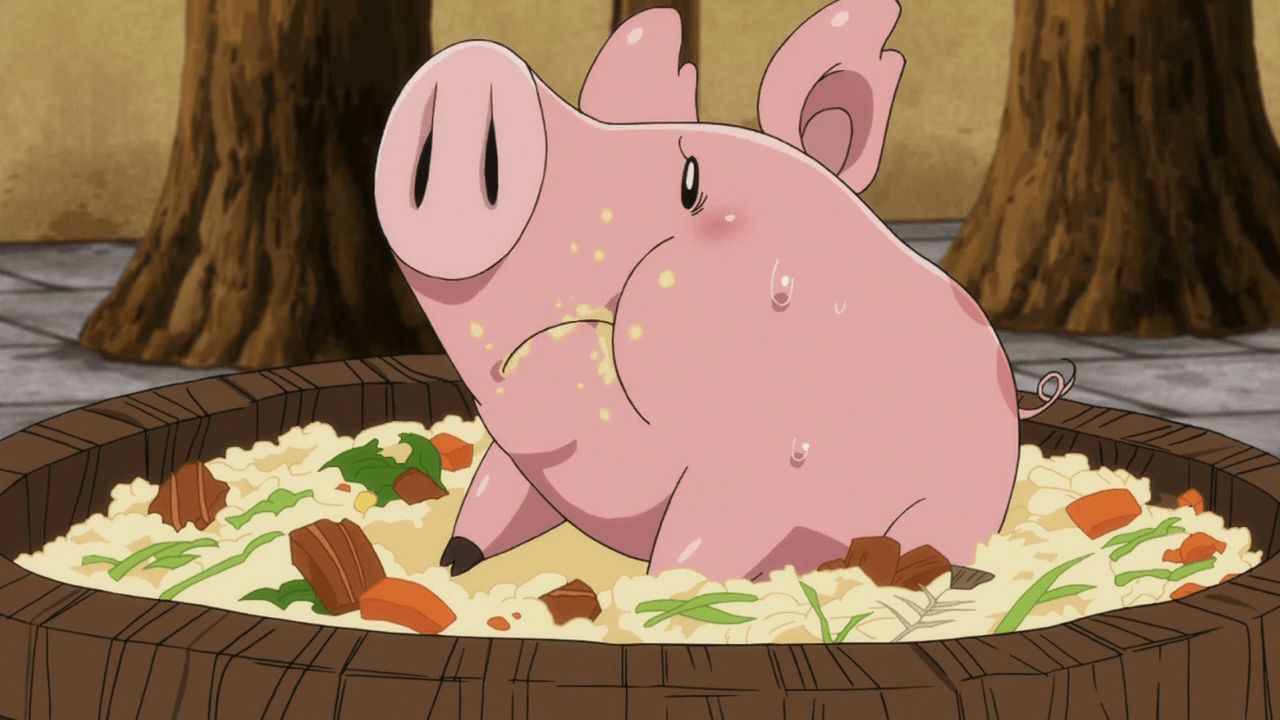
Let's be honest. When you first started watching or reading Nanatsu no Taizai, you probably thought Hawk was just the mandatory mascot. Every shonen has one. You've got Chopper in One Piece, Kon in Bleach, and then you have this pink, talking pig who claims to be the captain of the "Order of Scraps Disposal." It feels like a gag. You expect him to just squeal, get tossed around for comedic effect, and maybe sell some plushies. But Hawk Seven Deadly Sins fans know better. As the story unfolds, it becomes clear that Nakaba Suzuki didn't just put a pig in the story for laughs; Hawk is the literal glue holding the Sins together, and his backstory is significantly darker than his bright pink skin suggests.
He’s loud. He’s arrogant. He’s constantly threatening to eat people's leftovers. Yet, if you look at the power scaling and the emotional stakes of the series, Hawk is the one character who bridges the gap between the mundane world of the Boar Hat tavern and the cosmic, god-level threats of the Demon and Goddess clans.
The Mystery of the Talking Pig
Why does he talk? Seriously. In a world full of fairies, giants, and demons, a talking pig is still considered weird. For a long time, we just accepted it. It’s anime, right? But the truth about Hawk is tied to the Purgatory arc, and it changes everything you thought you knew about the little guy.
He isn't just a pig.
He is a creature from Purgatory, a realm so hostile that ordinary souls are shredded to nothingness in seconds. Hawk—or Mildred, as his brother Wild calls him—was born in that chaotic hellscape. He survived there. Think about that for a second. While Meliodas and Ban were struggling to maintain their sanity and physical forms in Purgatory, Hawk’s species was just... living there. This gives Hawk Seven Deadly Sins a whole new layer of respect. He wasn't just a lucky mascot; he was an apex survivor from a dimension that would kill a Holy Knight in a heartbeat.
The Demon King used Hawk as a literal window. Because Hawk was born in Purgatory and ended up in the living world, the Demon King could peer through his eyes to keep tabs on Meliodas. That "cute" pig was a biological surveillance camera for the ultimate antagonist of the series. It’s a gut-punch of a realization that recontextualizes every funny moment Hawk had in the early chapters.
Transpork and the Power of Evolution
Most people forget that Hawk actually has a combat ability. It’s called Transpork. It sounds like a pun, and it is, but the mechanics are fascinating. By consuming a part of a magical creature, Hawk takes on its characteristics and abilities.
- He ate a piece of a Red Demon and grew horns, gaining the ability to breathe fire.
- He ate a Grey Demon bit and turned grey, gaining dark magic properties.
- He even mimicked a manta ray to fly.
It’s a localized, temporary version of power absorption. While it’s often used for gags—like when he turns into a tiny, useless version of a monster—it shows that his biology is fundamentally different from anything else in Britannia. He is a living sponge for magical energy.
That Heartbreaking Moment at Liones
If you want to talk about why Hawk matters, you have to talk about the battle with Hendrickson. This is the moment most fans stopped seeing him as a joke. Meliodas was down. The Sins were exhausted. Hendrickson unleashed a "Dead End" orb of pure dark energy that would have vaporized everyone.
And Hawk stepped in.
"Don't die, Meliodas." That was it. He stood his ground against a power level he had no business fighting. He took the hit, charred to a crisp, and seemingly died. It was the first major "death" in the series that actually felt heavy. Even though he eventually returned (shrunk down to a tiny size), that act of pure self-sacrifice defined his role. He is the conscience of the group. He’s the one who calls out Meliodas when the Captain gets too detached or creepy. He’s the one who keeps the humanity alive in a group of legendary criminals.
The Connection to Wandering Will
The bond between Hawk and the Sins isn't just about protection. It’s about family. You see this most clearly in his relationship with Ban. They call each other "Master" and "Apprentice," and while it’s played for laughs, it’s one of the most genuine friendships in the show. Ban, who has lived through centuries of pain and immortality, finds a weird sort of peace in Hawk’s simple, scrap-obsessed worldview.
Then there's Wild. Meeting Hawk’s brother in Purgatory is one of the high points of the later manga chapters. Wild spent millions of years (Purgatory time is weird) looking for his lost brother Mildred. The sheer devotion between these two "swine" outshines many of the human romances in the series. It proves that in the Hawk Seven Deadly Sins universe, the "monsters" often have more heart than the humans.
Why We Need Characters Like Hawk
Dark fantasy has a habit of becoming a bit too "grimdark." When you have Meliodas dealing with a 3,000-year curse and Elizabeth dying over and over, you need a pressure valve. Hawk is that valve. But he works because he’s not just a clown. He’s a character with stakes.
He represents the "common" life that the Sins are fighting to protect. He likes beer, he likes scraps, and he likes his friends. He’s the physical embodiment of the Boar Hat's hearth. Without him, the tavern is just a building. With him, it’s a home.
Debunking the "Useless Mascot" Myth
Some critics argue that Hawk takes up too much screen time that could go to underutilized characters like Diane or Escanor. I disagree. Hawk provides a perspective that the god-tier Sins can't. He feels fear. When a Commandment shows up, Hawk’s reaction is the "correct" one: pure terror. This helps ground the power levels. If even the brave (and delusional) Hawk is shaking, you know the situation is dire.
Also, let's not overlook his stats. At one point, his power level was measured at 30. Thirty! Compared to Galand’s 26,000 or Meliodas’s 60,000+, he is statistically zero. Yet he still charges into battle. That takes a specific kind of courage that the overpowered characters don't need to tap into.
The Legacy of the Scraps Disposal Captain
By the end of the series, Hawk’s journey comes full circle. He heads back to Purgatory to be with his brother and to pay respects to the life he lived there. It’s a surprisingly mature ending for a character who started out as a walking ham joke. He realizes he belongs to two worlds.
If you’re revisiting the series or jumping in for the first time, watch Hawk closely. Notice how he’s usually the first to notice when Elizabeth is sad. Notice how he stands in front of the people he loves even when he knows he’s going to get kicked.
Next Steps for Fans:
- Rewatch the Holy Knight Saga: Pay attention to Hawk’s dialogue during the Hendrickson fight; it foreshadows his Purgatory origins way earlier than you think.
- Read the "Seven Days" Side Stories: These give more flavor to the world and show how the Sins interacted with "normal" creatures before the main plot kicked off.
- Analyze the Name: In Japanese, his name is "Hoke," which sounds like "Foke" or "Hoku." There are tons of puns in his speech patterns that the English translation sometimes misses, mostly centered around "ton" (the Japanese word for pig/pork).
Honestly, the Hawk Seven Deadly Sins experience isn't complete until you stop laughing at the pig and start rooting for him. He’s the heart of the Boar Hat, the survivor of Purgatory, and arguably the bravest member of the entire cast. No scraps left behind.