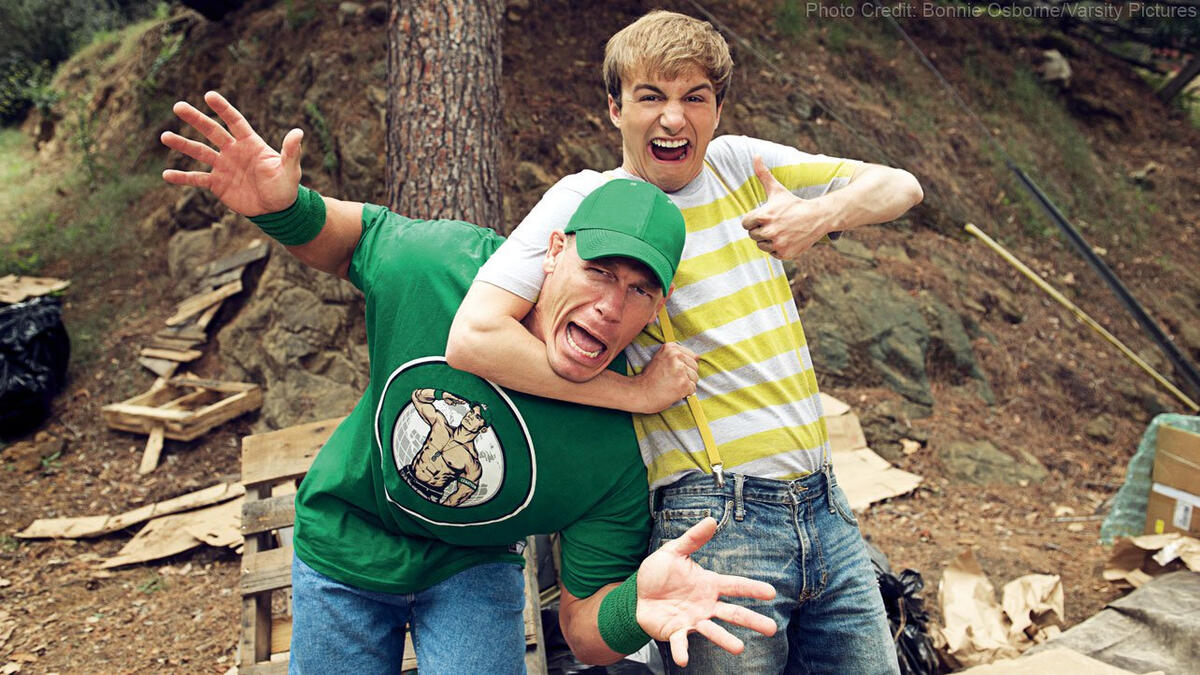
If you were a kid in 2010, you probably remember the high-pitched, glass-shattering screams of Fred Figglehorn. For everyone else, Fred was a YouTube sensation played by Lucas Cruikshank, a hyperactive teenager in a striped shirt who basically pioneered the "loud equals funny" era of the internet. But tucked away in the fever dream that was Fred: The Movie, there is a casting choice so bizarre it still feels like a hallucination: WWE legend John Cena playing Fred's imaginary, ultra-masculine father.
Honestly, it makes no sense on paper. You have the face of professional wrestling—a man built like a literal mountain—appearing in a neon-colored Nickelodeon movie to give life advice to a kid who talks like he’s inhaled a helium tank.
But here’s the thing. Cena didn't just show up for a paycheck. He leaned into the absolute absurdity of the role, and looking back from 2026, it’s clear this weird little flick was the secret blueprint for the Hollywood heavyweight he eventually became.
Why John Cena as Fred’s Dad Was Pure Chaos
In the world of the film, Fred’s actual father is long gone. His mom, played by Siobhan Fallon Hogan, is mostly seen napping or being completely overwhelmed by her son's existence. Enter "Dad Figglehorn." He’s a figment of Fred’s imagination, appearing in bursts of smoke whenever Fred needs a motivational boost or a lesson in "being a man."
Cena plays it straight. That’s the genius of it. He treats Fred’s quest to find his crush, Judy (played by Pixie Lott), with the same intensity he’d bring to a WrestleMania main event.
There's a scene where Cena’s character gives Fred advice on women, and it is peak 2010s Nickelodeon. He pops up in the kitchen, flexes his biceps, and delivers lines with a deadpan sincerity that makes the scene actually watchable for anyone over the age of twelve. The running joke, of course, plays on Cena's "You Can't See Me" catchphrase—since he’s imaginary, nobody else in the movie can actually see him. It's meta, it's silly, and it worked surprisingly well.
The Movie That Critics Hated (But Cena Loved)
Let’s be real for a second. Fred: The Movie is not "cinema." It holds a rare and somewhat prestigious 0% on Rotten Tomatoes. Critics absolutely shredded it. They called it annoying, loud, and a sign of the impending apocalypse for children's media.
But Cena has a totally different take. In interviews, he’s actually credited these movies with saving his acting career. Before Fred, Cena was being pushed as a traditional action hero. Think The Marine or 12 Rounds. He was supposed to be the next Schwarzenegger or Stallone—the stoic, buff guy who blows things up.
He hated it.
He once told YouTuber Chris Van Vliet that he was doing those early action movies as a "business decision" for WWE. He was bored. He wasn't having fun. It wasn't until he stepped onto the set of the Fred movies that he realized he could parody himself. He learned that being the "big guy who’s okay with looking ridiculous" was a much better niche than "big guy who never smiles."
Without Fred: The Movie, we probably don't get the comedic version of John Cena in Trainwreck, Blockers, or his iconic turn as Peacemaker. He had to learn how to be a joke before he could become a comedy star.
A Quick Breakdown of the Fred Trilogy Appearances:
- Fred: The Movie (2010): The debut. Cena appears as the imaginary mentor who helps Fred navigate the journey to Judy's house.
- Fred 2: Night of the Living Fred (2011): Cena returns. This one is even weirder, involving a wrestling match inside Fred’s head that was actually filmed at a real WWE event (reportedly after a SmackDown taping in South Carolina).
- Fred 3: Camp Fred (2012): The final installment. By this point, the shtick was well-established, and Cena was basically a staple of the franchise.
The Paycheck vs. The Pivot
You’d think a massive star like Cena would be pulling in millions for a Nickelodeon gig, right? Not exactly. Reports have surfaced over the years suggesting he made somewhere around $25,000 for the first film.
For a guy who was the face of a billion-dollar wrestling company, that’s basically pocket change. It proves he wasn't there for the money. He was there to experiment. He wanted to see if his personality could translate to a younger audience and if he could handle the timing required for absurd comedy.
Basically, he used Fred Figglehorn as a low-stakes training ground. If the movie failed (which it did, critically), nobody was going to blame the "imaginary dad" cameo. If it succeeded with kids (which it did, pulling massive ratings on Nickelodeon), he looked like a hero to a whole new generation of fans.
Why We’re Still Talking About This in 2026
It’s easy to dismiss these movies as "cringe" artifacts of the early internet era. But the DNA of Cena’s current career—the self-deprecation, the "Kenmaid" cameo in Barbie, the hilarious stunts in Ricky Stanicky—started right here.
He didn't care about his "tough guy" image. He was willing to be a sidekick to a YouTube kid with a squeaky voice. That level of ego-stripping is rare for top-tier athletes. It's why he’s survived in Hollywood while other wrestlers-turned-actors have faded into direct-to-video obscurity.
Actionable Takeaways for the Curious
If you’re looking to revisit this era of pop culture, or if you’re a Cena completionist, here is how to handle the Fred experience:
- Watch for the Timing: Don't look at the plot. Watch Cena’s facial expressions. You can see him learning how to use his size for comedic effect rather than intimidation.
- Check the Sequel Cameo: The WWE arena scene in Fred 2 is a fascinating look at "branded synergy." It’s one of the few times a fictional movie world completely collided with a live WWE broadcast.
- Appreciate the Hustle: Lucas Cruikshank was one of the first "creators" to jump from YouTube to a feature film. Whether you like the character or not, it was a massive moment for digital media.
Cena’s role as Dad Figglehorn remains one of the most "wait, that actually happened?" moments in 21st-century entertainment. It was loud, it was messy, and it was widely despised by anyone over the age of fifteen—but for John Cena, it was the best move he ever made.
Before you go, if you’re diving back into Cena’s filmography, skip the generic action flicks from his early days. Go straight from the Fred trilogy to Trainwreck. You’ll see the exact moment where the "imaginary dad" energy turned into a legit Hollywood powerhouse.