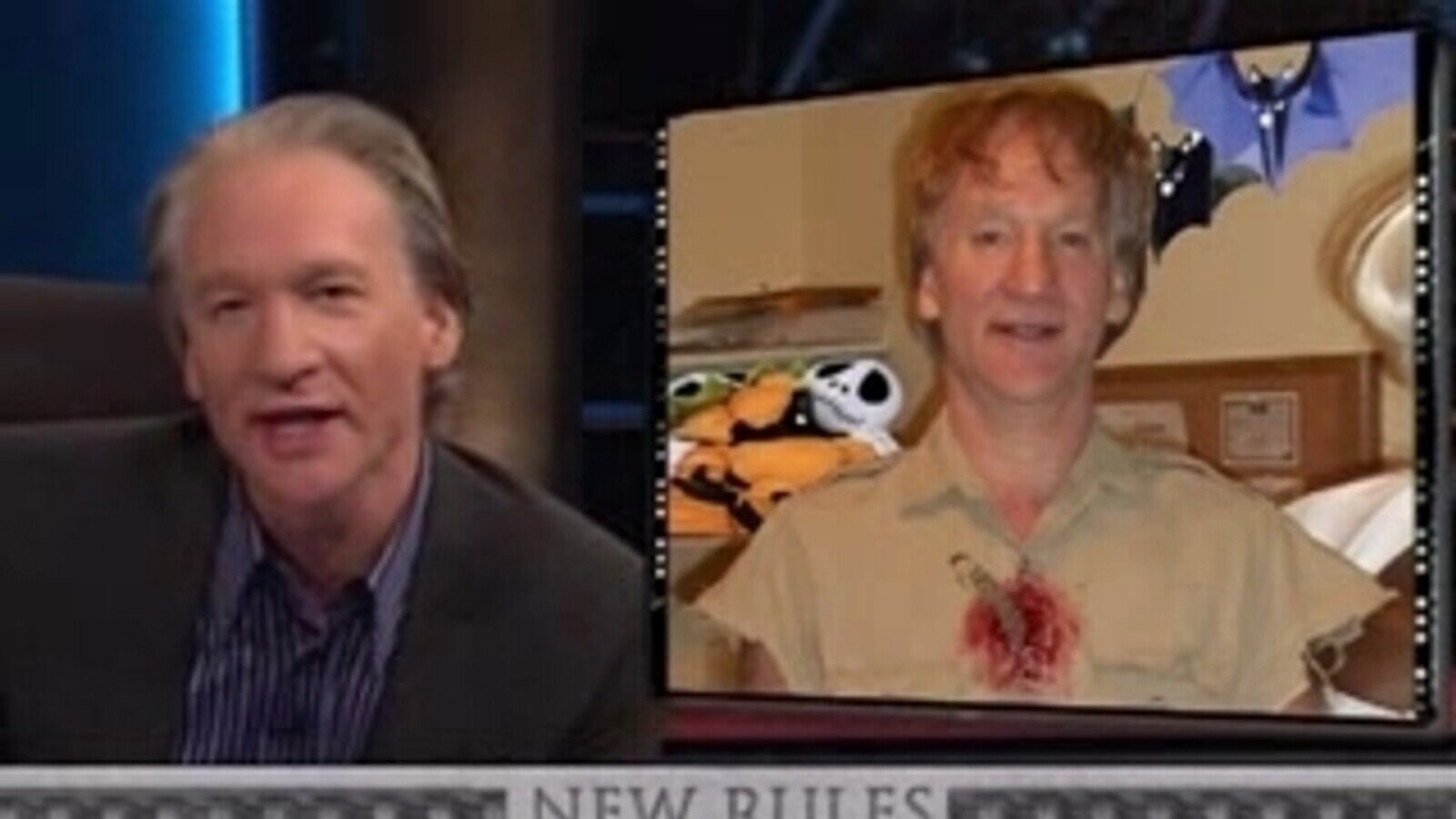
Timing is everything in comedy, but sometimes, the clock is just plain cruel. Back in 2006, the world was still reeling from the sudden, freak death of Steve Irwin. The "Crocodile Hunter" was basically a global saint of wildlife conservation—a guy who radiated pure, chaotic, wholesome energy. Then came Halloween, barely two months after Irwin was pierced by a stingray barb in a tragic accident at the Great Barrier Reef.
Bill Maher decided to show up at a party dressed as the late naturalist.
It wasn't just a khaki outfit. It was a khaki shirt soaked in fake blood with a plastic stingray barb protruding directly from the chest. Honestly, it’s one of those moments that lives in the "hall of fame" of celebrity PR disasters, yet Maher—being Maher—didn't exactly follow the standard apology script.
The Costume That Set the Internet on Fire
This wasn't some private gaffe that accidentally leaked. It was a deliberate choice that surfaced in the early days of viral internet culture. Photos of Bill Maher as Steve Irwin began circulating, and the backlash was instantaneous, especially from Australia.
You've gotta remember the context. Irwin died on September 4, 2006. By late October, the grief was still incredibly raw. When the images hit the web, people weren't just offended; they were genuinely hurt. It felt like a low blow against a man who had dedicated his life to animals.
Maher didn't just wear it to a house party; he leaned into the controversy on his show, Real Time with Bill Maher. On the November 3, 2006, episode, he addressed the elephant in the room. Or rather, the stingray in the room.
Why Maher Refused to Apologize
Most celebrities, when faced with an international outcry, hire a crisis manager and release a statement saying they "deeply regret any pain caused." Maher went the other way. He doubled down.
On his show, he famously snapped at the audience and the critics. "Stop hassling me about my Halloween costume," he told his viewers. He even went so far as to suggest that Irwin might have been "doing something" to the animal that he shouldn't have been. That specific comment—implying the victim was at fault—was the gasoline on the fire.
He compared the situation to the political climate of the time, specifically referencing John Kerry’s botched joke about U.S. soldiers in Iraq. Maher basically asked, "Who do you think I am, John Kerry?" He made it clear he wasn't going to play the "apology tour" game.
The Cultural Impact: Comedy vs. Cruelty
The debate around Bill Maher as Steve Irwin actually sparked a much larger conversation about the ethics of "too soon" comedy. Is there a statute of limitations on tragedy?
For Maher's defenders, the costume was just edgy satire. They argued that comedy shouldn't have "no-go zones," even for beloved figures. But for the vast majority of the public, it crossed a line into being mean-spirited.
- The Australia Factor: In Australia, Irwin was more than a TV star; he was a national icon. The mockery felt like a direct insult to the country's collective mourning.
- The Family Factor: Steve left behind a wife, Terri, and two very young children, Bindi and Robert. Critics pointed out that while Maher was "making a point" about political correctness, a family was actually suffering.
- The "Woke" Retrospective: Interestingly, Maher has used this incident in recent years to rail against "cancel culture" and "woke" sensitivities. To him, the backlash to his 2006 costume was the precursor to the modern era of being "easily offended."
What Most People Get Wrong About the Incident
A lot of people think Maher eventually apologized because of pressure from HBO. He didn't. In fact, he’s spent the better part of the last two decades maintaining that the world has become too "soft" regarding what he calls "forbidden costumes."
In a 2022 segment, he revisited the topic of offensive Halloween outfits. He basically told people that if they are worried about seeing a "forbidden" costume, they should just stay home. He hasn't changed his tune one bit.
It’s a classic example of his brand: the "grumpy truth-teller" who refuses to bend to public sentiment. Whether you find that principled or just plain rude usually depends on how much you liked Steve Irwin.
Why This Still Matters Today
The Bill Maher as Steve Irwin saga is a textbook case of the "Edge-lord" archetype in American media. It highlights the friction between two very different worlds: the Hollywood elite who value shock value and the general public who value empathy.
If you’re looking for a takeaway, it’s probably this: Shock comedy works best when it punches up. Punching a dead man who was widely loved for his kindness? That’s a much harder sell, even for someone as seasoned as Maher.
Actionable Insights for Navigating "Edgy" Content
If you're a creator or just someone who enjoys sharp-tongued commentary, there's a lot to learn from how this played out.
- Know your "Too Soon" window: There is no hard rule, but two months after a tragic death is almost always going to result in a PR nightmare.
- Understand the "Sacred Cow": Every culture has figures who are essentially "off-limits" for mockery unless the joke is exceptionally clever. Irwin was one of them.
- Stand your ground (if you can afford to): Maher survived this because his brand is built on being the "un-PC" guy. If you don't have that specific niche, a stunt like this can end a career.
- Distinguish between satire and cruelty: Satire usually aims at a system or a hypocrisy. The Irwin costume didn't really have a "point" other than to be shocking, which is why it hasn't aged particularly well.
In the end, Bill Maher didn't lose his job, and Steve Irwin's legacy only grew stronger. But the incident remains a stark reminder of the time a comedian decided to test the limits of human empathy—and found exactly where the wall was built.