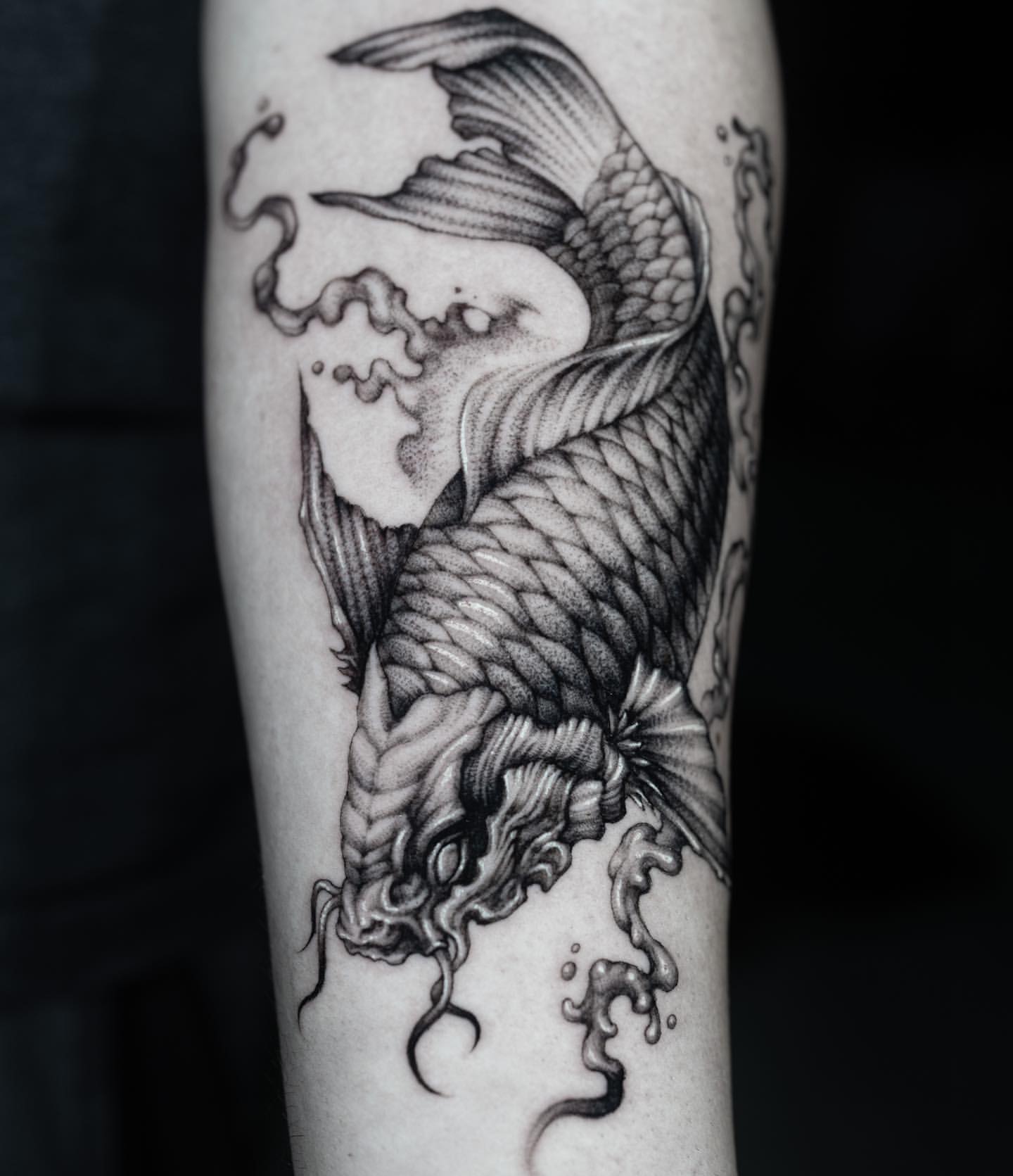
You’ve seen them. Those swirling circles of black and white, chasing each other’s tails in a never-ending dance of ink and skin. Most people glance at a koi fish tattoo and think, "Oh, nice, a yin-yang vibe." But if you’re a fan of Avatar: The Last Airbender, you know it’s way deeper than that. We’re talking about Tui and La. The Moon and the Ocean. The literal spirits that keep the world from falling into chaos.
Tattoos are personal, right? But the avatar koi fish tattoo has become this weirdly universal symbol for balance that transcends just being "fan art." It’s basically the gold standard for anyone who wants a tattoo that looks gorgeous but also carries a heavy weight of philosophy. Honestly, it’s one of the few designs from a "kids' show" that doesn't feel childish when you’re thirty and sitting in a professional boardroom.
The Spirit Oasis Logic: Tui and La Explained
Let's get into the lore because if you're putting this on your body forever, you should probably know the story. In the Season 1 finale, "The Siege of the North," we find out that the Moon and Ocean spirits gave up their immortality to live in the physical world as two koi fish. They live in the Spirit Oasis at the North Pole. Tui is the white fish (the Moon), and La is the black fish (the Ocean).
They don't just swim; they circle.
Push and pull. Life and death. Good and evil. It’s the classic Taoist concept of Dualism, but wrapped in a narrative that broke everyone's hearts when Admiral Zhao decided to be a villain and kill the moon. When people get an avatar koi fish tattoo, they aren't just getting fish. They’re getting a reminder that you can't have light without dark. It's about rhythm. It's about the fact that the tides don't work if the moon isn't there to pull them.
Why This Specific Design Slaps So Hard
Traditional Japanese koi tattoos (Irezumi) are legendary. They represent perseverance and strength. Legend says a koi that climbs a waterfall becomes a dragon. But the Avatar version is different. It’s minimalist.
Most people go for the fine-line style. You get these two delicate fish, usually on the forearm or the back of the neck, forming a perfect circle. It’s symmetrical but fluid. If you go to a shop like Bang Bang in NYC or look at the work of artists like Zaya on Instagram, you'll see how they play with the "flow" of the water.
Placement Matters (Seriously)
Where you put it changes the vibe.
- The Forearm: This is the "Look at my cool ink" spot. It’s visible. It moves when you move. It looks like the fish are actually swimming when you twist your wrist.
- Between the Shoulder Blades: This feels more spiritual. Centered. It’s like the "spine" of your personal balance.
- The Ribs: Painful? Yes. Hidden? Mostly. It’s a private reminder.
I’ve talked to collectors who say they chose the ribs specifically because balance is an internal struggle. It’s not for show. It’s for them.
Common Mistakes People Make with Avatar Ink
Don't be that person who gets the colors backward. In the show, Tui (the Moon) is white with a black spot, and La (the Ocean) is black with a white spot. It mimics the Yin Yang (Taijitu) perfectly. If your artist flips them, the "lore" heads will notice.
Another thing? Detail fatigue.
Koi have scales. They have fins. They have whiskers. In a small tattoo, all those little lines can bleed together over ten years. If you want a small avatar koi fish tattoo, go for "silhouette" or "fluid motion" styles rather than hyper-realism. You want it to look like fish in five years, not two dark blobs.
The Cultural Weight of the Yin Yang
It's important to recognize that while Avatar popularized this specific koi duo, the roots are ancient. Chinese philosophy has used the Yin Yang to explain the universe for millennia. By getting this tattoo, you're tapping into a lineage of thought that suggests nothing is absolute.
There's a bit of "softness" in the Avatar version. The show creators, Bryan Konietzko and Michael Dante DiMartino, took these heavy concepts and made them accessible. They gave the spirits personalities—or at least, a presence. When you see those fish in the pond, they feel peaceful. That’s what people are trying to capture. Peace in the middle of a war.
Style Variations: Beyond the Basics
You don't have to stick to black and grey.
- Watercolor: I've seen some incredible pieces where the "water" around the fish is splashed with blues and purples. It gives it a more "Spirit World" ethereal feel.
- The Red Moon: Some people add a tiny bit of red to Tui to represent the moment the moon spirit was endangered. It adds a bit of "edge" and a nod to the high-stakes drama of the show.
- Minimalist Outlines: Just the curves. No scales, no eyes. Just two sweeping lines that suggest the shape of fish. This is very popular with the "Pinterest aesthetic" crowd, and honestly, it ages the best.
What to Tell Your Tattoo Artist
When you walk into the studio, don't just say "I want the Avatar fish." Show them specific screenshots from the "Siege of the North" episodes. Tell them you want to focus on the S-curve of the bodies.
Explain the contrast. The black needs to be deep. The white—if they use white ink—needs to be handled carefully because white ink is notorious for turning yellow or fading into your skin tone. Many artists prefer to use "negative space" for the white fish, meaning they just tattoo the background and leave your natural skin as the fish. It’s a pro move.
The "Fan" vs. "Aesthetic" Divide
Is it "cringe" to get a tattoo from a cartoon?
Kinda depends on who you ask, but the general consensus in 2026 is: No. Animation is a respected medium, and Avatar is basically the Sopranos of Nickelodeon. It’s high art. Plus, the koi design is so naturally beautiful that even people who have never seen a single episode of the show will compliment you on it. It’s the ultimate "stealth" fan tattoo.
Actionable Steps for Your Next Session
If you’re ready to pull the trigger on an avatar koi fish tattoo, do these things first:
- Watch the episode again. Seriously. Re-center yourself on why you want this. Is it about the balance? Is it about the show?
- Research "Fine Line" specialists. This design lives or dies by the grace of the curves. You don't want a "traditional" artist who specializes in thick, bold American Traditional lines unless you want a very specific, chunky look.
- Consider the "Spot." Tui and La are always together. Don't separate them across two different arms. It ruins the "Push and Pull" symbolism. They belong in one circle.
- Think about size. If you go smaller than two inches, the "eyes" of the yin yang will likely disappear or blur within a few years. Aim for at least 3-4 inches to let the detail breathe.
Balance isn't something you find; it's something you create. And sometimes, you create it by sitting in a chair for three hours and letting someone needle it into your skin. Just make sure you get the spots right. Tui and La are watching.