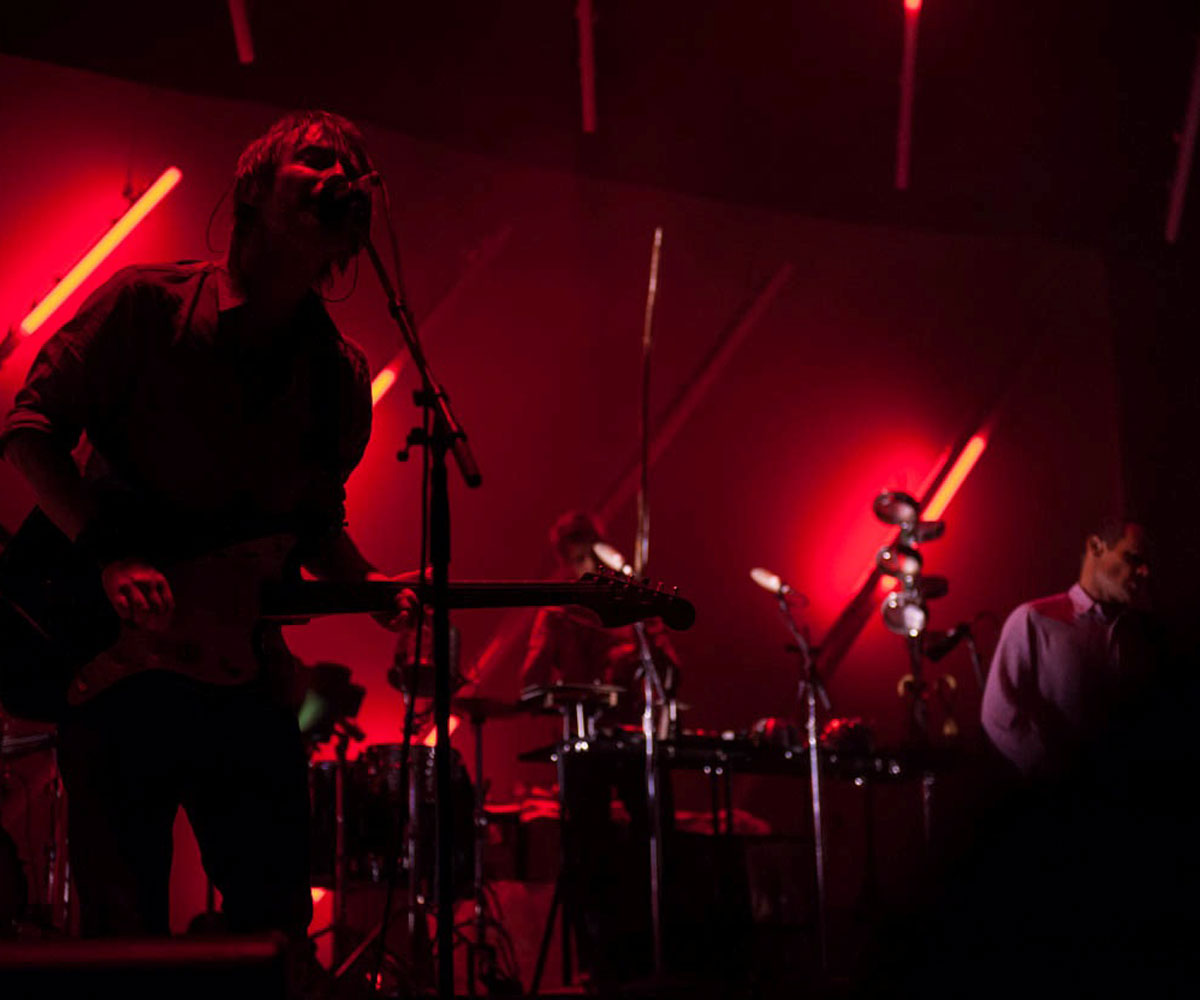
If you were lurking on music message boards back in 2009, you remember the sudden, frantic scramble when Thom Yorke announced a handful of shows at the Echoplex in Los Angeles. At first, nobody really knew what to call it. It was just "Thom’s new thing." Then we got the name: Atoms for Peace band. People immediately jumped to the conclusion that it was just a solo project with a high-budget backing band. They were wrong.
Honestly, calling Atoms for Peace a "side project" feels like a bit of an insult to the sheer level of technical wizardry happening on stage. You had Flea from the Red Hot Chili Peppers on bass, longtime Radiohead producer Nigel Godrich handling keys and programming, Joey Waronker of Beck and R.E.M. fame on drums, and Mauro Refosco bringing the percussion. This wasn’t just Thom playing The Eraser with friends. It was an experiment in how to turn cold, calculated laptop glitches into something that breathed, sweated, and moved.
The 10-Minute Jam Sessions You Never Heard
The DNA of this band is basically a love letter to Afrobeat and krautrock. While Radiohead was busy deconstructing the concept of a "rock band" with The King of Limbs, Atoms for Peace was in a room trying to see if human beings could actually replicate the precision of a sequencer without losing their soul.
It started with a specific problem. Yorke had released The Eraser in 2006, an album built almost entirely on a laptop. When it came time to perform it live, he didn't want to just stand behind a MacBook Pro and press "play." That’s boring. He wanted chaos. He wanted the heavy, driving throb of Flea’s bass to collide with Refosco’s Brazilian percussion influences.
I remember watching bootlegs of those early shows. You’ve never seen Flea play like this. He wasn't doing the "funk god" shtick; he was locked into these tight, repetitive, hypnotic grooves that felt more like Can or Neu! than the Chili Peppers. It was disciplined. It was weird. It was exactly what Yorke needed to bridge the gap between his electronic obsessions and a live audience.
Why Amok Is Better (and Stranger) Than You Remember
By the time the band got around to releasing their only studio album, Amok, in 2013, the narrative had shifted. Some critics thought it sounded too much like "Radiohead-lite." But if you actually sit with tracks like "Default" or "Before Your Very Eyes," you realize the complexity is staggering.
The recording process for Amok was a nightmare for anyone who likes a linear workflow. They spent three days in a studio in Los Angeles just jamming. Three days of purely improvised nonsense and rhythmic loops. Then, Nigel Godrich took those recordings and spent the better part of a year editing them down. He was essentially treating the band like a giant sample library. He’d take a four-bar bass line Flea played in hour six and loop it, then layer Yorke's vocals on top.
This created a strange, uncanny valley effect. Is it a live band? Yes. Is it an electronic record? Also yes. It’s both and neither.
The track "Ingenue" is probably the best example of this. On the surface, it’s a shimmering, synth-heavy ballad. But look closer. The percussion isn't a drum machine. It’s Refosco and Waronker playing in such perfect sync that they sound like a piece of software. That’s the "trick" of the Atoms for Peace band. They worked incredibly hard to sound like they weren't human, only to let the humanity bleed through the cracks at the last second.
The Flea Factor: More Than Just a Famous Name
Let's talk about Michael Balzary for a second. Most people see Flea and think of slap bass and tube socks. In Atoms for Peace, he was the secret weapon.
Yorke has often said in interviews—specifically one with Rolling Stone around the album's launch—that he was drawn to Flea because of his "energy." But it was more than that. Flea brought a physical weight to Yorke’s airy, sometimes paranoid compositions. While Thom is dancing like a man possessed, Flea is the anchor.
There’s a specific live performance of "The Clock" where Flea’s bass line is so distorted and aggressive it practically drowns out the vocals. In that moment, the Atoms for Peace band stopped being a "project" and became a real, living, breathing unit. They weren't just supporting Thom; they were challenging him.
Misconceptions and the "Solo Project" Myth
The biggest mistake people make is thinking this was a temporary fix for Thom's boredom. It wasn't.
If you look at the timeline, the influence of Atoms for Peace bled directly into Radiohead’s A Moon Shaped Pool and Yorke’s later solo work like ANIMA. The band taught Yorke how to trust other musicians with his electronic ideas. For a long time, Thom was very protective of his "laptop music." Atoms for Peace broke that habit.
Was it a "Supergroup"?
Technically, yes. But they hated the term. Joey Waronker once mentioned that the vibe in the studio felt more like a garage band than a meeting of icons. They weren't there to trade war stories about the 90s. They were there to figure out how to play a 7/8 time signature without falling over.
Why only one album?
Scheduling. Plain and simple. You try getting the drummer for Beck, the bassist for the world's biggest funk-rock band, and the lead singer of Radiohead in the same room for six months. It’s a logistical nightmare. While they never "broke up," they transitioned into a dormant state. They exist when they need to exist.
The Legacy of the Sound
What did they actually leave behind?
They proved that electronic music doesn't have to be cold. In the early 2010s, "EDM" was taking over the world with its plastic drops and synchronized light shows. Atoms for Peace was the antithesis of that. They were "Electronic Dance Music" for people who liked jazz, krautrock, and existential dread.
The Atoms for Peace band created a blueprint for the modern "hybrid" live show. Today, you see artists like Bon Iver or James Blake doing similar things—mixing live instrumentation with heavy processing in a way that feels seamless. But Yorke and Godrich were doing it with a full percussion section and a legendary bassist when most people were still trying to figure out how to use Ableton Live on stage.
How to Listen to Them Properly Today
If you’re just discovering them, don't start with the music videos. Go to YouTube and find the full concert from the Roundhouse in London or their Fuji Rock performance.
Watching Mauro Refosco and Joey Waronker interact is a masterclass in rhythm. They don't step on each other's toes. One provides the "heartbeat" while the other provides the "skin." It’s a texture you just don't get in standard rock music.
Essential Listening Path:
- "Default": The gateway drug. It has that iconic stuttering synth line.
- "Harrowdown Hill" (Live): Originally a solo Yorke track, but the Atoms for Peace version is superior because of the sheer aggression Flea brings to the bass hook.
- "Amok" (The track): A slow burner that shows off Nigel Godrich’s production genius.
- "Rabbit in Your Headlights" (Live): They occasionally covered Thom's collaboration with UNKLE, and it’s haunting.
Moving Forward with the Atoms for Peace Vibe
If you’re a musician or a fan trying to capture that specific energy, there are a few things to keep in mind. The "Atoms" sound is about the tension between the grid and the groove.
Stop Quantizing Everything. If you're producing music, try to play your percussion parts live without snapping them to the grid. That microscopic "human error" is where the magic of the Atoms for Peace band lives.
Focus on Texture Over Melody. A lot of Amok isn't built on traditional chord progressions. It’s built on layers of rhythmic noise that eventually coalesce into a song. It’s about the "feel" more than the "tune."
Study Afrobeat. Fela Kuti’s influence is all over this band. If you want to understand why Joey and Mauro play the way they do, you have to go back to the source.
The band hasn't toured in years, and with Thom Yorke currently focused on The Smile (with Jonny Greenwood and Tom Skinner), it’s unlikely we’ll see a reunion soon. But the records are still there. They still sound like they’re from the future. They still sound like a group of people trying to find the ghost in the machine.
Next Steps for Fans:
- Deep Dive into Mauro Refosco: Check out his work with Forro in the Dark to see where the rhythmic DNA of Atoms for Peace actually comes from.
- Analyze the "Ingenue" Music Video: Watch the choreography. It perfectly mirrors the "stutter-start" nature of the band's arrangements.
- Listen to The Smile: If you miss the complexity of Atoms for Peace, Yorke’s newest project, The Smile, is the spiritual successor, trading Flea’s funk for Tom Skinner’s jazz-influenced drumming.